
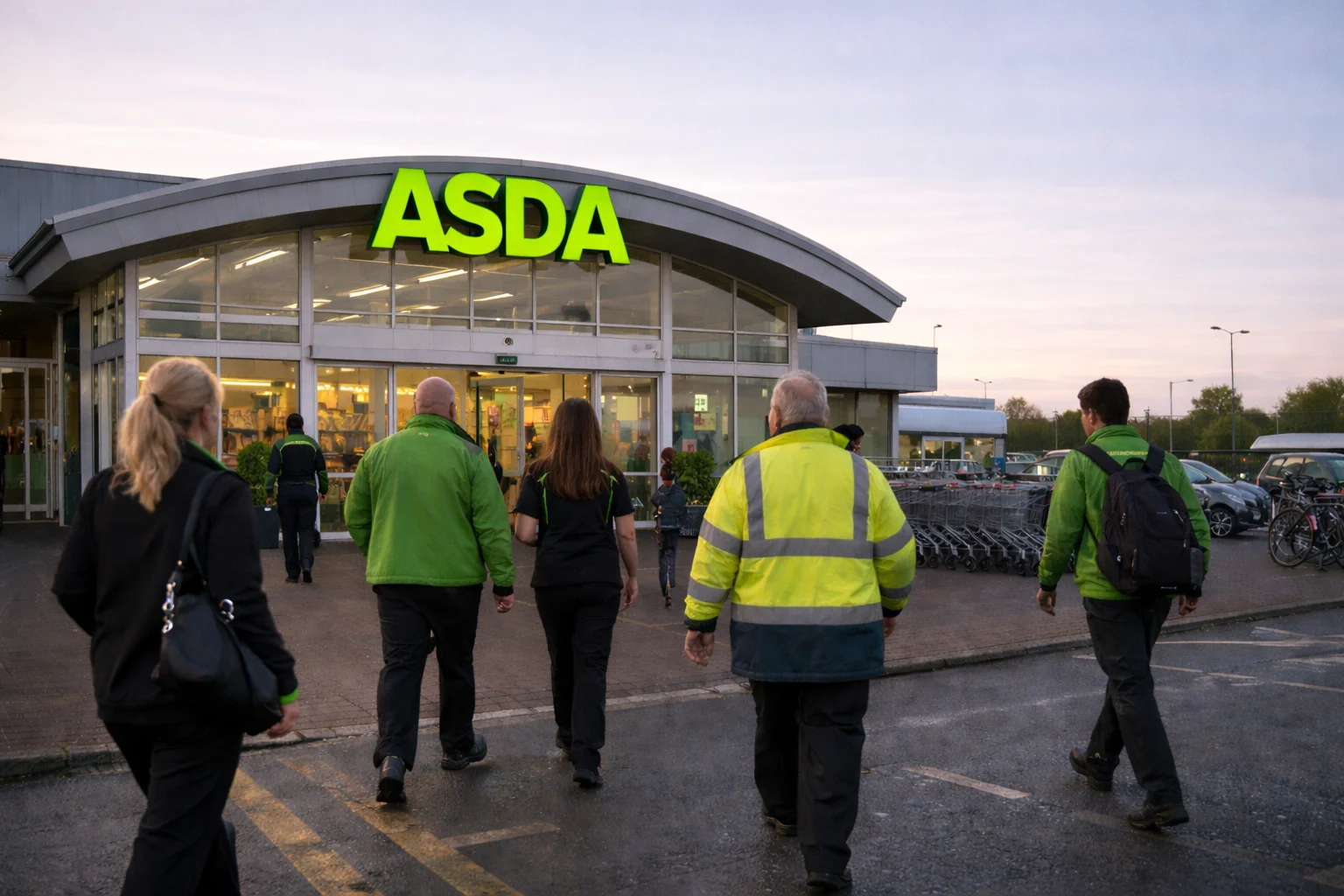
The Asda pay rise 2026 has now been fully implemented for eligible hourly-paid retail colleagues, taking the standard store rate to £13.10 per hour outside the M25 and £14.35 per hour inside the M25 from 5 July 2026.
Around 110,000 hourly-paid colleagues across Asda Retail and Asda Express are covered by the award.
Asda described the package as a 4% above-inflation pay award backed by an £80 million investment. It brings the retailer’s total investment in retail pay since 2021 to around £575 million.
| Key Asda Pay Detail | 2026 Position |
| National Hourly Rate | £13.10 |
| Inside-M25 Rate | £14.35 |
| First 2026 Increase | 1 April |
| Second 2026 Increase | 5 July |
| Retail Colleagues Covered | Around 110,000 |
| 2026 Pay Investment | £80 million |
| Retail Pay Investment Since 2021 | Around £575 million |
What Are the Latest Asda Pay Rates in 2026?
The Asda pay rise was introduced in two stages.
From 1 April 2026, the national rate increased from £12.60 to £12.71 per hour, while the inside-M25 rate moved from £13.82 to £13.93.
The second Asda pay rise of the year took effect on 5 July, when rates increased again to £13.10 nationally and £14.35 inside the M25.
| Location | Previous Rate | From 1 April 2026 | From 5 July 2026 |
| Outside M25 | £12.60 | £12.71 | £13.10 |
| Inside M25 | £13.82 | £13.93 | £14.35 |
The April increase also coincided with the statutory 2026 National Living Wage increase to £12.71 for workers aged 21 and over.
Chief People Officer James Goodman said: “I’m pleased we’ve been able to give them an above-inflation pay award.”
Who Gets the Asda Pay Rise?
The main Asda pay rise applies to hourly-paid colleagues working across Asda Retail and Asda Express.
It should not be assumed that the £13.10 retail rate automatically applies to every employee in Asda’s distribution network. Warehouse, logistics and transport workers can fall under separate pay arrangements.
What Did Asda Distribution Workers Get in 2026?
Asda Logistics Services workers covered by the separate GMB distribution negotiations received their own 2026 pay deal.
GMB announced on 1 April that 78% of members voting accepted the offer. The agreement included:
- Late-shift premium harmonisation for warehouse and transport workers at £0.13
- Night-shift premium harmonisation for warehouse and transport workers at £0.13
- A 3.15% increase on all rates thereafter
This is an important distinction for searches around the Asda warehouse pay rise 2026, because the retail and distribution awards were negotiated separately.
Distribution has also faced wider employment changes during 2026. GMB referred Asda’s Transport Regionalisation Programme dispute to ACAS arbitration, with a hearing held on 4 September and an arbitration decision expected by 25 September 2026.
GMB has also reported proposed outsourcing of Yorkshire XDC parcel operations to Evri and clothing dot-com operations to a DHL-run site in Derby.
How Much Extra Could an Asda Worker Earn?
Compared with the previous £12.60 national rate, the final £13.10 rate represents an additional 50p per hour.
For an employee working 30 hours a week, that would be equivalent to around £780 more in gross annual pay if the 50p increase applied across a full 52-week year.
Inside the M25, the increase from £13.82 to £14.35 is worth 53p an hour, equivalent to roughly £827 a year at 30 hours a week.
Actual additional earnings during 2026 will be lower than these annualised figures because the Asda pay rise was phased rather than applied at the final rate from January.
How Does Asda Pay Compare With Other Retailers?
Asda now pays above the legal minimum, but it is not the highest-paying major UK retailer for standard store roles.
| Retailer | 2026 National or Regional Rate | London/M25 Rate |
| Aldi | £13.50 | £14.88 |
| Selfridges | £13.45 | £14.80 |
| M&S | £13.41 | £14.74 |
| Tesco | £13.28 | £14.55 |
| Sainsbury’s | £13.23 | £14.54 |
| Asda | £13.10 | £14.35 |
| Morrisons | £13.00 currently | £13.11 nationally from 26 October |
Aldi’s current starting rates are particularly strong. Its latest Aldi pay rise for 2026 takes Store Assistant pay to £13.50 nationally and £14.88 inside the M25.
Tesco pays £13.28 nationally and £14.55 inside the M25, while Sainsbury’s pays £13.23 nationally and £14.54 in London. M&S Customer Assistants receive at least £13.41 nationally and £14.74 in London.
Morrisons has taken a phased approach during 2026. Its established Customer Assistant rate reached £13.00 in July and is due to rise to £13.11 on 26 October. This follows the earlier Morrisons pay rise developments.
What Family-Friendly Benefits Does Asda Offer?
One important part of Asda’s employee package is its expanded family-leave policy.
These benefits were announced alongside Asda’s separate £80 million 2025 pay investment, rather than the £80 million 2026 pay award. They remain in force and are therefore relevant when assessing Asda pay and benefits in 2026.
The changes include:
- Maternity And Adoption Pay: Increased from 12 weeks to 26 weeks for hourly-paid colleagues
- Paternity Leave: Increased from two weeks to four weeks at full contractual pay
- Secondary Kinship Carers: Paternity leave and pay extended to eligible secondary kinship carers
- Primary Kinship Carers: 26 weeks of company leave and pay
- Pregnancy Loss: Two weeks of paid leave for pregnancy loss before 24 weeks
- Neonatal Care: Up to 12 weeks of additional paid leave where qualifying conditions are met
The neonatal care policy was introduced separately in November 2024 and sits on top of maternity, paternity or adoption leave for eligible colleagues.
Usdaw National Officer Jayne Allport welcomed the changes as “valuable, additional support for our members when they need it most.”
What Other Benefits Do Asda Employees Receive?
Current Asda employment information also advertises benefits including:
- 15% colleague discount on eligible Asda and George purchases
- Free 24/7 remote GP service for colleagues, partners and children
- Eight free physiotherapy consultations each year for colleagues and their partner
- Company pension
- Confidential wellbeing and support services
- Mortgage advice
- Cycle-to-work support
- Financial wellbeing services
Benefits can vary according to position and eligibility, so employees should check the terms attached to their individual role.
How Has Asda Pay Changed Since 2019?
The 2026 Asda pay rise continues a substantial long-term increase in the headline hourly rate.
| Period | National Retail Rate |
| 2019 | Around £8.21 before Contract 6 |
| 2021 | £9.36 |
| 2024 | £12.04 |
| April 2025 | £12.21 |
| July 2025 | £12.45 |
| October 2025 | £12.60 |
| April 2026 | £12.71 |
| July 2026 | £13.10 |
The 2025 pay award is worth highlighting because it was also phased. Rates moved from £12.04 to £12.21, then £12.45 and finally £12.60 in October.
That represented a 4.7% above-inflation pay increase and was accompanied by the increase in colleague discount to 15% and the expansion of family-friendly policies.
From £9.36 in 2021 to £13.10 in 2026, the headline national rate has increased by around 40%.
Is the £1.2bn Asda Equal Pay Case Part of the Pay Rise?
No. The Asda pay rise 2026 and the long-running equal-pay litigation are separate matters.
The legal case concerns whether predominantly female store workers were historically paid less than predominantly male distribution employees despite carrying out work of equal value.
In February 2025, 12 of 14 lead claimant roles were found to be of equal value to comparator distribution roles.
Further decisions published in 2026 assessed additional jobs, with numerous store roles succeeding at the equal-value stage.
However, an equal-value finding does not automatically mean Asda owes the reported £1.2 billion.
The third major stage, known as the Material Factor Defence, is scheduled to begin on 23 November 2026. GMB says an outcome is not expected until spring 2027.
The issue also sits within a wider debate about UK equal-pay law. The government launched a 15-week consultation on equal pay and pay discrimination on 14 July 2026.
What Happened With Asda’s Payroll Underpayments?
A separate payroll issue affected around 53,000 current and former employees.
Problems connected to the Project Future IT transition resulted in incorrect sickness and holiday-pay calculations covering February 2024 to May 2025.
Around 33,000 affected workers were still employed by Asda, while approximately 20,000 had left. More than 80% of those underpaid were owed less than £19.
Asda said affected employees would receive the money owed plus a 12% discretionary interest payment. The company said the underlying system issues had been resolved by May 2025.
These repayments should not be confused with the Asda pay rise. One corrects earlier payroll calculations, while the other permanently changes hourly wage rates.
What Changed With Asda’s Sickness Policy?
Asda also reviewed its sickness-absence policy during 2026.
GMB said it considered some of the original proposals too harsh and entered consultation with the company. A joint statement later said changes had been made following discussions and that implementation would continue to be reviewed.
Again, this is separate from the basic hourly pay award but forms part of the wider employee-relations picture surrounding Asda in 2026.
What Should Employees Check on Their Payslip?
Employees affected by the Asda pay rise should check that the correct basic rate has been applied for their location and pay period.
In particular, check:
- Basic Hourly Rate
- M25 Or National Pay Band
- Overtime And Premium Payments
- Holiday Pay
- Sickness Pay
- Contracted Hours
- Payroll Adjustments Or Corrections
For eligible retail workers, the standard rate should generally be £13.10 outside the M25 or £14.35 inside the M25 from 5 July 2026.
Conclusion
The Asda pay rise 2026 has increased basic hourly retail pay to £13.10 nationally and £14.35 inside the M25, following two increases during the year. Around 110,000 retail and Express colleagues are covered by the £80 million award.
Pay is only one part of the picture. Asda now offers significantly enhanced family leave, a 15% colleague discount and a wider health and financial benefits package.
Distribution workers have a separate GMB-negotiated pay settlement, while the ongoing equal-pay litigation, Project Future payroll corrections and sickness-policy changes remain distinct employment issues.
Together, these developments make 2026 one of the more significant years for Asda pay, benefits and employee relations.
FAQs
What Is Asda’s Hourly Pay Rate in 2026?
Eligible retail colleagues receive £13.10 per hour nationally and £14.35 inside the M25 from 5 July 2026.
Did Asda Staff Get Two Pay Rises in 2026?
Yes. Pay first increased in April before the second stage took the national rate to £13.10 and the inside-M25 rate to £14.35 in July.
Is Asda Paying Above the National Living Wage?
Yes. The 2026 National Living Wage for workers aged 21 and over is £12.71, compared with Asda’s £13.10 national retail rate.
Did Asda Warehouse Workers Get the Same Pay Rise?
Not automatically. Distribution workers have separate pay arrangements. The 2026 ALS agreement included a 3.15% increase after shift-premium harmonisation.
What Is Asda Maternity Pay in 2026?
Asda’s enhanced policy provides eligible hourly-paid colleagues with 26 weeks of company maternity or adoption pay, increased from 12 weeks.
How Much Paternity Leave Does Asda Offer?
The enhanced policy provides four weeks at full contractual pay and also extends relevant support to secondary kinship carers.
Is the Asda Equal Pay Case Finished?
No. The Material Factor Defence hearing is due to begin on 23 November 2026, with GMB saying an outcome is expected around spring 2027.