
Without modular lighting, one failed component is enough to take an entire fitting out of service. Lighting maintenance rarely gets much attention until something stops working, and the costs start adding up. Replacing complete fittings, arranging maintenance visits, and disrupting daily operations can quickly become expensive.
If you manage a commercial property, keeping maintenance costs under control matters just as much as cutting energy bills. Modular lighting offers a practical fix by repairing or replacing individual components instead of removing the entire fitting. This helps businesses manage maintenance more efficiently while expanding the lifespans of lighting systems.
The biggest saving usually comes from avoiding unnecessary replacement. When only one part has failed, swapping out the whole fixture rarely makes sense.
How Does Modular Lighting Reduce Commercial Maintenance Costs?
Replace Only the Part That Needs Attention
This is where many maintenance budgets lose money unnecessarily. Traditional lighting systems are often built as complete units. If one internal component fails, the entire fitting may need to come out, even when the majority still works.
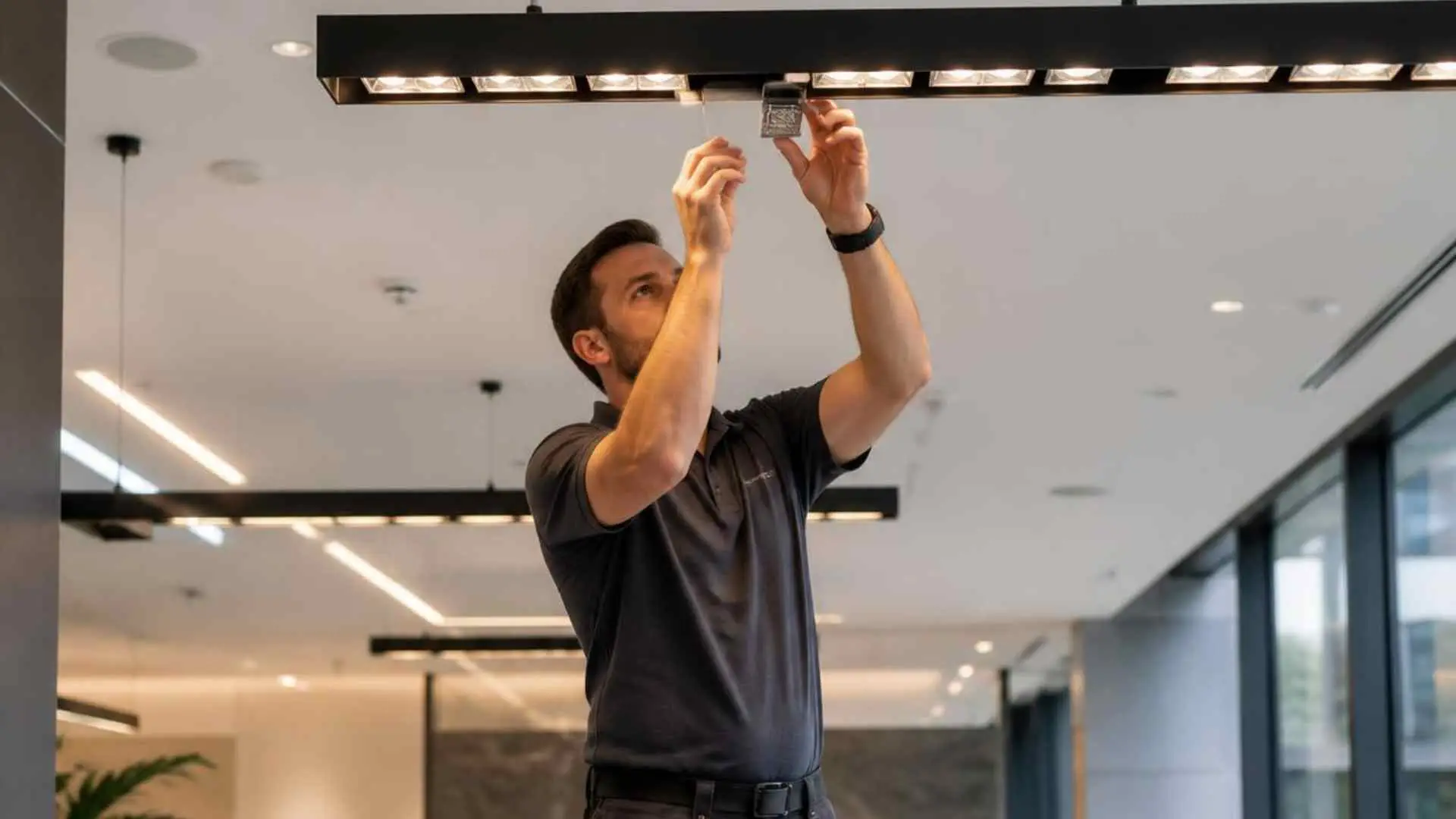
Modular lighting is different. Each fitting is built from independent, replaceable components. When one module reaches the end of its life, only that section needs replacing. This approach helps cut maintenance costs because fewer materials get replaced during repairs.
It also avoids throwing away fittings that still have years of useful life remaining. Over time, these smaller decisions add up to significant savings across a commercial property.
Faster Repairs Keep Businesses Running
Maintenance time is rarely just about the part being fixed. Maintenance costs are not limited to replacement products only. Labour, access equipment, and operational disruption all add to the real cost of every repair. Offices, hospitality, retail and commercial spaces can’t have lengthy maintenance works interrupting employees, customers, or day-to-day operations.
Replacing an entire lighting fixture always takes longer than changing a single component. Faster repairs mean less disruption to daily operations, which matters across most buildings.
Supporting Future Workplace Changes
Workplaces change far more often than lighting systems are typically designed for. Commercial spaces rarely stay the same for long. Offices add collaborative areas, retailers refresh store layouts, and businesses adapt their spaces as needs shift.
Through modular lighting, individual modules can be upgraded or swapped while the main fixture stays exactly where it is. Take an office redesigning workspace, where meeting rooms need brighter lighting and open-plan areas need something softer. Rather than installing entirely new fittings, individual components can simply be adjusted to fit the new layout.
Smart Technology Improves Long-Term Value
Lighting that runs longer than necessary adds up in ways that are easy to overlook. Apart from cutting maintenance costs, lighting also needs to run efficiently across the whole building. Modern modular systems support smart controls, allowing remote brightness adjustment, colour control, and energy optimisation.
Lighting can switch on only when it’s actually needed. This alone helps improve energy efficiency while trimming unnecessary running costs. There’s another advantage worth highlighting: future-proofing.
As lighting technology moves forward, individual modules can be upgraded without replacing the whole fixture. That protects the original investment and makes future improvements far easier to manage.
Better Planning Supports Better Maintenance
Strong maintenance planning is less about fixing problems and more about avoiding them. Good maintenance shouldn’t just fix today’s problem. It should make tomorrow’s repairs easier, too. Modular systems are built for easy disassembly, refurbishment, and reassembly.
They also support Digital Product Passports, which record details like product materials, repair guidance, energy performance, and recycling instructions. That makes maintenance planning far more organised across the product’s entire lifecycle. In the long run, that approach tends to deliver more value than repeatedly replacing whole fittings.
Modular Lighting Supports Long-Term Performance
The true cost of a lighting system isn’t visible on day one; this builds up gradually through maintenance and replacement. Commercial lighting maintenance should support long-term performance, not create an endless cycle of replacement costs.
Modular lighting helps achieve exactly that by allowing component-level repairs, reducing disruption, and making future upgrades simpler to manage.
Features like smart controls, easy disassembly, Digital Product Passports, and adaptable components add even more long-term value. If you are planning future lighting upgrades, repairable and adaptable systems tend to be the smarter investment, rather than replacing complete fittings.