

The cheapest card reader for a small business depends on whether you are comparing the device price, transaction fee or total annual cost.
Square has one of the lowest standard hardware prices at £19 plus VAT, while SumUp’s Solo Lite costs £25 excluding VAT before temporary discounts.
PayPal Point of Sale offers its first reader to eligible new business users for £29 excluding VAT, and myPOS sells its standalone Go 2 terminal for £29 excluding VAT.
However, the cheapest reader to buy is not necessarily the cheapest to operate.
For businesses mainly accepting UK consumer Visa and Mastercard payments, Lopay advertises a 0.79% Essential account rate with no monthly fee, although the free bank payout is weekly and higher rates apply to American Express, international and corporate cards.
Revolut advertises in-person fees from 0.8% plus 2p, but businesses must consider its account requirements and higher rates for commercial and international cards.
Based on the prices checked for this guide:
- Cheapest Standard Hardware: Square Reader
- Cheapest Standard Percentage Rate: Lopay Essential for qualifying UK consumer cards
- Cheapest Standalone Entry-Level Reader: myPOS Go 2
- Best Simple Flat-Rate Option: SumUp
- Best for Existing PayPal Users: PayPal Point of Sale
- Best for Existing Revolut Business Users: Revolut Reader or Terminal
- Best Subscription Option for Higher Turnover: SumUp Payments Plus or Tide Sell In-Person
- Cheapest Hardware-Free Option: Tap to Pay using a compatible smartphone
These recommendations are conditional. Your cheapest option may change if customers frequently use commercial, international or American Express cards, or if you need faster payouts.
Key Takeaways:
- Square offers one of the lowest standard reader prices, but it does not have the lowest published transaction rate.
- Low-volume and seasonal sellers usually benefit from a pay-as-you-go plan without monthly fees.
- Lopay and Revolut publish low rates for qualifying UK consumer cards, but their fees vary by card category or service.
- SumUp’s paid plan can become cheaper than its pay-as-you-go option when monthly card turnover reaches approximately £2,715.
- Tide’s paid plan can become cheaper than its pay-as-you-go reader at around £2,500 monthly turnover when the average payment is £20.
- Fixed per-transaction charges matter most when a business processes many small payments.
- Hardware, VAT, delivery, monthly subscriptions, payout charges and card-type surcharges should all be included in a first-year cost comparison.
- Promotional prices and eligibility conditions should be checked before ordering.
What Does “Cheapest Card Reader” Actually Mean?
Lowest Upfront Hardware Price
The upfront price includes more than the amount shown beside the reader.
Check whether the advertised figure includes:
- VAT
- Delivery
- A charging cable or dock
- A new-customer discount
- A limited-time promotion
- Account or subscription eligibility
- The full price of additional readers
Square currently lists its second-generation reader from £19 plus VAT. SumUp’s published standard price for the Solo Lite is £25 excluding VAT, although temporary promotions may reduce it.
PayPal’s £29 introductory price is limited to one reader for each eligible new business user; additional readers cost £69 excluding VAT.
Lowest Transaction Fee
Providers normally use one of four structures:
- A flat percentage for every card-present payment
- A percentage plus a fixed charge
- Different rates for different card categories
- A monthly subscription that reduces the processing rate
A 0.8% rate can be more expensive than a 1% rate when a fixed charge is added to every low-value payment. Similarly, a cheap domestic consumer-card rate may not apply when the customer pays with a corporate or international card.
Lowest Monthly Commitment
A no-monthly-fee reader is usually attractive to businesses with irregular sales because there is no subscription to pay during quiet months.
A monthly plan may still be cheaper for an established business when the reduction in transaction fees exceeds the subscription cost. The correct comparison is therefore not simply “monthly fee versus no monthly fee”, but:
Monthly Subscription Cost Compared With Monthly Transaction Savings
Lowest Total Annual Cost
A useful calculation is:
First-Year Cost = Hardware + VAT + Delivery + Subscription Fees + Transaction Fees + Additional Charges
Additional charges may include instant payouts, chargebacks, accessories, business-account subscriptions and higher fees for particular cards.
Best Cheap Card Readers for Small Businesses in the UK
1. Square Reader
Square Reader is one of the most accessible options for UK small businesses that want to begin taking card payments without committing to an expensive terminal or monthly contract.
The compact reader connects to a compatible smartphone or tablet and works with Square’s point-of-sale application, making it suitable for sole traders, market sellers, mobile service providers and new retailers.
Its main attraction is the low upfront hardware cost combined with straightforward pay-as-you-go pricing.
Square may not always have the lowest transaction rate, but its free basic POS software, simple setup and broad range of business tools make it a practical all-round choice for businesses that value ease of use as well as affordability.
Hardware and Plan Costs
Square Reader costs £19 plus VAT. The standard Square Point of Sale software has no monthly account or software charge, although optional paid software and additional hardware are available.
Transaction Fees
Square charges:
- 1.75% for in-person chip-and-PIN and contactless payments
- 2.5% for manually entered payments
- 1.4% plus 25p for online UK-card payments
- 2.5% plus 25p for online non-UK-card payments
An additional cross-border charge can apply to international in-person transactions.
Key Features
Square Reader connects wirelessly to a compatible phone or tablet. It accepts chip-and-PIN cards, contactless cards, Apple Pay and Google Pay.
Businesses also receive access to Square’s basic POS software, sales reporting, digital receipts and optional integrations.
Advantages
- Very low standard hardware price
- No standard monthly POS fee
- Simple flat rate for ordinary in-person transactions
- Free basic point-of-sale software
- Suitable for new and occasional sellers
Limitations
- Requires a compatible smartphone or tablet
- The 1.75% rate is higher than some card-dependent competitors
- International transactions can cost more
- Businesses with high turnover may find a subscription or negotiated plan cheaper
Best For
Square is best for new businesses that want a low-cost reader, straightforward pricing and useful POS software without a monthly commitment.
2. SumUp

SumUp is a popular choice for small businesses that want simple pricing and a selection of card readers for different working environments.
Its entry-level reader connects to a smartphone, while its standalone terminals are designed for businesses that prefer not to rely on a separate mobile device.
The standard pay-as-you-go plan has no monthly subscription, which makes SumUp suitable for new, seasonal and lower-volume businesses.
Companies processing more card sales can also consider SumUp’s paid plan, which exchanges a monthly charge for a reduced transaction rate and may lower the overall cost once turnover reaches the break-even point.
Hardware and Plan Costs
The SumUp Solo Lite has a standard price of £25 excluding VAT, or £30 including VAT, and pairs with a smartphone. SumUp also offers standalone terminals and Tap to Pay.
The standard pay-as-you-go plan has no monthly fee. Payments Plus costs £19 per month and reduces the in-person processing rate.
Transaction Fees
SumUp’s UK pages advertise:
- 1.69% for standard pay-as-you-go in-person payments
- 0.99% with Payments Plus
- 2.5% for online products such as payment links
The standard in-person rate covers major card categories, including American Express and international cards, making it simpler than card-dependent pricing.
Key Features
SumUp offers:
- Smartphone-connected readers
- Standalone card terminals
- Tap to Pay
- Payment links
- Digital receipts
- Invoicing
- POS tools
- A SumUp Business Account
Advantages
- Straightforward pay-as-you-go pricing
- No monthly charge on the standard plan
- One published rate for major in-person card types
- Several hardware choices
- A lower-fee monthly plan for growing businesses
Limitations
- The cheapest reader requires a smartphone
- Payments Plus is not economical at low turnover
- Promotional hardware prices can change
- Online payment rates are higher than in-person rates
Best For
SumUp is best for sole traders and small businesses wanting predictable fees, flexible hardware and the option to move to a lower-rate subscription as sales increase.
3. PayPal Point of Sale
PayPal Point of Sale, previously known as Zettle, provides a compact mobile card reader designed for businesses that want to accept contactless and chip-and-PIN payments through a smartphone or tablet.
It may be particularly convenient for merchants already using PayPal to receive online payments or manage business funds.
The reader has no standard monthly processing subscription and uses a straightforward in-person transaction rate.
However, the lowest advertised hardware price may only be available to eligible new business users, so businesses should check the full reader price, delivery charge and cost of any additional devices before ordering.
Hardware and Plan Costs
The PayPal Reader is available from £29 excluding VAT for one eligible new business user. Additional readers cost £69 excluding VAT, and delivery charges may apply.
There is no standard monthly fee for using the reader.
Transaction Fees
PayPal Point of Sale charges 1.75% for ordinary reader and contactless transactions. Its official pricing information states that this standard rate applies regardless of the card accepted, including American Express.
Payment links are charged separately at 2.5% per successful payment.
Key Features
The reader connects to a compatible smartphone or tablet through Bluetooth and requires an internet connection.
It supports:
- Chip-and-PIN payments
- Contactless cards
- Apple Pay
- Google Pay
- Samsung Pay
- Digital receipts
- PayPal Business integration
- Sales reporting
Advantages
- No standard monthly reader fee
- Simple in-person transaction rate
- American Express included in the standard rate
- Convenient for businesses already using PayPal
- Payments can reach the PayPal Business balance quickly
Limitations
- The £29 price has new-user eligibility conditions
- Additional readers cost considerably more
- A smartphone or tablet is required
- Payment-link transactions have a higher rate
Best For
PayPal Point of Sale is best for small businesses that already manage sales or money through PayPal and want a familiar mobile payment system.
4. myPOS Go 2
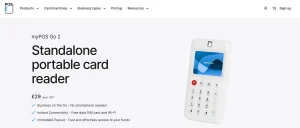
The myPOS Go 2 is an affordable standalone card reader that does not need to be connected to a smartphone.
It includes its own mobile connectivity and Wi-Fi capability, making it useful for market traders, delivery businesses, mobile professionals and other merchants who regularly accept payments away from a fixed business location.
Unlike providers that charge one flat transaction percentage, myPOS uses rates that can vary according to the card category and may include a fixed charge for each payment.
This structure can be competitive for businesses processing fewer, higher-value transactions, but merchants with many low-value sales should calculate the effective fee carefully.
Hardware and Plan Costs
The myPOS Go 2 costs £29 excluding VAT. Unlike the cheapest Square, SumUp and PayPal readers, it is a standalone device with built-in connectivity and does not need to be paired with a smartphone.
There is no fixed monthly payment-processing charge for businesses with less than £10,000 in monthly card turnover.
Transaction Fees
For businesses processing less than £10,000 per month, myPOS publishes the following card-present rates:
- 1.10% plus 7p for domestic consumer cards
- 2.20% plus 7p for EEA consumer cards
- 2.45% plus 7p for American Express
- 2.85% plus 7p for other consumer and commercial cards
Businesses processing more than £10,000 per month can request custom pricing.
Key Features
The myPOS Go 2 includes:
- Standalone operation
- Built-in mobile connectivity
- Wi-Fi
- Contactless payments
- Chip-and-PIN payments
- Email and SMS receipts
- A full-day battery
- Settlement into a myPOS merchant account
Advantages
- Low purchase price for a standalone reader
- No smartphone required
- No fixed monthly processing charge
- Suitable for outdoor and mobile selling
- Custom pricing may be available above £10,000 monthly turnover
Limitations
- The 7p fixed charge can be significant on low-value sales
- Fees vary substantially by card category
- Funds settle into the myPOS account rather than directly into an unrelated bank account
- Account transfers and other services should be reviewed for additional costs
Best For
The myPOS Go 2 is best for market traders and mobile businesses that need a low-priced standalone reader with its own connectivity.
5. Revolut

Revolut Reader is designed for businesses that already use or plan to use a Revolut Business account.
It connects payment acceptance with Revolut’s wider business-money platform, allowing merchants to manage card takings, transfers, expenses and multiple currencies within the same ecosystem.
Its published rate for qualifying domestic consumer cards can be competitive, especially for businesses that mainly serve UK customers.
However, commercial cards, international cards and American Express payments can attract higher charges, and the cost of the required Revolut Business plan should be included when comparing the total annual expense.
Hardware and Plan Costs
Revolut’s small-business information lists the Revolut Reader at a one-time price of £49. Its newer Lite Terminal costs £129 plus VAT, while the full Revolut Terminal costs £169 plus VAT.
Payment acceptance is included with Revolut Business plans, but the cost of the underlying business account should be considered separately.
Transaction Fees
Revolut advertises the following in-person rates:
- 0.8% plus 2p for domestic consumer Visa and Mastercard payments
- 2.6% plus 2p for domestic commercial cards
- 2.6% plus 2p for international cards
- 1.7% plus 2p for domestic consumer American Express
- 0.5% plus 2p for Revolut Pay on supported terminals
Tap to Pay on iPhone attracts an additional charge.
Key Features
Revolut’s payment products provide:
- Integration with Revolut Business
- Multi-currency settlement
- Card readers and standalone terminals
- Tap to Pay
- Payment links
- Digital receipts
- Refund management
- Settlement within 24 hours, subject to terms
Advantages
- Low rate for qualifying domestic consumer cards
- Integrated payment and business-money platform
- Useful multi-currency features
- No separate payment-acceptance setup or maintenance fee
- Competitive Revolut Pay rate
Limitations
- Higher rates apply to commercial and international cards
- A Revolut Business account is required
- Business-plan costs may alter the total price
- The lowest advertised fee does not apply to every transaction
Best For
Revolut is best for existing Revolut Business customers, particularly those accepting mostly domestic consumer cards or managing money in multiple currencies.
6. Lopay
Lopay is positioned as a low-cost payment provider for UK businesses that mainly accept domestic consumer Visa and Mastercard payments.
It offers both a physical card reader and Tap to Pay, allowing merchants to choose between dedicated hardware and accepting contactless payments directly on a compatible smartphone.
The lowest published transaction rate is linked to Lopay’s Essential payout arrangement, which provides free scheduled bank transfers rather than the fastest available settlement.
Businesses should therefore compare transaction savings against payout speed and check the additional charges that can apply to American Express, corporate and international cards.
Hardware and Plan Costs
Lopay’s first card reader costs £35 plus £6.95 postage and packaging when ordered through its app. Further readers cost £49 plus postage.
Its Essential and Standard accounts have no monthly fee, setup charge or minimum monthly turnover requirement.
Transaction Fees
Lopay publishes the following rates:
- 0.79% on the Essential account for UK consumer Visa and Mastercard transactions
- 0.99% on the Standard account
- 1.79% for Instant to Bank
- An additional 1% for American Express, international and corporate-card categories
Its phone-based Tap to Pay service adds 8p per transaction.
Key Features
Lopay supports:
- A Bluetooth card reader
- Tap to Pay on compatible phones
- Chip-and-PIN payments
- Contactless cards
- Apple Pay and Google Pay
- Digital receipts
- Payment links
- Invoices
- POS tools
- Multiple payout schedules
The Essential account includes free Thursday bank payouts. Faster settlement options are available at higher rates.
Advantages
- Very low rate for qualifying UK consumer cards
- No monthly fee
- No minimum turnover
- Physical reader and hardware-free options
- Choice of payout schedule
- Free basic POS features
Limitations
- The lowest-rate account has a weekly free payout schedule
- American Express, international and corporate cards cost more
- Tap to Pay adds a fixed 8p charge
- The first-reader discount applies only when ordered through the app
- Lopay’s own comparison content should not replace checking its full terms
Best For
Lopay is best for businesses mainly taking UK consumer Visa and Mastercard payments that are comfortable with weekly free bank payouts.
7. Tide

Tide’s card-payment services are aimed mainly at businesses that want their payment terminal and business account within one platform.
It offers a standalone card reader as well as Tap to Pay, with transactions, settlement records and business banking activity managed through the Tide ecosystem.
Businesses can choose between a pay-as-you-go option and a monthly Sell In-Person plan with lower transaction charges.
The subscription can become cost-effective at higher sales volumes, but businesses should calculate the break-even point using their actual turnover and average transaction value before selecting the paid plan.
Hardware and Plan Costs
Tide offers two main card-reader price structures:
- Pay As You Go: Device from £159 plus VAT and no monthly fee
- Sell In-Person: Device from £99 plus VAT and a £17.99 monthly fee
Tide also provides Tap to Pay on compatible iPhones.
Transaction Fees
For qualifying domestic consumer debit-card transactions, Tide advertises:
- 1.5% plus 5p on the card-reader pay-as-you-go option
- 0.89% plus 3p with Sell In-Person
- 1.5% plus 11p for pay-as-you-go Tap to Pay
- 0.89% plus 3p for subscription Tap to Pay
Different card types can have different charges.
Key Features
Tide provides:
- A standalone card reader
- Tap to Pay
- Integration with Tide business accounts
- Payment and settlement reporting
- Business banking tools
- Optional faster settlement
Next-business-day settlement is available for an additional monthly fee on applicable plans.
Advantages
- Payments integrate with a Tide business account
- Subscription rates are competitive for qualifying domestic cards
- Physical and hardware-free options
- Lower hardware price with the paid plan
- Useful for businesses already using Tide
Limitations
- The reader costs more upfront than entry-level mobile readers
- The best rate requires a monthly subscription
- Fixed charges affect low-value payments
- Fees vary by card category
- Banking and payment costs should be assessed together
Best For
Tide is best for existing Tide customers processing enough monthly card turnover to recover the cost of its Sell In-Person subscription.
Cheapest Card Readers Compared
| Provider | Entry-Level Hardware | Monthly Fee | Standard In-Person Fee Used for Comparison | Smartphone Required? | Best For |
|---|---|---|---|---|---|
| Square | £19 + VAT | £0 | 1.75% | Yes | Lowest Standard Hardware Price |
| SumUp | £25 Excluding VAT | £0 or £19 | 1.69% PAYG or 0.99% Plus | Yes for Solo Lite | Simple Flat-Rate Pricing |
| PayPal Point of Sale | £29 Excluding VAT | £0 | 1.75% | Yes | Existing PayPal Users |
| myPOS Go 2 | £29 Excluding VAT | £0 | 1.10% + 7p | No | Low-Cost Standalone Reader |
| Revolut Reader | £49 | Business-Plan Dependent | 0.8% + 2p | Yes | Revolut Business Users |
| Lopay | £35 + £6.95 Delivery | £0 | 0.79% | Yes | UK Consumer Cards |
| Tide | From £159 PAYG | £0 or £17.99 | 1.5% + 5p PAYG or 0.89% + 3p | No | Existing Tide Customers |
Important: The transaction rates shown are not directly equivalent in every case. Lopay, Revolut, myPOS and Tide vary their charges according to card type, payout option or plan. SumUp, Square and PayPal use simpler standard rates for ordinary in-person payments.
Which Card Reader Is Cheapest for Your Sales Volume?
The following estimate uses equal assumptions to show how pricing structures affect the result.
Comparison Assumptions
- One year of service
- One entry-level reader
- Prices excluding VAT where VAT is separately stated
- £20 average transaction
- Domestic consumer Visa or Mastercard payments
- No refunds, chargebacks or international cards
- No optional instant-settlement fees
- Standard published pricing rather than temporary promotions
- Revolut Business account costs excluded
- The cheaper SumUp or Tide plan selected at each turnover level
Estimated First-Year Costs
| Monthly Card Turnover | Square | SumUp | PayPal | myPOS | Revolut | Lopay | Tide |
|---|---|---|---|---|---|---|---|
| £500 | £124 | £126 | £134 | £116 | £103 | £89 | £264 |
| £2,000 | £439 | £431 | £449 | £377 | £265 | £232 | £564 |
| £5,000 | £1,069 | £847 | £1,079 | £899 | £589 | £516 | £939 |
| £10,000 | £2,119 | £1,441 | £2,129 | £1,769 | £1,129 | £990 | £1,563 |
These figures are calculations based on the stated assumptions, not provider quotations.
Under this narrow scenario, Lopay produces the lowest calculated first-year cost. That result depends on the business accepting qualifying UK consumer Visa and Mastercard payments and using the Essential account’s free payout arrangement.
Revolut is also competitive under these assumptions, but the table excludes any cost associated with the required Revolut Business account. A business with many commercial or international-card payments would face substantially higher Revolut fees.
How to Calculate a Subscription Break-Even Point?
Use this formula:
Break-Even Turnover = Monthly Subscription Cost ÷ Difference Between Transaction Rates
For SumUp:
- Pay-as-you-go rate: 1.69%
- Payments Plus rate: 0.99%
- Difference: 0.70%
- Monthly subscription: £19
£19 ÷ 0.007 = approximately £2,714
Payments Plus therefore begins to recover its subscription cost at around £2,715 in monthly in-person card turnover, before considering any other plan benefits.
For Tide, fixed charges also matter. At an average payment of £20:
- Pay-as-you-go effective charge: 1.5% plus 5p
- Subscription charge: 0.89% plus 3p
- Difference per £20 transaction: approximately 14.2p
- Approximate break-even turnover: around £2,534 per month
The precise result changes with the average payment value.
Why Average Transaction Value Matters?
Suppose myPOS charges 1.10% plus 7p for a domestic consumer-card payment.
- On a £5 sale, the fee is approximately 12.5p, or an effective rate of 2.5%.
- On a £20 sale, the fee is approximately 29p, or an effective rate of 1.45%.
- On a £100 sale, the fee is approximately £1.17, or an effective rate of 1.17%.
The percentage-plus-fixed-fee structure becomes relatively cheaper as the transaction value rises. It can be less attractive for cafés, kiosks and other businesses processing many small payments.
Cheapest Card Reader by Business Type
Best for Market Traders and Pop-Up Sellers
Market traders should prioritise:
- Low upfront costs
- No monthly fee
- Portability
- Battery life
- Mobile connectivity
- Reliable operation away from fixed Wi-Fi
The myPOS Go 2 is a strong standalone option because it includes connectivity. Square, SumUp, PayPal and Lopay may be cheaper initially but rely on a compatible phone for their entry-level readers.
Best for Mobile Tradespeople and Service Businesses
Mobile professionals may benefit from Square, SumUp, Lopay or Revolut because these platforms combine in-person payments with features such as payment links, invoices and digital receipts.
The best choice depends on whether customers usually pay in person or remotely and how quickly funds are needed.
Best for Cafés and Low-Value Retailers
Businesses processing many low-value sales should be cautious about fixed per-transaction charges.
A flat-percentage provider such as SumUp, Square or PayPal can be easier to predict. A percentage-plus-fixed-fee provider may still be cheaper, but only after calculating the effective rate at the business’s actual average sale value.
Best for Salons and Appointment Businesses
Salons and appointment businesses should compare:
- Card-present fees
- Deposits and payment links
- Tipping
- Digital receipts
- Booking integrations
- Payout timing
Square and SumUp offer broader business-management ecosystems, while Lopay may reduce fees for businesses mainly accepting qualifying UK consumer cards.
Best for Seasonal Businesses
A pay-as-you-go plan normally suits a seasonal business because there is no subscription during months without sales.
Square, SumUp, PayPal, myPOS and Lopay all have options without a standard monthly processing charge. A subscription should only be used when savings during active months exceed the cost across the full year.
Best for Growing Shops
Businesses with rising turnover should calculate whether a subscription or custom quote is cheaper than a standard pay-as-you-go plan.
SumUp promotes Payments Plus to businesses taking approximately £3,000 or more per month. myPOS invites businesses processing more than £10,000 per month to request custom pricing, while Square offers custom pricing to qualifying higher-volume merchants.
Can You Accept Card Payments Without Buying a Reader?

Yes. Tap to Pay allows a compatible NFC-enabled smartphone to accept contactless cards and mobile-wallet payments without separate reader hardware.
Square, SumUp, Revolut, Lopay and Tide offer phone-based payment acceptance. Hardware may cost £0, but normal transaction charges still apply.
How Tap to Pay Works?
The business installs an approved payment app on a compatible phone. At checkout, the customer holds a contactless card, phone or wearable near the merchant’s device.
Compatibility depends on:
- Phone model
- Operating-system version
- NFC capability
- Provider eligibility
- Country
- Payment method
- PIN and verification requirements
When Tap to Pay Is the Cheapest Option?
Tap to Pay may be suitable for:
- A new business testing card acceptance
- Occasional market or event sales
- Mobile professionals
- Businesses with very low transaction volumes
- A backup when the main reader is unavailable
When a Physical Reader Is Worth Buying?
A physical reader may be preferable when:
- Customers regularly need chip and PIN
- Several employees take payments
- The merchant wants a separate work device
- Phone battery life is a concern
- A counter-based checkout is needed
- The business needs a printer or integrated POS hardware
Hidden Costs to Check Before Choosing a Card Reader
VAT and Delivery Charges
Some prices exclude VAT, while others display an inclusive figure. Delivery may be free, charged separately or included only during a promotion.
Commercial and International-Card Fees
Lopay, myPOS, Revolut and Tide can charge different rates according to card category. Ask the provider how it identifies domestic, commercial, EEA and international cards.
American Express Charges
Square, SumUp and PayPal include American Express in their standard published in-person rates. Lopay, Revolut and myPOS publish separate or additional charges.
Refund and Chargeback Fees
Check whether the original processing fee is returned after a refund and whether the provider charges for disputes or chargebacks. Revolut, for example, lists a £15 chargeback fee.
Instant or Faster-Payout Fees
The lowest transaction rate may come with slower free payouts. Lopay’s Essential account includes free Thursday payouts, while Tide charges separately for an optional faster-settlement service.
Business-Account and Subscription Costs
Revolut and Tide integrate payments with their business-account platforms. Include any account-plan cost that the business would not otherwise pay.
Additional-Reader Prices
Introductory prices frequently apply only to the first reader. PayPal’s first-reader offer and Lopay’s app discount both have separate pricing for additional hardware.
Accessories, Docks and Receipt Printers
Charging docks, stands, receipt printers, cash drawers and barcode scanners can cost more than the basic reader.
Cancellation and Contract Charges
Pay-as-you-go readers normally avoid a long commitment, but rental terminals may involve minimum terms and automatic renewal.
Connectivity and Mobile-Data Costs
A phone-connected reader uses the phone’s Wi-Fi or mobile data. A standalone device may include mobile connectivity, but its account and usage terms should still be reviewed.
How to Choose the Right Low-Cost Card Reader?
Estimate Your Monthly Card Turnover
Use recent sales records or a cautious forecast. Do not choose a subscription based on an unusually busy month.
Calculate Your Average Transaction Value
Divide monthly card turnover by the number of card payments. This is essential when comparing percentage-only pricing with percentage-plus-fixed-fee pricing.
Identify the Cards Your Customers Use
Determine whether most customers use:
- UK consumer debit cards
- UK consumer credit cards
- American Express
- Corporate cards
- International cards
- Mobile wallets
Decide Whether You Need Standalone Connectivity
A phone-connected reader is usually cheaper. A standalone machine may justify its higher price if the business cannot depend on an employee’s phone.
Compare Settlement and Payout Times
The cheapest transaction rate may involve weekly payouts or settlement into a provider account. Consider cash flow as well as fees.
Check Accounting and POS Integrations
A reader with a slightly higher fee may reduce administrative work if it connects to the business’s accounting, inventory, booking or ecommerce tools.
Review Contract and Cancellation Terms
Check:
- Minimum contract period
- Renewal terms
- Hardware ownership
- Early-cancellation fees
- Monthly minimums
- Account-closure rules
Calculate the Full First-Year Cost
Use:
First-Year Cost = Hardware + VAT + Delivery + 12 Months of Subscriptions + Processing Fees + Expected Additional Charges
Repeat the calculation for at least two sales forecasts. This shows whether the preferred provider remains affordable if turnover rises or falls.
Conclusion: Which Cheap Card Reader Should You Choose?
The cheapest card reader for small business UK use is not one universal device.
Square is one of the cheapest standard readers to buy. SumUp offers simple flat-rate pricing and a useful subscription path for growing turnover. PayPal Point of Sale suits existing PayPal users, while the myPOS Go 2 is an inexpensive standalone option.
Lopay can produce the lowest processing cost for businesses mainly accepting qualifying UK consumer cards and willing to use its Essential payout arrangement.
Revolut is competitive for existing Revolut Business customers, while Tide’s subscription becomes more attractive once monthly turnover is high enough to offset the recurring charge.
Before choosing, calculate the first-year cost using your real turnover, average sale value, customer card mix and required payout speed. Recheck the provider’s official pricing and terms immediately before ordering.
Frequently Asked Questions
What Is the Cheapest Card Reader for a Small Business in the UK?
Square has one of the lowest standard device prices at £19 plus VAT. Lopay publishes one of the lowest transaction rates for qualifying UK consumer cards, but its cheapest payout arrangement and card-category rules must be considered.
Is There a Card Reader With No Monthly Fee?
Yes. Square, SumUp, PayPal Point of Sale, myPOS and Lopay all provide options without a standard monthly processing subscription. Hardware and transaction fees still apply.
Can a Small Business Get a Free Card Reader?
A business may not need a separate reader if it uses Tap to Pay on a compatible smartphone. Some providers also run temporary hardware promotions, but normal transaction fees remain payable.
Which Card Reader Has the Lowest Transaction Fees?
Lopay advertises 0.79% for qualifying UK consumer Visa and Mastercard payments on its Essential account. Revolut advertises rates from 0.8% plus 2p. Neither rate applies identically to every card or business situation.
Is SumUp Cheaper Than Square?
SumUp’s standard 1.69% in-person fee is slightly lower than Square’s 1.75% rate. Square’s reader is cheaper at its standard price. SumUp Payments Plus can create greater savings once monthly card turnover reaches roughly £2,715.
Do I Need a Business Bank Account to Use a Card Reader?
Requirements vary. Some providers pay directly into a nominated bank account, while others settle funds into their own merchant or business-account ecosystem. Check eligibility before purchasing hardware.
Can I Use My Phone as a Card Reader?
Yes. Several providers support Tap to Pay on compatible NFC-enabled phones. Contactless payments can be accepted without a separate reader, although transaction fees and device requirements apply.
Are Card Reader Fees Tax-Deductible?
Card-processing and financial charges incurred wholly for business purposes may normally be treated as allowable business costs, depending on the business’s circumstances and accounting method. HMRC advises businesses to seek guidance when unsure.
How Quickly Will Card Payments Reach My Bank Account?
Settlement can range from instant access within a provider account to next-day, weekly or scheduled bank payouts. Faster settlement may require a higher transaction rate or additional subscription.
Do Cheap Card Readers Accept American Express?
Many do, but the fee varies. Square, SumUp and PayPal include American Express within their standard published in-person rate. myPOS, Revolut and Lopay publish separate or additional charges.