

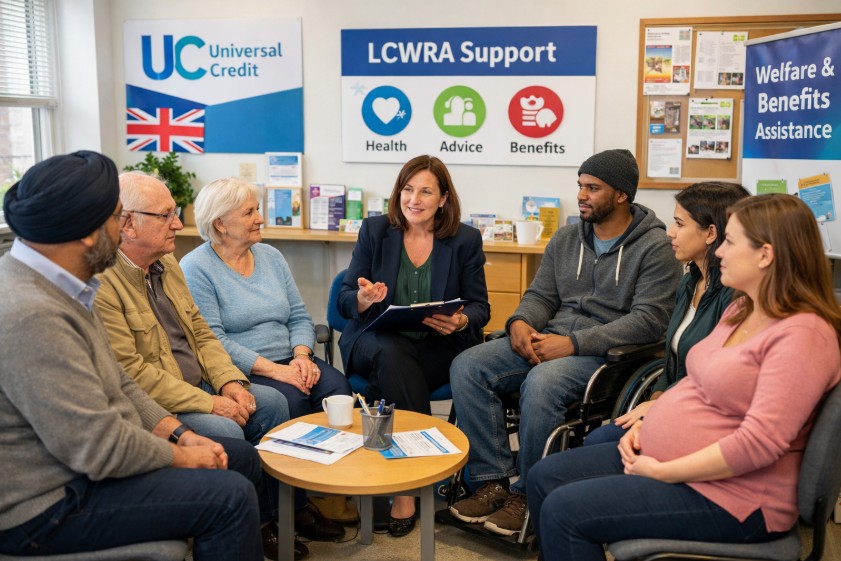
🩺 LCWRA Automatic Qualification – Quick Explanation
There are specific conditions and situations that automatically qualify you for LCWRA, but there is no simple list of diagnoses.
Instead, you qualify through defined legal routes such as terminal illness, certain cancer treatments, high-risk pregnancy,
substantial risk to health, pension age disability benefits, or migration from the ESA Support Group.
If none apply, you must go through a Work Capability Assessment.
If you are claiming Universal Credit in the UK, here are the key takeaways:
- Terminal illness under 12 months qualifies through the Special Rules route.
- Chemotherapy or radiotherapy can lead to automatic treatment as LCWRA.
- High risk pregnancy may qualify with medical evidence.
- Substantial risk to health can override the normal assessment.
- ESA Support Group claimants usually transfer to LCWRA automatically.
Understanding these conditions that automatically qualify you for LCWRA helps you avoid delays and submit the right evidence from the start.
Are There Any Conditions That Automatically Qualify You for LCWRA?

There is no official list of medical diagnoses that automatically qualify you for LCWRA. Instead, the law focuses on how your condition affects your ability to carry out work-related activity. This is an important distinction because the Department for Work and Pensions assesses functional limitation rather than the name of your illness.
However, certain circumstances allow you to be treated as having Limited Capability for Work Related Activity without completing the full points-based assessment. These are legal exceptions written into Universal Credit regulations. They include terminal illness, specific cancer treatment situations, high-risk pregnancy, substantial risk to health, and pension age claimants receiving certain disability benefits.
So while there are no automatic conditions in the traditional sense, there are clearly defined routes where you can qualify for LCWRA without going through the standard scoring system.
What Situations Allow You to Be Treated as Automatically Qualifying for LCWRA?
When discussing conditions that automatically qualify you for LCWRA, it is more accurate to talk about situations where you are treated as having LCWRA under special rules. These routes remove the need to score points under the normal assessment.
Do You Automatically Qualify for LCWRA If You Are Terminally Ill?
If you are suffering from a progressive disease and your death can reasonably be expected within 12 months, you qualify under the Special Rules for End of Life. This is one of the clearest automatic routes into LCWRA.
You do not need to complete a UC50 questionnaire or attend a Work Capability Assessment. Instead, a medical professional must complete an SR1 form confirming your prognosis. Once submitted, the DWP fast-tracks your claim, and you are treated as having LCWRA immediately.
This route is designed to reduce stress and remove unnecessary procedures at a critical time in your life.
Does Cancer Treatment Automatically Qualify You for LCWRA?
If you are receiving chemotherapy or radiotherapy, you can be treated as automatically qualifying for LCWRA. This also applies if you are likely to start treatment within six months or are recovering from such treatment.
The decision maker must be satisfied that the treatment prevents you from engaging in work-related activity.
You will usually need:
- A consultant or oncology letter
- Hospital treatment confirmation
- Evidence of ongoing recovery impact
Side effects such as extreme fatigue, weakened immunity and cognitive impairment are recognised. You may still qualify during recovery if the functional impact continues.
Can a High Risk Pregnancy Qualify You Automatically for LCWRA?
Pregnancy alone does not qualify you. However, if there is a serious risk to your health or your unborn child if you undertake work related activity, you can be treated as having LCWRA.
Medical evidence must clearly confirm the risk. This could include:
- Pre eclampsia
- Severe hypertension
- History of premature birth
- Placental complications
- Severe anaemia
A midwife or consultant must state that engaging in work related activity would pose a serious health risk. Once accepted, you are exempt from work related requirements.
Can You Qualify for LCWRA If There Is a Substantial Risk to Health?

If requiring you to undertake work-related activity would create a substantial risk to your physical or mental health or to someone else, you can be treated as having LCWRA. This is often referred to as Regulation 35.
This route applies where:
- Your condition is life-threatening or unstable
- You have severe mental health conditions
- You experience unpredictable neurological episodes
- Your behaviour could pose a risk in a work setting
The term substantial is not precisely defined, which means strong evidence is crucial. You must show that the risk is serious and directly linked to work-related activity.
Do Pension Age Claimants Receiving Certain Benefits Automatically Qualify?
If you have reached State Pension age and receive specific high rate disability benefits, you may be treated as having LCWRA under Universal Credit rules.
Qualifying benefits include:
- Attendance Allowance
- The highest rate care component of DLA
- Enhanced rate of the daily living component of PIP
These benefits demonstrate significant care needs. In these circumstances, further assessment is usually not required.
What If You Were Previously in the ESA Support Group?
If you were placed in the ESA Support Group and you move to Universal Credit without a break in your claim, you should automatically be placed in the LCWRA group. The LCWRA group is the Universal Credit equivalent of the ESA Support Group.
You do not normally need to provide new medical evidence or complete a fresh assessment at the point of transfer. However, you can still be reviewed in the future if your circumstances change.
If there is a gap in your claim or a change in your health condition, the DWP may require reassessment. To avoid delays, ensure your migration from ESA to Universal Credit is seamless and clearly documented.
What Happens If You Don’t Meet the Automatic LCWRA Routes?
If none of the conditions that automatically qualify you for LCWRA apply, you must go through the Work Capability Assessment process.
This involves:
- Submitting fit notes from your GP
- Completing a UC50 capability for work questionnaire
- Possibly attending a telephone, video or face-to-face assessment
The assessment looks at how your condition affects your daily functioning. You may be found fit for work, have Limited Capability for Work, or be placed in the LCWRA group.
To qualify for LCW, you must score 15 points across descriptors. To qualify for LCWRA, you must meet at least one of the specific LCWRA descriptors or fall within the special treatment rules. Your answers must explain how you are affected on your worst days.
What Are the LCWRA Descriptors That Could Qualify You?

If you do not qualify under automatic treatment rules, you can still meet one of the LCWRA descriptors. Meeting just one descriptor is enough.
The descriptors cover severe limitations in physical and mental functioning.
Physical function descriptors include:
- You cannot mobilise more than 50 metres without significant discomfort
- You cannot transfer from one seated position to another without assistance
- You cannot raise either arm to place something in a coat pocket
- You cannot pick up and move a 0.5 litre carton of liquid
- You cannot press a button or turn pages with either hand
Communication and sensory descriptors include:
- You cannot convey a simple message
- You cannot understand a simple instruction due to sensory impairment
Continence and consciousness descriptors include:
- Weekly loss of bowel or bladder control requiring clothing changes
- Frequent episodes of altered consciousness
Mental and cognitive descriptors include:
- You cannot learn a simple task due to cognitive impairment
- You require supervision to remain safe
- You cannot reliably initiate or complete two sequential actions
- You cannot cope with any change in routine
- Social engagement is always precluded
- You display uncontrollable aggressive behaviour
Eating-related descriptors include:
- You cannot convey food or drink to your mouth without assistance
- You cannot chew or swallow food without help
These descriptors are strict. Your evidence must clearly demonstrate that the limitation applies reliably and repeatedly.
How Does the Work Capability Assessment Actually Work?
The Work Capability Assessment determines whether you have Limited Capability for Work or Limited Capability for Work-Related Activity.
The process usually begins after you submit a fit note. A decision maker reviews your claim and may send you a UC50 form.
You will:
- Complete the questionnaire within four weeks
- Provide supporting medical evidence
- Possibly attend an assessment conducted by a healthcare professional
The healthcare professional writes a report, but the final decision is made by a DWP decision maker.
If you score 15 points, you qualify for LCW. If you meet at least one LCWRA descriptor or qualify under special rules, you are placed in the LCWRA group. You may be reassessed in the future unless you have a severe lifelong condition.
What Evidence Do You Need to Support Your LCWRA Claim?
Strong evidence is essential, whether you qualify automatically or through descriptors.
You should provide:
- Current fit notes
- Specialist or consultant letters
- Hospital discharge summaries
- Treatment plans
- A detailed UC50 form
Your medical letters should explain functional limitations, not just diagnoses. For example, stating that you cannot walk 50 metres or that work related activity would create substantial risk is far more persuasive than simply naming a condition.
You should also explain how your condition affects you on your worst days and whether symptoms fluctuate. Clear, detailed evidence reduces the risk of refusal and appeal.
How Much Is the LCWRA Payment and What Do You Get?
If you qualify for LCWRA, you receive an additional monthly element added to your Universal Credit award. The current rate is approximately 416.19 per month.
You also receive:
- No requirement to attend work-focused interviews
- No obligation to undertake work-related activity
- Protection from job search conditions
Payment normally begins after three full assessment periods unless you qualify under the terminal illness route.
Here is a comparison:
| Feature | LCW | LCWRA |
|---|---|---|
| Extra payment | No | Yes |
| Work requirements | Work preparation required | None |
| Points needed | 15 points | One severe descriptor |
| Work coach meetings | Required | Not required |
LCWRA provides both financial support and relief from conditionality.
Can Mental Health Conditions Automatically Qualify You for LCWRA?

A diagnosis of anxiety or depression alone does not automatically qualify you for LCWRA. However, if your mental health condition meets one of the LCWRA descriptors or creates a substantial risk to health, you can qualify.
Severe conditions such as schizophrenia, severe PTSD or treatment resistant depression may meet the criteria if they prevent social engagement, safe functioning or task completion. The key factor is how your condition affects your ability to engage in work related activity.
Detailed psychiatric evidence and clear descriptions of risk are crucial in mental health claims.
What Should You Do If Your LCWRA Claim Is Refused?
If you are refused LCWRA, you can challenge the decision.
First, request a mandatory reconsideration. You must explain which descriptor or rule applies to you and why the decision is wrong.
You should:
- Request a copy of the healthcare professional’s report
- Submit additional medical evidence
- Clarify which descriptor you meet
If the decision is not changed, you can appeal to an independent tribunal. Many decisions are overturned at the appeal stage when stronger evidence is provided.
Act promptly because time limits apply.
Key Takeaways About Conditions That Automatically Qualify You for LCWRA
Understanding the conditions that automatically qualify you for LCWRA can prevent unnecessary stress and delays.
Key points include:
- There is no fixed list of qualifying diagnoses
- Terminal illness qualifies under Special Rules
- Cancer treatment can lead to automatic treatment
- High risk pregnancy may qualify with medical proof
- Substantial risk to health is a powerful legal route
- ESA Support Group transfers usually move to LCWRA
- Meeting one LCWRA descriptor is enough
The system focuses on functional impact rather than labels. Clear medical evidence and detailed explanations of your limitations are essential.
Conclusion
The conditions that automatically qualify you for LCWRA are not based on diagnosis alone but on specific legal routes and severe functional limitations. Terminal illness, certain cancer treatments, high-risk pregnancy, substantial health risk, pension age disability benefits and ESA Support Group migration provide clear pathways.
If you do not fall into these categories, you can still qualify by meeting at least one LCWRA descriptor during the Work Capability Assessment. The key to success is strong evidence that explains exactly how your condition limits you.
By understanding these rules and preparing your documentation carefully, you improve your chances of securing the financial support and protection that LCWRA is designed to provide.
FAQs
Can anxiety alone qualify you for LCWRA?
Yes, if it severely limits your ability to engage in work related activity or creates a substantial risk to health. Evidence must show functional impact, not just diagnosis.
Do you need 15 points to qualify for LCWRA?
No, you only need to meet one LCWRA descriptor or qualify under special treatment rules. The 15-point system applies to LCW, not LCWRA.
Does receiving PIP mean you automatically get LCWRA?
Not automatically, unless you are over State Pension age and receive the enhanced daily living component. Otherwise, PIP strengthens evidence but does not guarantee LCWRA.
How long does it take to receive LCWRA payments?
Payments usually begin after three full assessment periods from your first fit note. Terminal illness cases are fast-tracked without the waiting period.
Can you work while receiving LCWRA?
Yes, but you are not required to look for work or undertake work-related activity. Any earnings must still be reported to Universal Credit.
Is LCWRA permanent?
Not necessarily, as you may be reassessed unless you have a severe lifelong condition, the DWP decides review periods individually.
What is Regulation 35 in simple terms?
It allows you to qualify for LCWRA if work related activity would create a substantial risk to your health or someone else’s safety. Strong medical evidence is essential.