
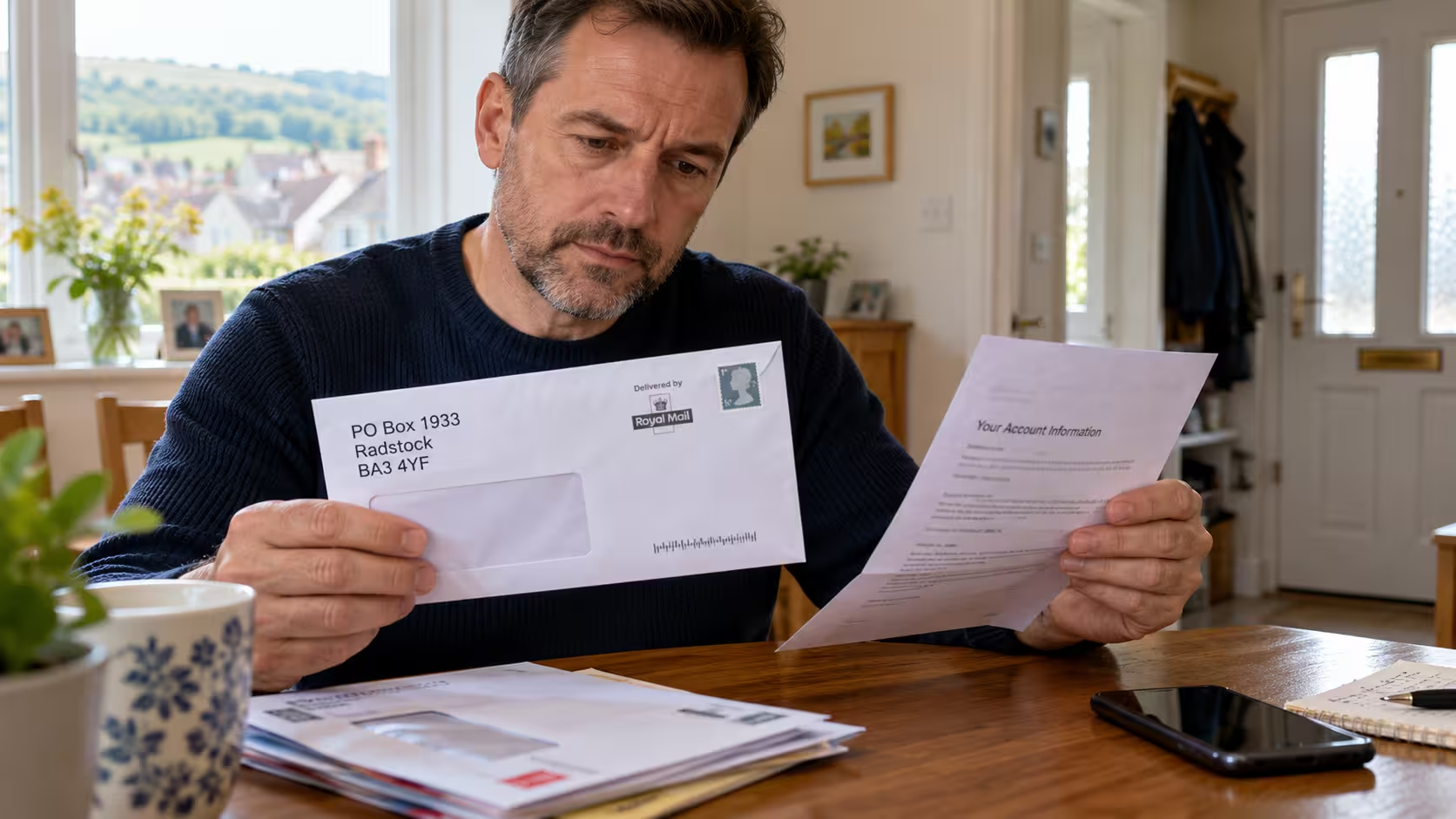
People searching for PO Box 1933 Midsomer Norton are usually trying to identify the sender of an unexpected letter.
The address most closely connected with this search is PO Box 1933, Radstock, BA3 4YF, which Docmail officially identifies as its default return address for client mailings.
This means seeing PO Box 1933 on an envelope does not necessarily mean that Docmail itself sent the communication.
A business, public organisation, healthcare provider or another Docmail customer may have commissioned the mailing while Docmail’s PO Box appears only as the return address.
The address itself therefore has a documented and legitimate use. However, recipients should still check the organisation named inside the letter before paying money, sharing personal information or taking action.
Where Is PO Box 1933 Located?
The address officially identified by Docmail is:
PO Box 1933
Radstock
BA3 4YF
Docmail states that this is its default PO Box return address for client mailings. When a Docmail customer does not use its own return address, undeliverable mail can be returned through this address instead.
The important point is that a return address performs a postal and administrative function. It does not necessarily identify the organisation responsible for the information printed inside the letter.
This situation is not unique to PO Box 1933. Similar questions can arise when people receive mail carrying addresses such as PO Box 6887 Coventry, where the PO Box itself may not be enough to determine the underlying sender.
Why Do Midsomer Norton And Radstock Both Appear?
The official address published by Docmail uses Radstock, BA3 4YF, rather than Midsomer Norton.
However, online searches frequently use phrases such as:
- PO Box 1933 Midsomer Norton
- PO Box 1933 Radstock
- PO Box 1933 BA3 4YF
- PO Box 1933 Somerset
Midsomer Norton and Radstock are neighbouring Somerset communities, which helps explain why people may use either location when trying to identify correspondence associated with the postcode.
When checking a letter, the complete PO Box number and postcode are more useful than relying solely on the town name appearing in an online search.
Who Uses PO Box 1933 Radstock?
PO Box 1933 Radstock BA3 4YF is Docmail’s default return address for client mailings. Docmail explains that it provides a place for undeliverable mail to be returned when clients choose not to provide their own return address.
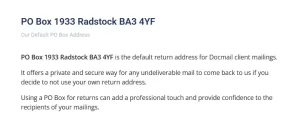
Docmail confirms that PO Box 1933 Radstock BA3 4YF is its default return address for client mailings.
This is why it would be misleading to say that PO Box 1933 belongs to one underlying sender.
A company can arrange for its correspondence to be printed and mailed through a third-party mailing service.
The return address can therefore belong to the mailing process while the organisation named inside the document remains responsible for the actual message.
Similar distinctions matter with other centralised postal addresses.
For example, PO Box 951 Newcastle upon Tyne appears in documented financial correspondence, but recipients still need to examine the contents and context of an individual letter before deciding what it means.
What Is Docmail?
Docmail provides mailing services that allow organisations to prepare and send physical correspondence without handling every stage of printing, enclosing and posting internally.
Its services can therefore be used by organisations sending significant volumes of letters.
For someone receiving a letter, there may consequently be two separate parties involved:
- Mailing Provider: The company involved in producing, processing or sending the physical correspondence
- Underlying Organisation: The business or organisation actually contacting the recipient
The organisation identified inside the letter is therefore normally more important than the PO Box printed on the envelope.
Does PO Box 1933 Belong To One Company?
Docmail officially identifies PO Box 1933 as its default return address, but this does not mean every letter displaying it originates directly from Docmail.
Different Docmail clients may use the default return arrangement.
For example, an organisation may send hundreds or thousands of customer letters through a mailing provider. If one cannot be delivered, the PO Box gives Royal Mail somewhere to return it.
The return address is therefore mainly part of the postal handling process.
This same principle is useful when identifying other unfamiliar postal addresses such as PO Box 17280 Birmingham.
The organisation named inside the correspondence generally provides stronger evidence about who is making contact than the PO Box alone.
Why Have I Received A Letter From PO Box 1933?
A person may receive a letter carrying PO Box 1933 Radstock because an organisation used Docmail to produce or process the mailing and did not provide a separate return address.
The reason for receiving the correspondence depends entirely on the organisation responsible for it.
It could relate to an existing account, customer relationship, healthcare service, financial matter, administrative notice, membership, appointment or another type of communication.
Recipients should check the following details before responding:
- Organisation Name: Identify the company, public body or other organisation shown inside the letter
- Reason For Contact: Check whether the correspondence clearly explains why it was sent
- Reference Number: Look for an account, case, customer or other reference that can be independently checked
- Recipient Details: Confirm that the name and postal address are correct
- Requested Action: Determine exactly what the sender wants the recipient to do
- Payment Details: Verify any request involving money before making a payment
- Personal Information: Be cautious about requests for banking or sensitive personal details
A useful comparison can also be made with PO Box 585 Belfast, where understanding the difference between a postal return address and the department responsible for the correspondence is similarly important.
How Can You Identify The Actual Sender?
Start with the contents of the letter rather than the address printed on the back of the envelope.
Look for an organisation name, company registration details, departmental information, account references or an explanation of an existing relationship.
Then verify the organisation independently.
For example, if the letter claims to come from a bank, use the bank’s official website, mobile application or a trusted telephone number already held by the recipient rather than depending entirely on contact information contained in an unexpected letter.
If the letter relates to a business, its identity may also be checked through recognised company information and official contact channels.
This additional verification is particularly important when the correspondence is unexpected.
Is PO Box 1933 Midsomer Norton Legitimate?
The documented PO Box 1933 Radstock BA3 4YF address is legitimate in the sense that Docmail publicly identifies it as its default return address for client mailings.
However, there is an important difference between establishing that a return address is genuine and establishing that a specific letter is genuine.
A real return address can appear on legitimate correspondence, but the address alone cannot confirm:
- Who Commissioned The Letter
- Whether Every Claim Is Correct
- Whether A Payment Request Is Genuine
- Whether Contact Details Are Authentic
- Whether The Recipient Actually Owes Money
- Whether Personal Information Should Be Provided
Recipients should therefore verify the individual communication rather than using the PO Box as proof of authenticity.
Is PO Box 1933 A Scam?
There is no reasonable basis for describing PO Box 1933 itself as a scam address because Docmail publicly documents its use as the default return address for client mailings.
That does not mean every communication showing a genuine address should automatically be trusted.
Criminals can imitate legitimate organisations, branding, addresses and professional-looking documents.
Royal Mail specifically warns people to be cautious about communications requesting payment or personal information and advises recipients of suspicious physical mail to report it through its scam-mail process.
Royal Mail explains how to recognise suspicious communications and what recipients should do with suspected scam mail.
Some warning signs include:
- Unexpected Payment Requests: Be cautious if money is demanded for an account, service or obligation that is not recognised
- Pressure To Act Quickly: Fraudsters may create artificial urgency to prevent proper checking
- Requests For Sensitive Details: Treat requests for banking credentials, passwords or security information with particular caution
- Unfamiliar Contact Details: Verify telephone numbers, websites and payment instructions independently
- Unclear Sender Identity: Investigate correspondence that does not clearly identify the organisation responsible
- Unusual Payment Methods: Be particularly careful if money must be transferred through unfamiliar or unexpected channels
- Conflicting Information: Different company names, addresses or account details can justify further investigation
A genuine-looking envelope should never be the only reason for trusting the contents.
How To Check Who Really Sent A Letter From PO Box 1933
Identifying the actual sender is usually easier when the letter is assessed systematically.
Check The Organisation Named In The Letter
Find the organisation prominently identified within the correspondence.
Check the:
- Company Or Organisation Name: Establish exactly who claims to be contacting the recipient
- Department Name: Look for a specific team or service
- Account Or Reference Number: Compare it with genuine previous correspondence where possible
- Reason For Contact: Confirm that the stated reason makes sense
- Previous Relationship: Consider whether the recipient has dealt with the organisation before
- Contact Information: Check whether the details correspond with independently verified information
Do not assume that Docmail is the organisation contacting the recipient simply because PO Box 1933 appears on the envelope.
Other centralised addresses can create the same confusion.
The discussion around PO Box 189 Huddersfield HD8 1DY similarly demonstrates why the organisation inside a letter can matter more than the postal processing address printed outside.
Verify Contact Details Independently
If there is any doubt about the letter, do not rely exclusively on the telephone number, QR code, web address or email address printed within it.
Instead, find the organisation through a recognised official channel.
Then ask whether:
- The Reference Number Is Valid: Confirm that the reference belongs to the organisation
- The Letter Was Issued By Them: Ask whether their records show the correspondence
- The Requested Action Is Genuine: Confirm what the recipient is actually required to do
- The Amount Is Correct: Verify any payment request before transferring money
- The Payment Details Are Correct: Check bank details separately if payment instructions have changed
Independent verification provides much stronger evidence than relying solely on PO Box 1933.
Be Careful With Requests For Money Or Personal Information
Unexpected payment demands deserve particular attention.
Do not assume that high-quality printing, professional wording, a familiar logo or a legitimate postal address proves that a request is authentic.
Before paying money:
- Confirm the Sender: Establish that the organisation really issued the letter
- Check the Account: Make sure the correspondence relates to a genuine account or obligation
- Verify the Amount: Confirm why the money is owed and whether the figure is correct
- Use A Separate Contact Route: Contact the organisation through independently sourced details
- Check Payment Information: Investigate unexpected changes to bank details
- Avoid Being Rushed: Legitimate verification should take priority over artificial urgency
The same precautions should be used before supplying sensitive personal information.
What Should You Do If You Suspect The Letter Is Fraudulent?
If a letter displaying PO Box 1933 appears suspicious, the safest course is to avoid acting until the sender has been independently confirmed.
Recipients should:
- Keep the Letter and Envelope: They may contain useful evidence if the correspondence needs to be investigated
- Do Not Pay Immediately: Verify unexpected demands before transferring money
- Protect Personal Information: Do not provide passwords, banking credentials or unnecessary identification details
- Contact The Organisation Independently: Use recognised contact information rather than questionable details printed in the correspondence
- Check Existing Accounts: Secure online accounts or previous genuine documents may confirm whether the communication relates to a real issue
- Report Suspected Scam Mail: Royal Mail provides a process for reporting suspicious physical mail delivered through the letterbox
- Act Quickly If Money Has Been Lost: Contact the relevant bank or financial provider immediately where fraudulent payments may have occurred
The existence of a genuine Docmail return address neither proves nor disproves the authenticity of an individual communication.
The specific sender, reason for contact and requested action must be assessed separately.
Conclusion
PO Box 1933 Midsomer Norton is commonly searched by people trying to understand correspondence displaying PO Box 1933 Radstock BA3 4YF.
The strongest first-party evidence comes directly from Docmail, which identifies the Radstock PO Box as its default return address for client mailings.
This means the address should normally be understood as part of the mail-handling process rather than as proof that Docmail itself is contacting the recipient.
Someone receiving a letter should therefore focus on the organisation named inside it, the reason for contact, any account or reference details and any action being requested.
The address itself has a legitimate documented purpose. However, individual letters should still be independently verified when they are unexpected, particularly when they request payment or sensitive personal information.
Frequently Asked Questions
Who Owns PO Box 1933, Midsomer Norton?
Docmail officially identifies PO Box 1933 Radstock BA3 4YF as its default return address for client mailings. The first-party information refers specifically to Radstock.
What Company Uses PO Box 1933 Radstock?
Docmail uses the address as a default return address for client mailings. Different organisations using Docmail may therefore have correspondence carrying the same return address.
Is PO Box 1933 BA3 4YF A Real Address?
Yes. Docmail publicly documents PO Box 1933 Radstock BA3 4YF as its default return PO Box.
Why Did I Receive A Letter From PO Box 1933?
An organisation may have used Docmail to produce or process its correspondence, with PO Box 1933 appearing as the return address. The actual reason for contact should be explained inside the letter.
Is A Letter From PO Box 1933 Genuine?
The return address has a documented legitimate use, but that alone cannot prove an individual letter is genuine. The named sender and any requests in the correspondence should be verified separately.
Is PO Box 1933 Connected To Docmail?
Yes. Docmail directly confirms that PO Box 1933 Radstock BA3 4YF is its default return address for client mailings.
Can Different Companies Use PO Box 1933?
Yes. Because Docmail describes it as a default return address for client mailings, correspondence carrying the address can potentially relate to different organisations rather than one exclusive sender.
How Can Someone Find Out Who Actually Sent The Letter?
Check the organisation named inside the correspondence and verify it through independently obtained official contact details. The PO Box should not be used on its own to identify the underlying sender.