
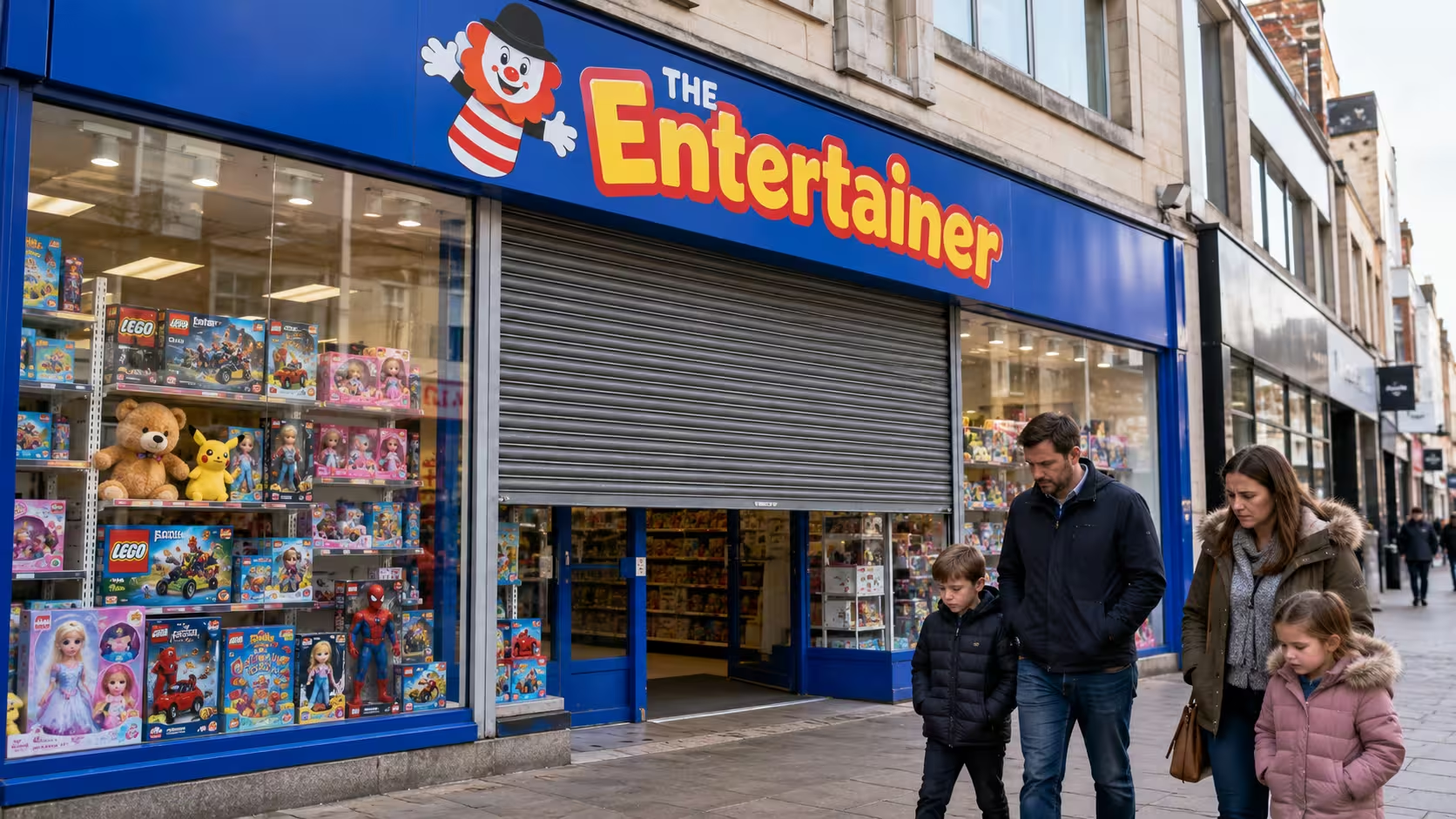
The UK toy chain Entertainer store closure story is not a nationwide shutdown. The retailer is closing selected branches where weaker footfall, lease costs and rising operating expenses make stores less viable.
At the same time, The Entertainer continues opening new locations, expanding through Tesco concessions and investing in larger store formats. This suggests the business is reshaping its store network rather than withdrawing from the UK market.
For customers and employees, the key point is that further individual closures may still happen where stores no longer perform strongly enough.
However, the company’s continued investment in new locations shows that physical retail remains an important part of its wider strategy.
Which Entertainer Stores Have Closed In 2025 And 2026?
The Entertainer has been reviewing individual locations rather than announcing a single nationwide closure programme. That distinction is important because several stores have closed while the retailer has continued opening others.
Entertainer Stores Closed In 2025
Several branches disappeared during 2025 as leases expired or locations stopped producing acceptable returns.
Store Location Closure Date Reported Position
Luton Point 25 January 2025 Store closed after its lease came to an end
Croydon Whitgift Centre 1 February 2025 Closure linked to the future of the shopping centre and location
Barrow-in-Furness 3 May 2025 Store was no longer considered profitable
Hartlepool 27 September 2025 Closure connected with the landlord’s redevelopment plans
Sheffield, The Moor 11 October 2025 Store closed following a clearance sale
The Luton store closed on 25 January and the Croydon branch followed on 1 February 2025. Barrow-in-Furness closed on 3 May after The Entertainer said difficult decisions sometimes had to be made where branches were no longer profitable.
Hartlepool subsequently closed on 27 September, while Sheffield’s branch on The Moor ended trading in October following discounts of up to 50% during its closing-down sale.
The pattern is similar to restructuring elsewhere on the British high street. The Poundland store closures have also demonstrated how retailers can remove weaker locations while continuing to trade across a much larger estate.
Entertainer Stores Closed In 2026
The closures continued into 2026.
Store Location Closure Timing Main Reason Reported
Dundee Wellgate 5 January 2026 Weak footfall and commercially unviable lease renewal
Preston St George's 5 January 2026 Lease renewal no longer commercially viable
Haywards Heath 6 January 2026 Store closure following years at Orchards Shopping Centre
Wakefield Trinity Walk January 2026 Lease renewal considered commercially unviable
Poole High Street January 2026 Lease not renewed
Wrexham Eagles Meadow Early 2026 Rising costs and changing shopping patterns
Kidderminster Swan Centre 7 February 2026 Costs growing faster than sales
Dundee provides one of the clearest examples of how individual location performance can determine whether a branch survives.
Chief executive Andrew Murphy said the problem was not Dundee itself but The Entertainer’s position inside the Wellgate Centre, where footfall had weakened significantly.
The Preston store closed on 5 January after the company concluded that renewing the lease was no longer commercially viable. The company nevertheless directed local customers towards its online shop and nearby Tesco concessions.
Kidderminster then closed on 7 February 2026. The company’s explanation was particularly significant because it summarised the wider pressures affecting its physical estate.
It said shopping patterns were changing while cost growth was exceeding increases in sales.
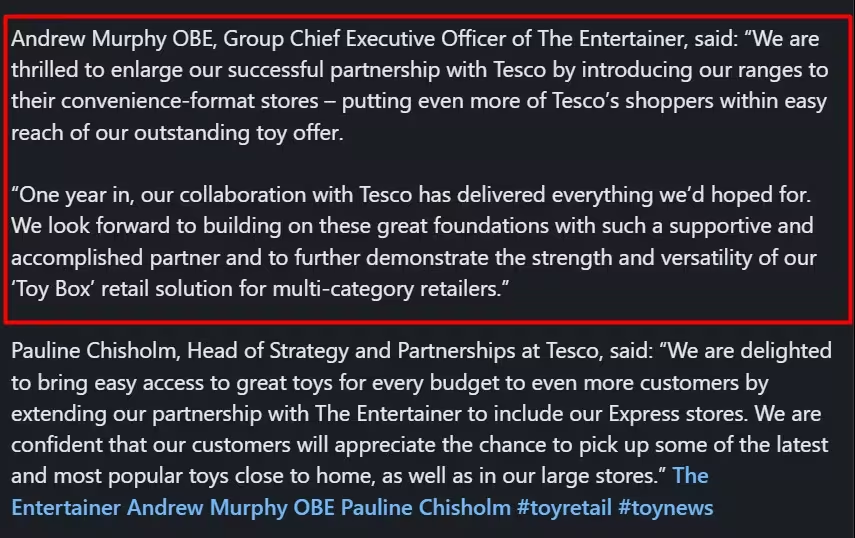
The Entertainer CEO Andrew Murphy highlights the retailer’s expanding Tesco partnership, bringing toys to more convenience stores across the UK.
Why Is The Entertainer Closing Some Of Its UK Stores?
There is no single reason behind every UK toy chain Entertainer store closure. Decisions appear to be made at the individual-store level depending on profitability, lease conditions and the quality of the location.
The most important factors include:
- Lease Renewal Costs: A store that works financially under one lease may become unattractive when the agreement expires and new terms have to be negotiated.
- Reduced Shopping Centre Footfall: Some locations have lost customers as surrounding shops close or shopping patterns move towards retail parks, supermarkets and online channels.
- Higher Employment Costs: Rising wages and employment-related costs increase the cost of operating labour-intensive physical stores.
- Business Rates Pressure: Large retailers with significant physical estates continue to argue that the business rates system places additional pressure on high street shops.
- Changing Shopping Habits: Families increasingly combine toy purchases with supermarket shopping or order products online rather than making a separate journey to a specialist toy shop.
- Store-Level Profitability: The Entertainer has made clear that branches which are no longer commercially sustainable can be closed even while the wider group continues growing.
Other retailers are making similar decisions. The Morrisons store closures in 2026 involve the removal of loss-making locations alongside continued investment elsewhere, showing how store closures do not always mean the wider business is withdrawing from a market.
What Are The Latest Official Updates From The Entertainer In 2026?
The company’s latest activity provides a much more complicated picture than the closure headlines suggest.
The Entertainer entered 2026 after reporting positive Christmas trading. Stores traded around 3.5% ahead of the previous year during the nine weeks to 3 January 2026.
By April, the retailer said UK retail sales had increased by more than 20% over the previous 12 months and announced another round of store investment.
Its strategy during 2026 has included:
- Opening New Stores: New locations and larger replacement stores have continued to appear.
- Closing Weaker Locations: Branches where leases or trading conditions no longer work financially have been removed.
- Testing New Formats: The company has introduced the Toys for Less outlet concept.
- Expanding Collectables: The Trafford Centre store includes the new DropZone concept aimed at collectibles and the growing adult toy market.
- Investing In Ecommerce: A new technology platform is being developed for launch in spring 2027.
- Restructuring Store Staffing: Some branches have experienced redundancies or reduced working hours as operating structures have changed.
In September 2026, The Entertainer announced a major ecommerce partnership with THG Commerce. The planned platform will include improved search, personalised recommendations, conversational product discovery and an upgraded Click & Collect experience.
That digital investment indicates that the retailer sees physical shops and ecommerce as complementary rather than competing parts of its future.
Is The Entertainer Going Out Of Business?
No evidence currently suggests that The Entertainer is shutting down its entire UK business.
That distinction is crucial.
A retailer going into administration or closing every branch looks very different from a company selectively removing stores while continuing to open new ones.
The collapse of The Original Factory Shop provides a useful contrast. That retailer ultimately closed its entire remaining estate after administrators were unable to secure a viable rescue.
The Entertainer, by comparison, has continued opening stores, developing its concession network and investing in digital infrastructure.
Its own website currently describes a network of 160 Entertainer stores alongside thousands of branded retail concessions.
Therefore, individual closing-down signs should not be interpreted as evidence that every Entertainer branch is about to disappear.
The more accurate description is that The Entertainer is reshaping its store estate.
Why Is The Entertainer Opening New Stores While Closing Others?
This apparent contradiction is actually central to understanding The Entertainer’s strategy.
Retailers do not necessarily want the largest possible number of shops. They want stores capable of producing sufficient sales and profit relative to rent, staffing, rates and other operating costs.
A weak location can therefore close while investment goes into a stronger destination elsewhere.
The Entertainer announced in April 2026 that its Cardiff St David’s store would move into a unit around 25% larger than its existing location. It also confirmed a new shop at Castleford’s Junction 32 outlet development and a large outlet store at The Galleria in Hatfield.
The Hatfield store opened as The Entertainer, Toys for Less, occupying around 8,000 sq ft and carrying more than 5,000 toys. It was almost twice the size of an average Entertainer shop.
Then, in September, the company opened at Manchester’s Trafford Centre. The new branch became its eighth opening within a 12-month period and carries thousands of toys, games and collectables.
This strategy resembles changes happening elsewhere in UK retail, where operators are concentrating on stronger locations while withdrawing from weaker ones.
The changing estate behind the M&S Leeds store closure similarly demonstrates how closing one branch does not automatically mean a retailer is leaving an entire city or market.
How Is The Entertainer Performing Financially?
The financial position requires more balance than simply describing the company as either struggling or financially strong.
The latest publicly reported full-year accounts showed Teal Group Holdings moving from profit into loss.
For the year ending 1 February 2025, the group recorded a pre-tax loss of approximately £10 million after reporting a profit of more than £6 million in the previous year.
The business also restructured its head office, resulting in 41 redundancies and the withdrawal of 15 roles that had been planned for recruitment.
However, those figures do not tell the entire story.
The company subsequently reported:
- Positive Christmas Store Trading: Stores were 3.5% ahead during the nine weeks to 3 January 2026.
- Strong UK Retail Sales Growth: Sales were reported to have increased by more than 20% over the 12 months leading up to April 2026.
- Continued Store Investment: New stores, relocations and large-format locations were announced despite individual closures.
This means The Entertainer has faced meaningful profitability and cost pressures, but the available evidence does not support describing it as a business in nationwide collapse.
As of 22 October 2026, Companies House still showed the relevant Entertainer company as active, with its next accounts due by 31 October 2026.
How Are Rising Business Rates And Employment Costs Affecting The Entertainer?
Physical retail businesses have to carry costs that can become particularly difficult when individual shops experience declining footfall.
For The Entertainer, employment costs and business rates have repeatedly emerged as concerns.
In October 2026, the company confirmed that redundancies and reduced working hours had affected stores including Wolverhampton, Walsall, Birmingham, Brierley Hill, West Bromwich, Lichfield, Sutton Coldfield and Cannock.
The company said it had been affected by the business rates burden and accelerating employment costs.
However, it also said the overall number of jobs across the affected stores had increased slightly because new roles had been introduced under the revised operating structure.
The Entertainer has also become involved in the wider debate around business rates reform.
In October 2026, it was among more than 200 business leaders supporting proposals for a 2% levy on eligible online sales that supporters argue could help finance lower property-based business rates.
The proposal remains a policy campaign rather than an implemented tax change, but The Entertainer’s involvement makes its position clear. The company wants the cost structure facing physical retailers to be reconsidered as more shopping shifts online.
What Has Changed With The Entertainer’s Tesco And Concession Strategy?
One of the biggest changes to The Entertainer’s business model has occurred away from its traditional high street stores.
The retailer has expanded heavily through concessions, particularly inside Tesco.
Its current company information lists:
- 160 The Entertainer Stores
- 2,719 Tesco Stores With Branded Concessions
- 140 Matalan Stores
- Marks & Spencer Early Learning Centre Concessions
- Around 7,000 Products Available Online
This creates an important alternative to opening a standalone shop in every town.
A dedicated store requires its own lease, rates, utilities, management structure and full staffing model. A concession can place The Entertainer’s products in an existing retailer where customers are already shopping.
That does not mean concessions will replace every specialist toy shop. The company’s continued investment in larger stores demonstrates that physical branches remain an important part of its strategy.
Instead, the model allows The Entertainer to reach customers through several channels at once.
How Has Employee Ownership Changed The Entertainer?
Another important change is that The Entertainer is no longer simply the Grant family’s privately owned retail business.
Gary and Catherine Grant founded the company in 1981 and spent more than four decades building it into one of Britain’s largest specialist toy retailers.
During 2025, the family transferred ownership into an Employee Ownership Trust.
The company now describes itself as employee-owned, meaning staff can have a greater interest in the business’s long-term performance and may benefit financially from future success.
Employee ownership, however, does not eliminate commercial realities.
Stores still have to generate sufficient sales to justify their costs. The closures that followed the ownership transition therefore show that employee ownership and difficult restructuring decisions can exist at the same time.
The October 2026 staffing changes further demonstrate this point. Some jobs and working hours were reduced even though the overall business continued opening stores and creating other positions.
The Entertainer founder Gary Grant explains the decision to transfer family ownership to an employee trust, giving staff a stake in the company’s future.
What Do The Store Closures Mean For Employees And Local Communities?
For customers, an Entertainer closure can mean losing one of the few remaining specialist toy shops in a town centre.
For employees, the consequences can be much more serious.
The company has frequently acknowledged the impact closures have on staff when announcing local decisions. At Kidderminster and Preston, for example, its statements specifically expressed regret about colleagues being affected.
The local effects can include:
- Loss of Retail Jobs: Some employees may face redundancy when a branch closes.
- Reduced Town Centre Choice: Families lose access to a specialist toy retailer.
- More Empty Retail Units: Closures can contribute to vacancy problems in already struggling shopping centres.
- Lower Footfall For Nearby Businesses: Losing a recognised national retailer may reduce reasons for families to visit a particular shopping area.
- Greater Dependence On Online Shopping: Customers may need to use ecommerce or travel to another branch.
- More Reliance On Concessions: Tesco and other retail partnerships increasingly become the local alternative.
Dundee illustrates the wider issue particularly clearly. Months after The Entertainer left the Wellgate Centre, reports indicated that nearly half the units were empty.
That demonstrates why a store closure can matter beyond the retailer involved.
The same problems can be seen in other restructuring stories, including the TG Jones closures, where changing retail economics have placed further pressure on traditional town-centre estates.
What Is The Entertainer Planning For Its Stores In The Future?
The available evidence suggests that The Entertainer intends to remain a substantial physical retailer, but the type and location of those stores are likely to keep changing.
Its future strategy appears to centre on several areas.
- Stronger Destination Stores: Investment is moving towards shopping centres and destinations capable of generating reliable footfall.
- Larger Store Formats: Hatfield and Cardiff show that the company is prepared to increase store size when it believes the location can support it.
- Outlet Retailing: The Toys for Less format introduces a different proposition built around discounted products.
- Collectables And Adult Customers: The DropZone concept indicates growing attention towards the expanding collectibles and adult enthusiast market.
- Tesco And Third-Party Concessions: These partnerships allow the brand to reach consumers without relying entirely on standalone leases.
- Improved Ecommerce: The new digital platform planned for spring 2027 is designed to make product discovery, personalisation and Click & Collect more effective.
The company has also shown that it will walk away from partnerships where the commercial model does not fit.
In July 2026, The Entertainer withdrew from trial arrangements involving TG Jones and Hobbycraft.
Chief executive Andrew Murphy said the Hobbycraft trial had performed successfully in sales terms but could not progress because the parties disagreed about the breadth of the range that should be offered.
That suggests future growth is likely to be selective rather than expansion for expansion’s sake.
What Does The Entertainer Store Restructuring Say About UK High Streets?
The Entertainer’s experience reflects a broader structural change affecting British retail.
A high street shop now has to compete not only with nearby stores but also with supermarkets, retail parks, online marketplaces, social commerce and next-day home delivery.
At the same time, physical businesses have to manage rent, rates, wages, energy costs, stock, insurance and staffing.
The challenge is particularly serious when footfall declines, but many of those costs remain fixed.
This helps explain why the UK is seeing two apparently conflicting trends at once. Retailers can close dozens of weak stores while still investing heavily in new locations that offer stronger traffic and better economics.
The difficulties facing The Entertainer therefore differ significantly from outright retail collapses such as Claire’s Accessories’ collapse.
The Entertainer is still opening shops, developing new formats and spending on technology, even while removing individual branches that no longer work financially.
The British high street is consequently not disappearing in one simple direction. Instead, retailers are becoming much more selective about where physical stores can justify their costs.
Conclusion
The UK toy chain Entertainer store closure story is best understood as a restructuring of the retailer’s physical estate rather than the disappearance of The Entertainer itself.
Branches in several towns have closed during 2025 and 2026 because of lease decisions, falling footfall, changing shopping patterns and rising operating costs. For affected employees and communities, those closures remain significant.
However, the wider company is taking a different path from retailers that have entered administration and closed their entire estates.
The Entertainer has simultaneously opened stores, launched a major outlet format, expanded its presence through Tesco and other retailers, entered employee ownership and committed to a substantial ecommerce upgrade.
The most important development to watch is therefore not simply how many Entertainer shops close.
It is where the company chooses to close, where it continues to invest and whether its larger stores, concessions and digital strategy can deliver sustainable profitability as UK retail costs continue to rise.
Frequently Asked Questions
Is The Entertainer Closing Down Completely?
No. Individual Entertainer branches have closed, but the company continues operating a large UK store network, opening new locations and expanding through concessions and online retail.
Which Entertainer Stores Closed In 2026?
Reported 2026 closures include Dundee, Preston, Haywards Heath, Wakefield, Poole, Wrexham and Kidderminster. Closure dates and circumstances differ by location.
Why Is The Entertainer Closing Stores?
The company has cited factors including commercially unviable lease renewals, changing shopping patterns, weak local footfall and operating costs increasing faster than sales.
Is The Entertainer In Financial Trouble?
The latest publicly reported full-year accounts showed a pre-tax loss, so the company has faced genuine financial pressure. However, it has subsequently reported sales growth and continued opening and investing in stores, meaning the position is more complex than a simple collapse.
Is The Entertainer Still Opening New Stores?
Yes. During 2026 the retailer has invested in locations including Hatfield, Cardiff, Castleford and Manchester’s Trafford Centre while continuing to review weaker branches.
How Many Tesco Stores Have The Entertainer Toy Sections?
The Entertainer’s current company information states that its branded concessions are present in 2,719 Tesco stores, alongside its standalone shops and other retail partnerships.
Who Owns The Entertainer Now?
The Entertainer became employee-owned during 2025 after the Grant family transferred its ownership into an Employee Ownership Trust. Employees are now beneficiaries of the trust and have an interest in the company’s future success.