

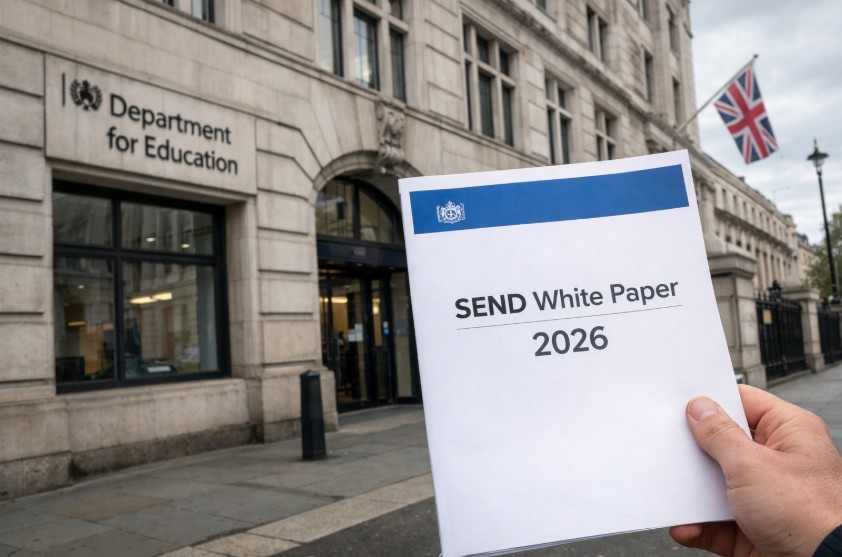
The SEND white paper 2026 sets out a long term plan to reform England’s special educational needs and disabilities system by reserving Education, Health and Care Plans for the most complex cases by 2035, while strengthening mainstream support for all other pupils.
It introduces a layered model of provision, new Individual Support Plans, and significant investment to make inclusion routine rather than contested.
Key takeaways:
- EHCPs will be focused on children with the highest level of specialist need by 2035
- From 2029, transition points will trigger reassessment against new thresholds
- A universal offer and three layers of support will guide provision in schools
- £4 billion will fund inclusive mainstream support and specialist expertise
- Greater accountability will apply to schools, councils and health partners
The reforms aim to rebuild parental trust and create a more sustainable SEND system.
What Is the SEND White Paper 2026 and Why Has It Been Introduced?

The SEND white paper 2026 forms part of the government’s wider schools reform programme titled Every Child Achieving and Thriving.
It sets out a vision to improve outcomes for children and young people by reshaping both mainstream education and the SEND system in England.
At its core, the white paper responds to longstanding concerns that the current system is inconsistent, adversarial and financially unsustainable.
Ministers describe a structure in which families often feel they must fight for support, while schools and local authorities struggle to manage rising demand and high needs deficits.
The government’s ambition includes:
- Shifting school experiences from narrow to broad
- Ensuring children who have been sidelined are included
- Encouraging communities to engage more actively with schools
- Making support available earlier and more routinely
The SEND reform consultation titled Putting Children and Young People First accompanies the white paper and seeks views from parents, professionals and sector leaders. Alongside this, the 6,500 additional teachers delivery plan signals a parallel commitment to workforce capacity.
Together, these proposals position the SEND white paper 2026 as both a structural reform and a cultural reset designed to place inclusion at the centre of mainstream education.
Why Is the Current SEND System in England Considered Unsustainable?
The current SEND system in England has faced mounting pressure over the past decade. The number of Education, Health and Care Plans has more than doubled, placing financial strain on local authorities and increasing reliance on tribunal appeals to resolve disputes.
Many parents report delays in assessment and a perception that support is provided too late. Parliamentary scrutiny has described the system as broken but not beyond repair, highlighting examples of inclusive practice that could be scaled nationally.
At the same time, high needs funding deficits have grown, and mainstream schools have expressed concerns about capacity and specialist expertise.
The combination of rising demand, inconsistent provision and strained budgets has prompted calls for systemic reform, culminating in the SEND white paper 2026.
How Will the SEND White Paper 2026 Change Education, Health and Care Plans (EHCPs)?

The SEND white paper 2026 proposes significant changes to the role and scope of Education, Health and Care Plans within England’s education framework. EHCPs will remain a legal document, but their purpose and eligibility criteria are expected to shift over time.
Under the new framework, EHCPs will sit within a broader tiered system of support. They will no longer be the primary gateway to additional help.
Instead, mainstream schools will take on greater responsibility for delivering structured support through Individual Support Plans, with EHCPs reserved for specialist cases.
Will EHCPs Be Reserved for the Most Complex Cases by 2035?
Yes, the government’s stated ambition is that by 2035, EHCPs will be reserved for children with the most complex needs who require specialist provision packages. This represents a major change in how statutory support is allocated.
Key elements include:
- A new threshold for specialist provision linked to the highest level of need
- Reassessment of pupils with EHCPs at key transition points from 2029
- Protection for certain age groups to ensure continuity during the transition
- Digitisation of plans to improve transparency and accountability
Children currently in Year 3 and above are expected to retain their existing EHCP until at least age 16. Younger cohorts will be reassessed at transition between primary and secondary phases.
Importantly, the government anticipates that EHCP numbers may continue rising in the short term before gradually returning to current levels by 2035.
The intention is not to remove support, but to rebalance it so that mainstream provision becomes more inclusive and capable of meeting a wider range of needs without formal statutory plans.
What Happens to Children Who No Longer Qualify for an EHCP?
For children who do not meet the revised threshold for specialist provision, the SEND white paper 2026 introduces Individual Support Plans.
These plans will be developed by schools in consultation with parents and will outline needs, support strategies and intended outcomes.
All children with SEND will have a legal right to an Individual Support Plan, even if they do not hold an EHCP. This shifts responsibility more directly onto schools and early years settings.
Key features include:
- Plans created and reviewed at school level
- Clear documentation of targeted and targeted plus interventions
- Digital and accessible formats
- Ongoing collaboration with families
Where a council determines that an EHCP is not required, it will be expected to work with the school to ensure appropriate support is in place. Parents will retain the right to appeal certain decisions to the SEND tribunal, which remains the final route for dispute resolution.
This approach aims to reduce adversarial processes and make support available without prolonged legal challenges, aligning with the wider objective of delivering help as routine rather than exceptional.
What Is the DfE’s New Layered Reform Approach to SEND Support?

The Department for Education proposes a layered system designed to provide flexible and graduated support.
Rather than relying primarily on EHCP status, the new model establishes a universal offer for all pupils and three additional layers that can be accessed as needs evolve.
This structure is intended to create clarity for schools and families while standardising expectations across England.
What Is the Universal Offer in Mainstream Schools?
The universal offer forms the foundation of the SEND white paper 2026 reforms. It sets a national baseline for inclusive practice in mainstream schools and colleges.
It includes:
- Inclusive leadership and governance planning
- Evidence based classroom strategies
- Strong partnerships with families and wider services
- A requirement for staff training in SEND and inclusion
The updated SEND code of practice will support these standards, with additional guidance on areas such as speech and language, social and emotional development and mental health needs.
Schools will also be required to produce an annual inclusion strategy, replacing existing SEN information reports. Ofsted will assess how effectively these strategies are embedded in practice.
How Will the Three Layers of Support Work?
Beyond the universal offer, three interlocking layers will provide graduated support.
Targeted support will address ongoing and commonly occurring needs that cannot be met through universal provision alone. This may include small group interventions or curriculum adjustments and will be documented in an Individual Support Plan.
Targeted plus support will enable schools to draw on the Experts at Hand service. This includes access to educational psychologists, speech and language therapists and other specialists commissioned locally. Short term placements in specialist settings may also be used where appropriate.
Specialist support will apply to children with the most complex needs. Specialist provision packages will outline evidence based interventions, and only pupils at this level will be entitled to an EHCP under the reformed system.
Children will be able to move between layers as their needs change, ensuring flexibility and continuity.
What Are Individual Support Plans (ISPs) and How Do They Differ from EHCPs?

Individual Support Plans are central to the SEND white paper 2026. They are designed to ensure that all pupils with SEND receive structured and documented support, regardless of whether they qualify for an EHCP.
Unlike EHCPs, ISPs will be:
- Created and managed by schools rather than local authorities
- Focused on practical classroom and targeted interventions
- Digital and regularly reviewed
- Accessible to parents and carers
EHCPs will remain statutory documents with legal protections and will apply to specialist cases only. They will outline high level provision and placement decisions agreed with the local authority.
The following table summarises the distinction:
| Feature | EHCP | Individual Support Plan |
|---|---|---|
| Eligibility | Most complex needs | All pupils with SEND |
| Legal status | Statutory document | School led plan with legal entitlement |
| Responsibility | Local authority | School or setting |
| Purpose | Specialist provision and placement | Targeted and graduated support |
Together, ISPs and EHCPs form a tiered documentation system aligned with the new layered approach.
What Does the £4 Billion Investment Mean for Schools and Families?
The SEND white paper 2026 is backed by a £4 billion investment over three years to strengthen mainstream inclusion and specialist capacity.
The funding includes £1.6 billion for an Inclusive Mainstream Fund to support early intervention and targeted group work. A further £1.8 billion will establish the Experts at Hand service, ensuring access to specialist professionals in every area regardless of EHCP status.
Additional commitments include over £200 million for Best Start Family Hubs to deliver SEND outreach and £200 million to help local authorities transition to the new system. Capital investment will create 60,000 new specialist places, alongside training for every teacher in SEND practice. For families, the funding signals a shift towards earlier support delivered locally.
Prime Minister Keir Starmer acknowledged the strain families have experienced under the current system.
He said he has heard “first hand the struggles and exhaustion faced by too many parents who feel they have to fight the system to get their child the support they need.”
He added that “getting the right support should never be a battle – it should be a given,” signalling the government’s intention to move away from what he described as a one size fits all approach.
Education Secretary Bridget Phillipson described the reforms as a watershed moment.
She said children with SEND “deserve a system that lifts them up, and that puts no limit on what they can go on to achieve.”
She emphasised that support should be available “in their local school, without families having to fight.”
How Will Local Authorities and Integrated Care Boards Be Affected?
Local authorities will retain responsibility for statutory EHCP decisions but will operate within a rebalanced funding framework. High needs funding will be redirected more directly into school budgets to support inclusion at scale.
Key changes include:
- Commissioning of local specialist services in partnership with Integrated Care Boards
- Conditions attached to inclusion funding to ensure effective use
- A requirement to collaborate within local SEND clusters
- Stronger accountability through oversight from the Children’s Commissioner
Councils will also be expected to modernise complaints processes and adopt digital systems for plan management. Independent special schools will face tighter regulation, with new powers enabling the Secretary of State to refuse expansion where demand is not evidenced.
These measures aim to align financial incentives with inclusive practice while strengthening cross sector collaboration.
How Will Complaints, Mediation, and SEND Tribunals Change?

The SEND white paper 2026 recognises that disputes and tribunal appeals have become increasingly common. To address this, reforms will prioritise earlier resolution and improved transparency.
Proposals include:
- Strengthened mediation services commissioned by councils
- Improved complaints procedures within mainstream schools and colleges
- Digital systems for handling disputes and tracking outcomes
- Continued access to the SEND tribunal as a last resort
Parents will retain the right to appeal decisions about needs assessments and specialist thresholds. However, the expectation is that clearer standards and earlier intervention will reduce the need for formal appeals.
Independent scrutiny of complaints data will also be explored to ensure accountability and rebuild trust between families and public services.
What Could the SEND White Paper 2026 Mean by 2035?
By 2035, the SEND white paper 2026 aims to create a system in which mainstream inclusion is the norm and EHCPs are focused on the most complex needs. Specialist provision packages and local expertise will support pupils closer to home, reducing reliance on distant placements.
The government expects EHCP numbers to stabilise at sustainable levels while maintaining legal protections for those who require them. If implemented as planned, the reforms could replace an adversarial culture with a graduated and collaborative model of support.
The long term success of this vision will depend on consistent funding, effective oversight and sustained workforce development.
What Are the Concerns and Criticisms Surrounding the SEND White Paper 2026?

While many welcome the ambition of the SEND white paper 2026, concerns remain about implementation and rights protection. Parliamentary scrutiny has emphasised the need for cast iron guarantees that children’s legal entitlements will be strengthened rather than reduced.
Parents have expressed anxiety about revised EHCP thresholds and whether mainstream schools will have sufficient capacity. Questions also persist about accountability for health services within the integrated model.
Critics argue that without adequate resourcing and cultural change, structural reform alone may not rebuild trust. Ongoing oversight by the Education Committee and the Children’s Commissioner will therefore play a crucial role.
Responding to the proposals, Education Committee Chair Helen Hayes MP said;
England’s “broken SEND support system has let down children, families, teachers and the other professionals who work with them for too long.” However, she also stated that the system “is not beyond repair,” highlighting examples of inclusive practice both in England and abroad.
She warned that parents would need reassurance that proposed changes to EHCPs would strengthen rights rather than erode them.
She made clear that she would be looking for “cast iron guarantees” that children’s entitlements remain protected and that health authorities are held accountable for their role in the SEND system.
Conclusion
The SEND white paper 2026 represents one of the most significant reforms to England’s special educational needs system in a generation. By reshaping EHCP eligibility, introducing Individual Support Plans and embedding a layered model of support, it seeks to move from crisis management to early intervention and inclusion.
Backed by substantial investment and new accountability measures, the reforms aim to end the perception that families must fight for help. Yet the success of this transformation will depend on careful implementation, sustained funding and transparent oversight.
If delivered effectively, the SEND white paper 2026 could reshape Education, Health and Care Plans by 2035 and create a more balanced and inclusive framework for children, schools and local authorities across England.
FAQs
What is the main goal of the SEND white paper 2026?
The main goal is to reform the SEND system, so support is delivered earlier and more consistently in mainstream schools. It also aims to reserve EHCPs for the most complex cases by 2035.
When will the new SEND reforms begin?
Many changes are expected to begin from 2029, particularly reassessments at transition points. Legislation will be introduced at the earliest opportunity to underpin the reforms.
Will parents still be able to appeal decisions?
Yes, parents will continue to have access to the SEND tribunal if disputes cannot be resolved locally. Mediation services will be strengthened to reduce the need for formal appeals.
What is an Individual Support Plan?
An Individual Support Plan is a school led document outlining a child’s needs and targeted support. It will apply to all pupils with SEND, not just those with EHCPs.
How will schools be held accountable under the new system?
Schools will be required to publish annual inclusion strategies and follow national standards. Ofsted will assess how effectively inclusion is delivered in practice.
What role will health services play in the reforms?
Integrated Care Boards will work with councils to commission specialist services locally. Health professionals will contribute through the Experts at Hand model.
Will special schools continue under the new system?
Yes, specialist provision will remain for children with the most complex needs. There will also be a review of curriculum practice and stronger oversight of independent special schools.