
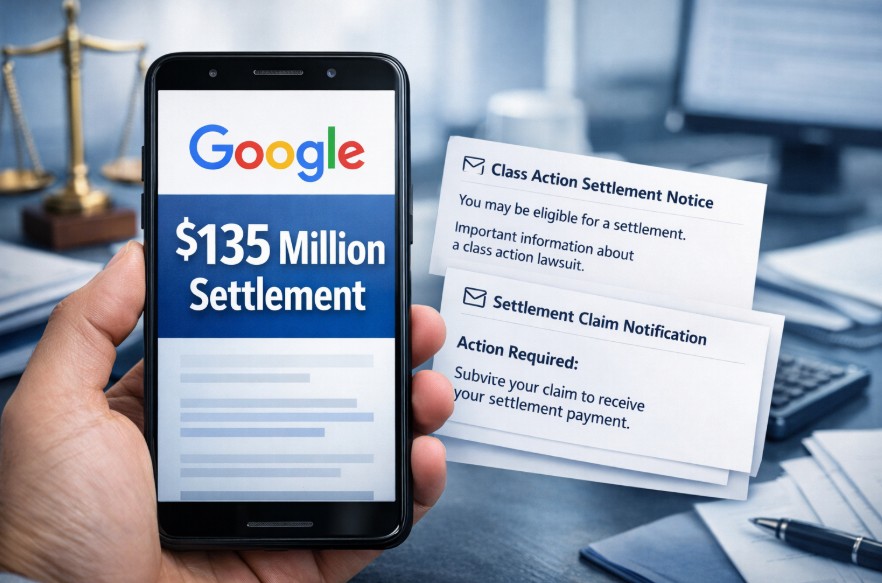
If you used an Android phone with a mobile data plan in the United States at any point since 12 November 2017, you may qualify for part of Google’s $135 million Android settlement.
The case claims that Android devices sent information to Google in the background without clear permission, even when the phone was not actively being used. Google denies any wrongdoing, but agreed to settle rather than continue the lawsuit.
Key points you need to know:
- You must be a US resident who used an Android phone with cellular data since 12 November 2017.
- California residents who were part of a separate lawsuit are not included.
- You may have received a Notice ID and Confirmation Code by email or post.
- The final approval hearing is scheduled for 23 June 2026.
- You must choose a payment method to receive any money.
- Most payouts are expected to be small, although some reports suggest payments could be capped at $100 per person.
What Is the $135 Million Google Android Settlement?
The $135 million Google Android settlement is a proposed class action agreement between Google and millions of Android users across the United States.
The lawsuit alleged that Google programmed Android phones to send data back to the company without proper user consent.
According to the claims, these data transfers happened quietly in the background, even when your phone was idle, your apps were closed, your screen was locked or location settings had been turned off.
The lawsuit argued that this process used mobile data that users had already paid for through their phone plans. The settlement does not mean the court has decided Google broke the law.
Instead, it is an agreement reached before trial to avoid a longer and more expensive legal fight. Around 100 million Android users may be covered by the settlement if it receives final approval from the court in June 2026.
Who Is Eligible for the Google Android Settlement?
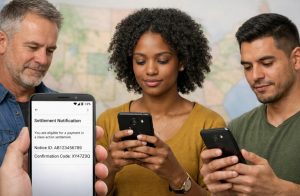
To qualify for the Google Android settlement, you must meet several conditions linked to where you live, what type of phone you used and when you used it. The settlement is broad, but not every Android owner will automatically qualify.
Do You Need To Be A US Resident To Qualify?
Yes. You must have been living in the United States while using an Android device with a cellular data plan.
The settlement only covers people in the US because the legal case was filed as a nationwide American class action. If you live in the UK, Europe or another country, you cannot claim compensation from this settlement, even if you used an Android phone during the same period.
To qualify, you generally need to be:
- An individual rather than a business
- Based in the United States
- Using an Android device on a mobile network
The lawsuit covers people who paid for cellular data through a mobile carrier. Using Android only over Wi-Fi is not enough to qualify because the lawsuit focused on mobile data allegedly being used without permission.
Which Android Users Since November 2017 Are Included?
You may be included if you used an Android device with a cellular data plan at any time from 12 November 2017 onwards.
This does not only apply to current Android users. Even if you changed phones years ago, you could still qualify if you used Android during the period covered by the settlement.
The following people are likely to be included:
- Anyone who used an Android smartphone between 12 November 2017 and the date of final court approval
- People who connected to the internet using mobile data rather than only Wi-Fi
- Users whose devices may have sent information to Google in the background
- People who received a settlement email or letter with a Notice ID and Confirmation Code
You do not necessarily need to prove exactly how much data was used. Most eligible users are expected to be included automatically if their information matches Google’s records.
One claimant explained why the case gained attention:
“The transfers occur in the background, without any notice to the user. They can happen even when the phone is completely idle. Most people had no idea this was taking place.”
That statement reflects one of the main concerns raised in the lawsuit, many Android users believed no data was being sent while their phones were inactive.
Who Is Excluded From The Settlement?
Not everyone who used Android can receive a payment.
You are likely to be excluded if:
- You lived outside the United States
- You only used Android devices over Wi-Fi
- You never had a cellular data plan
- You were already part of the earlier California Android settlement
- You choose to opt out of the case before the deadline
California residents are excluded because a separate legal case already resulted in a different settlement for people in that state.
The excluded California case is commonly referred to as Csupo v Google LLC. If you were part of that case, you cannot also receive money from this nationwide settlement. Google has said that the settlement only applies to a defined group of users.
A company spokesperson stated:
“We are pleased to resolve this case, which mischaracterised standard industry practices that keep Android safe.”
The company still denies that its actions were unlawful, even while agreeing to pay the settlement amount.
Why Did Google Agree To Settle The Android Lawsuit?
Google agreed to settle because continuing the case would have been expensive, time-consuming and uncertain for both sides. The lawsuit had been moving through the courts since 2020 and was heading towards trial.
By agreeing to a $135 million settlement, Google avoids the risk of a larger financial judgement if it lost in court. The settlement also allows the company to end the dispute without formally admitting that it did anything wrong.
Court filings suggest both sides wanted to avoid:
- Years of additional legal arguments
- The cost of expert witnesses and trial preparation
- Uncertainty about what a jury might decide
- Further public attention around Android data collection
The agreement also includes changes to how Google explains its data practices. Google is expected to make it easier for Android users to understand what information may be transferred and to give clearer choices during phone setup.
One of the lawyers representing users said:
“Settlement Class Counsel believes that the settlement is best for all settlement class members. It avoids the costs and uncertainty of a trial while still providing compensation.”
That reflects the central reason behind the agreement: neither side wanted the case to continue for several more years.
What Did The Lawsuit Claim About Android Data Collection?

The lawsuit claimed that Android phones transferred information to Google in the background without properly informing users. According to the complaint, these transfers happened even when people believed their phones were inactive.
Users alleged that Android devices continued sending data when:
- The screen was locked
- Google apps were closed
- The phone was sitting idle
- Location services had been switched off
The legal claim was not simply about privacy. It also argued that these hidden transfers consumed mobile data that users had purchased from their network providers. Plaintiffs said the information helped Google improve its services, advertising systems and product development.
In their view, Android users were paying for data they never knowingly agreed to share. Google rejected those allegations and said the lawsuit misunderstood how Android works.
Did Google Admit Any Wrongdoing?
No. Google has repeatedly denied doing anything improper. The company agreed to settle the case, but the settlement documents make clear that Google is not admitting fault, liability or any breach of law.
This is common in major class action settlements, particularly when companies want to avoid a lengthy court battle. Google says the case misrepresented normal Android functions.
The company argued that some background data transfers are standard across smartphones and are used to keep devices secure, reliable and up to date.
However, agreeing to pay $135 million means Google has decided it is better to resolve the dispute than continue defending itself in court.
The settlement documents specifically state that:
- Google does not admit the allegations are true
- The court has not ruled that Google acted unlawfully
- The settlement should not be treated as proof of wrongdoing
At the same time, Google has agreed to improve disclosures and provide clearer consent options for Android users in future.
How Much Could You Receive From The Settlement?
The exact amount you could receive is still unknown. The final payment depends on how many people qualify and how many valid claims are made.
There are roughly 100 million possible class members. Once legal fees, taxes, administration costs and court expenses are deducted from the $135 million fund, the remaining money will be divided between eligible users. Current reports suggest most people may receive only a small amount.
Some estimates place the likely payment at around:
- $1 to $1.50 per person if a very large number of people participate
- Up to $100 in rare cases if fewer people submit claims
- A different amount depending on whether the court approves all costs and fees
The settlement is designed as a shared fund, which means every eligible person receives a proportionate amount rather than a fixed payment.
Because the number of potential claimants is so high, you should not expect a large payout. The more people who participate, the smaller the individual payment becomes.
Still, if you qualify, it may be worth completing the process because no formal claim form appears to be required beyond choosing your payment option.
How Can You Check Whether You Are Included?
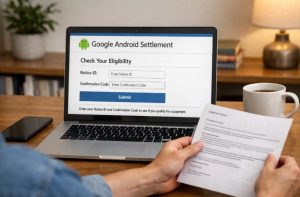
If you think you may qualify, the next step is to confirm whether you are already part of the settlement class. Most eligible Android users should have received some form of notification.
What Should You Do If You Received An Email Or Letter?
If you received an email or letter about the Google Android settlement, you should not ignore it. The notice usually includes two important details: your Notice ID and your Confirmation Code.
You will need both pieces of information to log into the official settlement website and choose how you would like to receive your payment.
The notice may arrive by email, through the post or as a message sent to the address linked to your Android account. Once you receive it, read the information carefully and make sure your personal details are correct.
It is important to keep your Notice ID and Confirmation Code in a safe place because you may need them later if you have any problems accessing your account.
After checking your details, you should choose your preferred payment method before the deadline. In most cases, if you have already received an official notice, you will not need to provide any extra documents or evidence.
What If You Did Not Receive A Notice ID Or Confirmation Code?
Not receiving a notice does not automatically mean you are excluded. Some people may qualify but never receive an email or letter because they changed address, switched email accounts or the notice was filtered as spam.
If you believe you used an Android phone with cellular data in the US after 12 November 2017, you should still check.
You can try the following:
- Search your email inbox and spam folder
- Check older email accounts linked to your Android device
- Visit the official settlement website
- Contact the settlement administrator directly
The settlement administrator may be able to confirm your eligibility using information such as your name, former address or mobile phone details. Many people are in this position because they no longer use the same Android phone they had in 2017 or 2018.
How Can You Contact The Settlement Administrator?
If you are unsure whether you qualify, the settlement administrator can help. You can contact the administrator by telephone, email or post. The main helpline number is 1-844-655-4255.
You may be asked for:
- Your full name
- Your previous address
- Information about your Android device
- The period when you used your phone
The administrator can tell you whether you are already included and whether you need to do anything else.
According to the settlement information, around 100 million people could qualify. Because of that, it may take time for calls and emails to be answered, so it is sensible to check as early as possible.
How Can You File A Claim And Choose A Payment Method?
Unlike many class action cases, this settlement does not require most people to complete a long claim form. Instead, eligible users mainly need to confirm how they would like to be paid.
After entering your Notice ID and Confirmation Code on the settlement website, you can choose from several payment methods.
These may include:
- PayPal
- Venmo
- Zelle
- ACH bank transfer
- Virtual Mastercard
If you do not choose a payment method, the administrator may still try to send your payment automatically. However, there is a risk that the payment could fail or be lost if your details are outdated.
To avoid problems, you should:
- Log in as soon as possible
- Confirm your contact details
- Select your preferred payment method
- Save any confirmation message
You do not need to prove how much mobile data your Android phone used. The settlement is based on whether you were part of the covered group of users.
Google has also agreed to make future Android setup screens clearer, so users can better understand what information may be shared.
When Will The Google Android Settlement Be Paid?
The settlement will not be paid immediately. Before any money can be sent, the court must approve the agreement.
A final approval hearing is scheduled for 23 June 2026. During that hearing, the judge will decide whether the settlement is fair and should go ahead.
If the court approves the settlement, payments are likely to be sent afterwards. However, there could still be a delay if there are objections, appeals or administrative issues.
The process normally works in this order:
- Final approval hearing
- Deduction of legal fees and administration costs
- Calculation of individual payments
- Distribution to users who selected a payment method
Because millions of people may qualify, the full payment process could take several weeks or months after the hearing. At the moment, there is no confirmed payment date beyond the fact that no money will be issued before the court grants approval.
Can You Opt Out Of The Settlement And What Happens If You Do?

You have the right to opt out of the settlement if you do not want to be part of it. However, choosing to opt out can affect whether you receive money or keep the right to sue Google yourself.
What Happens If You Stay In The Settlement?
If you remain in the settlement, you may receive a payment once the court approves the case and the funds are distributed.
By staying in the settlement:
- You keep your right to receive money
- You do not need to start your own legal case
- You give up the right to sue Google separately over the same issue
For most people, remaining in the settlement is the simplest option because the likely payment may be small, and bringing an individual case would probably cost far more.
What Happens If You Choose To Opt Out?
If you opt out, you will not receive any payment from the settlement fund. However, opting out means you keep the legal right to bring your own claim against Google in future.
Some people choose this option if they believe they suffered greater losses than the settlement would cover. If you want to opt out, you normally need to send a written request before the deadline.
That request must usually include:
- Your full name and address
- A statement saying you want to be excluded
- Your signature
The opt-out deadline is expected to fall before the June 2026 hearing. Some reports say the exclusion deadline is 29 May 2026.
When Could Opting Out Make Sense?
For most people, opting out probably does not make financial sense because the legal costs of an individual lawsuit would likely be much higher than the value of any claim.
Still, opting out could be worth considering if:
- You believe you lost a significant amount of money
- You have strong evidence of specific harm
- You want to pursue your own legal action
- You do not agree with the settlement terms
If you are uncertain, it may help to speak to a solicitor before deciding. Once you stay in the settlement and the court approves it, you generally lose the right to bring your own case later.
Why Does This Google Android Settlement Matter To People In The UK?
Even though this settlement only applies to people in the United States, it still matters to you in the UK because it highlights how much information smartphones can collect and transfer without you noticing.
The case has raised wider questions about privacy, consent and whether technology companies clearly explain what happens to your data.
For UK Android users, the settlement is a reminder to:
- Review privacy settings on your phone
- Check which apps can use mobile data
- Read Android permissions more carefully
- Understand how your information may be shared
The case could also influence future legal action in the UK and Europe, where privacy rules are often stricter than in the US. Regulators may watch closely to see whether similar complaints appear in Britain.
Although you cannot claim compensation unless you lived in the US, the wider privacy concerns are still relevant to Android users everywhere.
What Should You Do Next If You Think You Qualify?
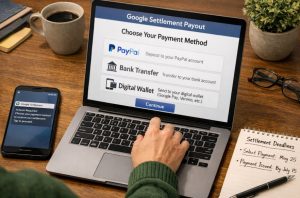
If you think you qualify, the most important thing is to act before any deadlines pass. Start by checking whether you have received a notice by email or post. If you have, keep your Notice ID and Confirmation Code safe.
Then:
- Visit the official settlement website
- Confirm that your details are correct
- Choose a payment method
- Watch for updates after the June 2026 hearing
If you have not received a notice but believe you are eligible, contact the settlement administrator and ask them to verify your information.
Do not assume you will automatically receive money without taking action. In many cases, you still need to confirm how you want to be paid.
Even if the final payment turns out to be small, it is still worth completing the process if you qualify. It only takes a few minutes, and missing the deadline could mean losing the chance to receive anything at all.
Conclusion
The $135 million Google Android settlement could provide compensation if you used an Android phone with a cellular data plan in the United States after 12 November 2017.
While the expected payment may be small, the case is significant because it focuses on how your phone data may have been collected without your knowledge.
Google denies wrongdoing, but the settlement may still lead to better privacy protections and clearer choices for Android users in future.
If you received a notice, your next step is simple: check your eligibility, choose a payment method and watch for updates after the June 2026 court hearing.
For people in the UK, the case is still important because it shows why you should pay close attention to privacy settings, data permissions and how technology companies use your information.
FAQs
Who can claim the $135 million Google Android settlement?
You may qualify if you lived in the United States and used an Android phone with a cellular data plan after 12 November 2017. People who were part of the earlier California settlement are not included.
How do I know if I am part of the settlement?
Most eligible users should receive an email or letter containing a Notice ID and Confirmation Code. If you have not received anything, you can contact the settlement administrator to check.
Do I need to submit a claim form?
Most people do not need to complete a full claim form. You usually only need to log in and choose how you want to receive your payment.
How much money will I receive from the settlement?
The exact amount is not yet known because it depends on how many people qualify and submit claims. Most payments are expected to be small once legal costs and fees are deducted.
When will the Google Android settlement payment be sent?
Payments will only be sent after the court gives final approval to the settlement. The final approval hearing is currently scheduled for 23 June 2026.
Can people in the UK receive money from the settlement?
No, the settlement only applies to people who lived in the United States during the covered period. UK Android users cannot claim, but the case may still affect future privacy rules.
What happens if I do not choose a payment method?
If you do not choose a payment method, your payment could be delayed or you may not receive it at all. It is best to select your preferred option as soon as possible.