


Is State Pension Paid in Arrears? UK Payment Schedule and First Payment Explained

State Pension Paid in Arrears

Yes. The UK State Pension is usually paid in arrears, which means the money received generally relates to a period that has already passed rather than paying for the weeks ahead.

For most pensioners, the State Pension is paid every four weeks. The House of Commons Library describes the State Pension as a weekly benefit that is usually paid four-weekly in arrears.

Under the new State Pension, a claimant receives a full payment every four weeks after the first payment. The exact payment day normally depends on the final two digits of the person’s National Insurance number.

The official GOV.UK State Pension payment guidance also confirms that a payment may arrive earlier when the normal payment day falls on a bank holiday.

This means a pensioner seeing money enter their account every four weeks should not normally regard it as an advance payment for the following four weeks.

What Does “State Pension Paid in Arrears” Mean?

State Pension Paid in Arrears Payment

When a State Pension is paid in arrears, the payment relates to pension entitlement that has already built up.

In simple terms, if a pensioner receives the normal four-weekly payment, that money generally relates to the previous pension period rather than the next four weeks.

This distinction can be important when someone is:

  • Checking when the first State Pension payment should arrive
  • Planning household bills around pension dates
  • Looking at a payment that arrived earlier because of a bank holiday
  • Trying to understand a delayed or backdated payment
  • Comparing weekly State Pension rates with the amount deposited into a bank account

Does a State Pension Payment Cover the Previous Four Weeks?

For the usual four-weekly arrangement, State Pension payments are made in arrears. The House of Commons Library states that the State Pension is usually paid four-weekly in arrears.

A pensioner therefore needs to distinguish between the date money reaches the account and the period for which the pension has been earned.

An early bank holiday payment, for example, does not mean the State Pension has suddenly changed from being paid in arrears to being paid in advance.

Is State Pension Paid Monthly or Every Four Weeks?

The State Pension is usually paid every four weeks, not once per calendar month.

That sounds similar, but the two systems are not the same. A calendar month can contain 28, 29, 30 or 31 days, whereas four weeks is always 28 days.

Because of that, a four-weekly State Pension payment can move through the calendar rather than appearing on exactly the same date each month.

GOV.UK says the new State Pension is usually paid into a claimant’s account every four weeks.

Pensioners following wider retirement changes may also need to account for the DWP State Pension age change in 2026, as the gradual move from State Pension age 66 to 67 affects when some people become entitled to claim.

When Is the State Pension Paid?

The day on which State Pension is normally paid depends on the last two digits of the claimant’s National Insurance number.

The current payment-day schedule is:

Last Two Digits Of NI NumberNormal Payment Day
00–19Monday
20–39Tuesday
40–59Wednesday
60–79Thursday
80–99Friday

GOV.UK confirms this payment-day system for the new State Pension.

Why Does the State Pension Payment Date Change Each Month?

A four-weekly payment cycle repeats every 28 days.

That means a pensioner who receives a payment on one date in a calendar month should not automatically expect the next payment to arrive on the same numerical date the following month.

For example, a four-week cycle may result in payments appearing near the beginning of one month and later in another, while still following the correct payment schedule.

The situation can change again when a bank holiday affects the normal payment day.

Previous bank holiday adjustments, including early DWP benefit payments in May 2026, show why pensioners should check official dates instead of assuming the usual weekday will always apply.

When Will the First State Pension Payment Be Made?

The first State Pension payment does not necessarily follow the same timing as every later payment.

For the new State Pension, GOV.UK says the first payment will be made no later than five weeks after the date the claimant chooses to start receiving their pension.

Full payments are then made every four weeks. A claimant might also receive part of a payment before the first full payment.

This is why a newly retired person should not simply calculate four weeks from State Pension age and assume that exact date will be the first payday.

Why Can the First State Pension Payment Look Different?
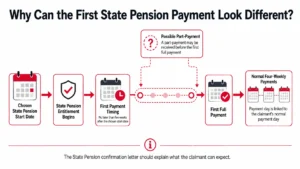
First State Pension Payment Look Different

The first payment can differ because entitlement begins from the chosen State Pension start date, while the normal payment cycle is linked to the claimant’s payment day.

The confirmation letter issued after a claim should explain what the pensioner can expect.

A person approaching retirement may therefore see:

  • A Start Date For State Pension Entitlement
  • A First Payment Within The Initial Payment Period
  • A Possible Part-Payment Before The First Full Payment
  • Full Four-Weekly Payments After That Point

The House of Commons Library notes that the introduction of the new State Pension in April 2016 allowed part-week payments at the beginning and end of a claim, helping cover gaps that could arise around the first payday.

Example of a First State Pension Payment

Suppose a person chooses to start the new State Pension part-way through the normal payment cycle.

The claimant may first receive an amount covering that shorter period, followed by the normal full four-week payment. The exact dates and amount depend on the individual’s State Pension start date and assigned payment day.

The example illustrates why the question “is State Pension paid in arrears?” should be considered separately from “when will the first State Pension payment arrive?”

They are related questions, but they are not identical.

Is the Basic State Pension Paid in Arrears?

The basic State Pension and the new State Pension operate under different entitlement systems, although State Pension is generally paid four-weekly in arrears.

The basic State Pension normally applies to men born before 6 April 1951 and women born before 6 April 1953. People reaching State Pension age under the newer system are generally covered by the new State Pension.

Payment arrangements also changed historically.

The House of Commons Library says that the State Pension is usually paid four-weekly in arrears and that, from 2010, individuals were allocated a payment day according to the final two digits of their National Insurance number.

That historical background is one reason it is safer to say the State Pension is usually paid in arrears rather than claiming every pensioner in every circumstance has always been paid in exactly the same way.

Latest DWP State Pension Payment Update for August 2026

A current DWP announcement affects some pensioners at the end of August 2026.

On 14 August 2026, the Department for Work and Pensions confirmed that benefit and pension payments normally due on Monday 31 August 2026 will instead be paid on Friday 28 August 2026 because of the August bank holiday.

The announcement specifically includes the State Pension among the affected payments and applies across the UK.

Pensioners whose normal State Pension payment is due on 31 August should therefore expect the money earlier.

The DWP August 2026 bank holiday payment announcement confirms that State Pension, Pension Credit, Universal Credit, Attendance Allowance and several other benefits are included in the change.

Does the Early August Payment Change the Arrears Period?

No. Receiving the money earlier because of the bank holiday does not convert the State Pension into a payment made in advance.

It is a change to the payment date, not a fundamental change to the way pension entitlement is calculated.

A pensioner paid on Friday 28 August rather than Monday 31 August should therefore be aware that the next normal payment is not automatically moved forward by the same number of days.

That distinction can help prevent an early payment from being mistaken for extra money.

What Happens When a State Pension Payment Is Due on a Bank Holiday?

When a normal State Pension payday falls on a bank holiday, the payment may be made earlier.

GOV.UK specifically warns new State Pension recipients that they might be paid earlier when their normal payment day is a bank holiday.

The August 2026 change provides a current example. State Pension payments due on Monday 31 August are being moved to Friday 28 August.

Similar payment adjustments have occurred around other bank holidays, so pensioners who depend on a fixed payment date for standing orders or bills should check the timing when a public holiday approaches.

An early payment can create what appears to be a longer gap before the next payment. This happens because the next payment normally returns to the established schedule rather than permanently moving forward.

How Much Is the State Pension in 2026/27?

The amount paid has increased for the 2026/27 tax year.

The Government announced that both the full new State Pension and full basic State Pension increased by 4.8% from April 2026 under the Triple Lock.

The full rates are:

  • Full New State Pension: £241.30 per week
  • Full Basic State Pension: £184.90 per week

For a straightforward four-week period, those weekly rates are equivalent to:

  • Full New State Pension: £965.20 over four weeks
  • Full Basic State Pension: £739.60 over four weeks

The actual amount a pensioner receives can differ because State Pension entitlement depends on the individual’s National Insurance record and, in some cases, transitional or protected amounts.

The official Government announcement on the 2026 State Pension increase says more than 12 million pensioners are affected by the uprating and confirms the new full weekly rates.

The rise has also renewed discussion around the cost and future of the State Pension Triple Lock, particularly as higher pension rates bring the full new State Pension closer to the Personal Allowance.

Higher weekly rates do not change the principle of State Pension being paid in arrears. They simply change the amount of entitlement that accumulates during the relevant period.

Follow the Money, Not the Month

State Pension Runs on a 28-Day Rhythm

Explore how a normal four-week payment, an early bank-holiday payment and the first State Pension payment fit into the cycle.

28
Regular State Pension

Entitlement Builds Before the Money Arrives

A normal four-weekly State Pension payment generally relates to the pension period that has already passed.

Reading the cycle
Week 1 begins building entitlement

The pension period is underway, but this portion is not being paid in advance for the weeks ahead.

28

Four weeks always equals 28 days. That is why a regular State Pension payment can move through calendar dates rather than appearing on the same numerical date every month.


${dots}
PAYMENT
`; updateLive( "Week 1 begins building entitlement", "The pension period is underway, but this portion is not being paid in advance for the weeks ahead." ); const weekButtons = visual.querySelectorAll(".sp28-week-hit"); const weekCopy = { 1: [ "Week 1 begins building entitlement", "The pension period is underway, but this portion is not being paid in advance for the weeks ahead." ], 2: [ "The entitlement period continues", "The regular payment builds across the four-week period rather than being tied to a calendar month." ], 3: [ "The cycle keeps following weeks, not month dates", "Because the normal cycle is 28 days, the eventual payday can appear on a different numerical date in the next calendar month." ], 4: [ "The four-week period leads into payment", "The money received generally relates to pension entitlement that has already arisen during the preceding payment period." ] }; weekButtons.forEach(function (button) { button.addEventListener("click", function () { weekButtons.forEach(function (item) { item.classList.remove("active"); }); button.classList.add("active"); const copy = weekCopy[button.dataset.week]; updateLive(copy[0], copy[1]); }); }); } /* ====================================================== SCENE 2 — AUGUST BANK HOLIDAY ====================================================== */ function renderHoliday() { ghost.textContent = "31"; sceneKicker.textContent = "August 2026 Bank Holiday"; sceneTitle.textContent = "The Date Can Move Without Changing the Arrears Rule"; sceneIntro.textContent = "State Pension payments normally due on Monday 31 August 2026 are being paid on Friday 28 August because of the bank holiday."; visual.innerHTML = `
BANK HOLIDAY SHIFT
`; updateLive( "The money arrives earlier", "The earlier Friday payment changes the date the money reaches the account. It does not convert State Pension from arrears into an advance payment." ); const points = visual.querySelectorAll(".sp28-date-point"); points.forEach(function (point) { point.addEventListener("click", function () { points.forEach(function (item) { item.classList.remove("active"); }); point.classList.add("active"); if (point.dataset.point === "early") { updateLive( "Friday 28 August is the earlier payment date", "The DWP confirmed on 14 August 2026 that payments normally due on Monday 31 August would instead be paid on Friday 28 August." ); } else { updateLive( "Monday 31 August remains the normal due date", "The next normal State Pension payment is not automatically moved forward by the same number of days simply because this payment arrived earlier." ); } }); }); } /* ====================================================== SCENE 3 — FIRST PAYMENT ====================================================== */ function renderFirst() { ghost.textContent = "5"; sceneKicker.textContent = "New State Pension"; sceneTitle.textContent = "The First Payment Has Its Own Starting Rhythm"; sceneIntro.textContent = "The first new State Pension payment can look different from the regular four-weekly payments that follow."; visual.innerHTML = `
FIRST PAYMENT: NO LATER THAN 5 WEEKS
`; updateLive( "The chosen start date begins the entitlement", "The first payday should not simply be assumed to fall exactly four weeks after State Pension age." ); const points = visual.querySelectorAll(".sp28-first-point"); points.forEach(function (point) { point.addEventListener("click", function () { points.forEach(function (item) { item.classList.remove("active"); }); point.classList.add("active"); if (point.dataset.point === "start") { updateLive( "The chosen start date begins the entitlement", "The claimant chooses when to start receiving the new State Pension, and the initial payment timing works from that starting point." ); } if (point.dataset.point === "first") { updateLive( "The first payment can look different", "GOV.UK says the first new State Pension payment will be made no later than five weeks after the chosen start date. A part-payment may also be made before the first full payment." ); } if (point.dataset.point === "regular") { updateLive( "Then the normal four-week rhythm takes over", "After the first payment, full new State Pension payments are made every four weeks." ); } }); }); } /* ====================================================== SCENE CONTROL ====================================================== */ function changeScene(scene) { if (scene === "rhythm") { renderRhythm(); } if (scene === "holiday") { renderHoliday(); } if (scene === "first") { renderFirst(); } } sceneButtons.forEach(function (button) { button.addEventListener("click", function () { sceneButtons.forEach(function (item) { item.classList.remove("active"); }); button.classList.add("active"); changeScene(button.dataset.scene); }); }); /* INITIAL STATE */ renderRhythm(); })();

Is Deferred State Pension the Same as State Pension Paid in Arrears?

No. Deferring the State Pension and receiving normal State Pension payments in arrears are different concepts.

A normal State Pension payment in arrears means the payment covers entitlement that has already arisen.

Deferral means a person chooses not to claim their State Pension when first eligible, which can affect the amount they later receive.

Someone considering postponing a claim should therefore not assume that “deferred pension” and “pension arrears” mean the same thing.

Discussion surrounding State Pension deferral and retirement income also highlights why the decision to delay a claim should be considered separately from the ordinary payment schedule.

In practical terms:

  • Normal Arrears Payment: Covers State Pension already due for the relevant payment period
  • Deferred State Pension: Results from choosing to delay claiming the pension
  • Backdated Or Corrected Payment: May arise when entitlement is recalculated or an underpayment is corrected

Keeping these categories separate makes bank statements and DWP letters easier to understand.

What Should a Pensioner Do if Their State Pension Has Not Arrived?

A missing State Pension payment does not necessarily mean entitlement has stopped.

The pensioner should first check whether the expected date matches the normal four-week schedule and assigned payment day.

Useful checks include:

  • Check the National Insurance Number: Confirm the expected weekday from the final two digits
  • Check the Previous Payment Date: Count the normal four-week cycle rather than relying on the same date each month
  • Check For A Bank Holiday: A payment may have been brought forward
  • Check the Bank Account: Confirm the account used for the State Pension has not changed or been restricted
  • Check DWP Correspondence: Review the State Pension award or payment letter
  • Contact The Pension Service: Raise the issue if the payment remains missing or unexplained

People who are still approaching retirement should also check their forecast carefully. Concerns about forecast accuracy have previously been raised in relation to some records, including the HMRC State Pension forecast issue.

A forecast issue is different from a missing payment after retirement, but both demonstrate why pensioners should rely on their individual record rather than assuming the full advertised State Pension rate automatically applies.

How Can Pensioners Budget for Four-Weekly State Pension Payments?

Pensioners Budget for Four-Weekly State Pension

Four-weekly State Pension payments can require a different budgeting approach from income received once per calendar month.

A pensioner may receive a regular amount every 28 days while rent, mortgage payments, energy bills, council tax or insurance continue to leave the account monthly.

One practical method is to work from the four-week payment date rather than assuming money will arrive on the same calendar date each month.

Pensioners may also find it useful to separate essential monthly expenses from flexible weekly spending.

For example:

  • Record Each Expected Pension Date: Use the four-week cycle
  • Allow For Bank Holidays: Note when payments may arrive earlier
  • Do Not Treat An Early Payment As Extra Income: It may need to last until the next normal payday
  • Check Annual Rate Changes: State Pension rates usually change at the start of a new tax year
  • Review Other Pensioner Income Separately: Pension Credit, workplace pensions and private pensions may follow different schedules

Changes in overall retirement income can also be easier to understand when pension increases are separated from one-off claims about special payments.

The distinction is important when interpreting reports about a DWP pensioner income increase, because an annual improvement in average pensioner income is not the same as a separate lump-sum payment.

Conclusion: Is State Pension Paid in Arrears?

Yes, the State Pension is usually paid in arrears, with most pensioners receiving payments every four weeks for entitlement that has already arisen. The payment date normally depends on the last two digits of the claimant’s National Insurance number.

The first new State Pension payment can work differently from later payments.

GOV.UK says it should arrive no later than five weeks after the chosen start date, with full payments every four weeks afterwards. A part-payment may also be made before the first full payment.

Bank holidays can temporarily move the date forward without changing the underlying arrears arrangement.

The most recent example is the DWP’s 14 August 2026 announcement confirming that State Pension payments due on Monday 31 August 2026 will be paid on Friday 28 August.

Pensioners should therefore distinguish between the period a State Pension payment covers, the date it reaches the account and the amount of State Pension to which the individual is entitled.

Frequently Asked Questions

Is State Pension Paid in Arrears?

Yes. State Pension is usually paid four-weekly in arrears, meaning the payment generally relates to entitlement that has already arisen rather than the coming four weeks.

How Many Weeks in Arrears Is State Pension Paid?

The usual State Pension payment cycle is every four weeks. This means most regular payments represent a four-week pension period that has already passed.

Is State Pension Paid Monthly or Every Four Weeks?

The State Pension is usually paid every four weeks rather than once per calendar month. Because four weeks equals 28 days, the payment can appear on different calendar dates from month to month.

What Period Does a State Pension Payment Cover?

Under the usual arrears arrangement, a four-weekly State Pension payment relates to pension entitlement for the preceding payment period rather than paying for the next four weeks.

How Long After State Pension Starts Is the First Payment Made?

For the new State Pension, GOV.UK says the first payment will arrive no later than five weeks after the date the claimant chooses to start receiving it. Full payments then follow every four weeks.

What Day of the Week Is State Pension Paid?

The normal payment day depends on the last two digits of the National Insurance number. Numbers ending 00–19 are normally paid on Monday, 20–39 on Tuesday, 40–59 on Wednesday, 60–79 on Thursday and 80–99 on Friday.

What Happens if a State Pension Payment Falls on a Bank Holiday?

The payment may be made earlier. For the August 2026 bank holiday, the DWP has confirmed that State Pension payments due on Monday 31 August will be paid on Friday 28 August 2026. Receiving the payment early does not mean the State Pension has changed from being paid in arrears to being paid in advance.

Similar Posts

Leave a Reply

Your email address will not be published. Required fields are marked *