

The 4 weekly State Pension payment dates do not follow one universal calendar for every UK pensioner.
State Pension is normally paid every four weeks, while the usual weekday is determined by the final two digits of a person’s National Insurance number.
That means two pensioners can both receive the State Pension but have completely different payment dates throughout 2026.
Once one confirmed payment date is known, the next normal payment can usually be estimated by adding 28 days.
The official State Pension payment rules confirm that the new State Pension is normally paid every four weeks.
The same guidance says the first payment can arrive no later than five weeks after the chosen start date, followed by full four-weekly payments.
The normal pattern depends on:
- National Insurance Number The last two digits determine the usual payment weekday
- Personal Payment Cycle A confirmed payment date establishes the pensioner’s four-week sequence
- Bank Holidays A payment may arrive earlier when the scheduled day is affected
- First Payment Timing The initial State Pension payment can follow a different timetable
For an established payment cycle, adding 28 days to a normal confirmed date will usually identify the next expected State Pension payment date.
Latest State Pension Updates For 2026
Several State Pension changes are relevant to pensioners in 2026, although none has replaced the normal four-week payment structure.
2026 Update Current Position Effect On Payment Dates
State Pension Increase Full new State Pension rose 4.8% to £241.30 a week from April 2026 Changes payment amount, not four-week frequency
State Pension Age Phased increase from 66 to 67 is underway between 2026 and 2028 Changes when some people become eligible
August Bank Holiday 31 August 2026 is a Monday bank holiday in England, Wales and Northern Ireland Affected Monday payments would normally arrive earlier
HMRC Tax Guidance New State Pension tax guidance was published in July 2026 Tax is based on pension entitlement rather than simply counting bank credits
More than 12 million pensioners were covered by the April 2026 uprating, with the full new State Pension increasing from £230.25 to £241.30 per week and the full basic State Pension rising from £176.45 to £184.90 per week.
The 2026 State Pension increase therefore affects how much eligible pensioners receive within each four-week payment period, but it does not turn State Pension into a monthly payment.
The State Pension age change in 2026 is also now taking effect. The legislated timetable gradually increases State Pension age from 66 to 67 between 2026 and 2028, with the exact age depending on date of birth.
State Pension age change in 2026 affects the date a person can become entitled to the pension rather than changing the normal payment cycle after entitlement begins.
As of 21 August 2026, current GOV.UK guidance continues to state that State Pension is normally paid every four weeks. No general move to monthly State Pension payments has been announced in the official payment rules.
Is The State Pension Paid Every 4 Weeks Or Monthly?
The State Pension is normally paid every four weeks, not once every calendar month.
This distinction is important because four weeks always equals 28 days. Calendar months, by comparison, contain 28, 29, 30 or 31 days.
A pensioner might therefore receive a payment near the beginning of one month and another closer to the end of a later month. The numerical date changes even though the weekday usually remains consistent.
A four-weekly schedule also means that household budgeting does not always align neatly with monthly bills such as rent, council tax, broadband, insurance and utility direct debits.
Why Are Four-Weekly And Monthly Payments Different?
Suppose a pensioner receives a normal State Pension payment on Wednesday 19 August.
Four weeks later is Wednesday 16 September.
The following payment would then be Wednesday 14 October.
The date has moved from the 19th to the 16th and then to the 14th, even though every payment remains exactly four weeks apart.
This is why searches for a fixed “State Pension payment date every month” can produce misleading expectations.
How Many State Pension Payments Are There In A Year?
A standard 52-week period contains 13 four-week periods because:
52 weeks ÷ 4 weeks = 13
However, the number of actual payments appearing during a particular tax year can sometimes be different because payment dates do not line up exactly with the tax-year boundaries.
HMRC guidance updated in July 2026 explains that a person paid every four weeks in arrears could, depending on the dates, receive 14 payments in one tax year and 12 in another.
For tax purposes, the calculation remains based on the pension entitlement arising during the tax year rather than simply adding the bank payments received.
That distinction has become more relevant as higher State Pension rates push retirement income closer to tax thresholds.
The interaction between State Pension and other retirement income means pension tax rules in the UK can matter even though tax is not normally deducted directly from the State Pension payment itself.
How Are State Pension Payment Dates Decided?
The normal State Pension payment day is based on the final two digits of the pensioner’s National Insurance number.
Last Two Digits Of NI Number Normal Payment Day
00–19 Monday
20–39 Tuesday
40–59 Wednesday
60–79 Thursday
80–99 Friday
A pensioner whose National Insurance number ends in 17 would normally be paid on a Monday.
Someone whose number ends in 35 would normally be paid on a Tuesday.
A number ending in 64 would normally correspond to Thursday.
The National Insurance number identifies the normal weekday. It does not, by itself, provide every actual calendar date on which the pension will arrive during 2026.
How To Calculate Your 4-Weekly State Pension Payment Dates?

Working out personal 4-weekly State Pension payment dates is relatively straightforward once one normal payment has been identified.
Find A Confirmed State Pension Payment Date
The safest starting point is an actual payment date confirmed through:
- State Pension Letter: Check the payment information supplied after the claim
- Bank Statement: Look for a previous regular DWP State Pension credit
- Payment History Compare several previous deposits to confirm the four-week pattern
A bank statement may contain a DWP payment reference. Understanding a DWP SP bank statement reference can help distinguish a normal recurring State Pension credit from other transactions when reviewing payment history.
Add 28 Days To The Confirmed Date
Four weeks equals 28 days.
If the normal confirmed payment was:
Wednesday 19 August 2026
Adding 28 days gives:
Wednesday 16 September 2026
Adding another 28 days gives:
Wednesday 14 October 2026
The calculation can then continue throughout the year.
Check Each Date Against Bank Holidays
Once the expected dates have been calculated, they should be compared with bank holidays.
This matters because the payment may arrive before the expected date when the normal payday is not a working day.
Example Of A 4-Weekly State Pension Payment Schedule
The following table is an illustrative example, not a universal DWP payment calendar.
It assumes Wednesday 19 August 2026 has already been confirmed as one pensioner’s normal payment date.
Payment Example Date Time Since Previous Payment
Confirmed Payment Wednesday 19 August 2026 Starting Date
Next Payment Wednesday 16 September 2026 28 Days
Third Payment Wednesday 14 October 2026 28 Days
Fourth Payment Wednesday 11 November 2026 28 Days
Fifth Payment Wednesday 9 December 2026 28 Days
Sixth Payment Wednesday 6 January 2027 28 Days
A pensioner whose cycle began on another Wednesday would have different dates despite having the same normal weekday.
This is why a generic list headed “State Pension payment dates 2026” should not automatically be treated as a personal DWP schedule.
What Happens To State Pension Payments On Bank Holidays?
State Pension payments can arrive earlier when the normal payment date falls on a bank holiday.
The 2026 UK bank holiday calendar shows that Monday 31 August 2026 is the summer bank holiday in England and Wales and Northern Ireland.
Under the normal government payment rule, a State Pension due on that Monday would usually be paid on the previous working day. In this case, that would ordinarily mean Friday 28 August 2026.
Pensioners paid on Tuesday, Wednesday, Thursday or Friday would not automatically be affected simply because a bank holiday occurs elsewhere in that week.
State Pension Bank Holiday Payment Dates
Bank holiday arrangements should be checked against the pensioner’s individual schedule.
The main points are:
- Payment Must Coincide With The Holiday Not every pensioner is affected by every bank holiday
- Payment Is Usually Brought Forward: The money normally arrives on the previous working day
- UK Nations Can Differ: Scotland and Northern Ireland have some different public holidays
- Normal Cycle Still Matters: An early credit does not necessarily create a new four-week payment sequence
Christmas And New Year State Pension Payments
Christmas can cause several payment changes because Christmas Day and Boxing Day may create consecutive or substitute bank holidays.
In England and Wales, Christmas Day falls on Friday 25 December 2026, while Monday 28 December 2026 is the Boxing Day substitute bank holiday.
Only pensioners whose normal scheduled payment is affected should expect an adjustment.
Does An Early Bank Holiday Payment Reset The Four-Week Cycle?
An early payment should not automatically be used as the starting point for calculating all future State Pension dates.
If the payment was moved only because of a bank holiday, the underlying scheduled date remains relevant.
For example, if a Monday payment is brought forward to the preceding Friday, adding 28 days to that early Friday could produce the wrong expectation for the following payment.
The safer method is to keep the normal scheduled payday as the reference point unless the Pension Service confirms that the actual payment arrangement has changed.
When Will The First State Pension Payment Arrive?
The first State Pension payment is not necessarily the same as an established four-weekly payment.
For the new State Pension, a claimant chooses when they want the pension to start when making the claim.
The first payment should arrive no later than five weeks after the chosen start date, and the claimant may receive a part-payment before the first full four-week payment. Full payments are then normally made every four weeks.
The payment letter is particularly important at this stage because it explains the individual timetable.
Why Has My State Pension Been Paid Early Or On A Different Date?
A State Pension payment arriving on an unexpected date does not automatically mean there is an error.
Common explanations include:
- Bank Holiday Adjustment: A scheduled payment may have been moved to the previous working day
- First Payment: The initial payment can differ from later full four-week payments
- Part Payment: The first amount can cover less than four weeks
- Updated Award: A change to entitlement can alter the amount received
- Account Change: Updated banking details may require the pensioner to check current correspondence
- Arrears or Corrections: Backdated entitlement can produce a payment that differs from the usual amount
Pensioners should compare unusual bank credits with their normal four-week amount before assuming that a new benefit or special pension bonus has been introduced.
Put a State Pension Payment Through the System
A State Pension date is not produced by one national monthly calendar. Decode the usual weekday, move a confirmed payment forward by 28 days and see what happens when a bank holiday blocks the normal route.
Decode the NI Ending
Select the final two-digit range from the National Insurance number.
Start with a normal payment already confirmed from records.
Four weeks is exactly 28 days, not one calendar month.
An affected scheduled payment may arrive earlier.
The article uses Wednesday 19 August 2026 as an illustrative confirmed payment. Adding 28 days produces the next normal date in that individual’s cycle.
The weekday remains Wednesday in this example, while the numerical date moves from the 19th to the 16th and then the 14th.
When Should A Missing State Pension Payment Be Checked?
A payment should be investigated when the expected date has passed, and there is no obvious explanation.
A pensioner can first:
- Confirm the Normal Weekday Check the last two National Insurance digits
- Check the Previous Payment: Add 28 days to the established scheduled date
- Check Bank Holidays Determine whether payment should have arrived earlier
- Review the Bank Account: Look carefully for the expected DWP credit
- Read Recent Correspondence Check whether DWP has notified the pensioner of a change
- Contact The Pension Service Do this if the expected payment remains missing
The distinction between payment timing and account administration has also become more important as changes to DWP pension banking rules affect how some benefit-related account information is handled.
Do State Pension Payment Rules Differ In Northern Ireland?
The core payment frequency is similar in Northern Ireland, where State Pension is also normally paid every four weeks.
The Northern Ireland pension payment guidance states that State Pension is usually paid every four weeks and that a payment due on a bank holiday is normally made on the last working day before the holiday.
The practical difference is that Northern Ireland has some public holidays that do not apply in England, Wales or Scotland.
That means a pensioner should check the bank-holiday calendar for the nation relevant to their payment rather than assuming all UK dates are identical.
State Pension Payments For People Living Abroad
People receiving the UK State Pension overseas can face different payment arrangements.
Current government guidance explicitly states that different rules apply to people living abroad.
Location can also affect whether annual State Pension increases are applied. Some countries receive annual uprating while pension payments are frozen at the rate first received in others.
The issue behind frozen State Pension rules for some overseas retirees is therefore separate from the four-week timetable used by most pensioners living in the UK.
Pensioners who move overseas should not assume their existing domestic payment frequency, currency or annual uprating arrangements will remain unchanged.
State Pension Payment Dates Vs Workplace Pension Pay Dates
The State Pension should not be confused with workplace or occupational pension schemes.
State Pension is normally paid every four weeks, but private and workplace schemes can set their own payment schedules.
Some schemes pay:
- Monthly
- On A Fixed Day Of The Month
- On The Last Working Day
- At Another Frequency Defined By The Scheme
This explains why a workplace pension calendar may list January, February and March dates that bear no relationship to an individual’s DWP State Pension cycle.
The difference can also be seen in public-sector pensions. The Civil Service pension increase in 2026 follows scheme-specific uprating and payment arrangements, while the State Pension continues to use its own DWP rules.
A retiree receiving both can therefore have one pension arriving every four weeks and another arriving monthly.
How To Budget When The State Pension Is Paid Every Four Weeks?
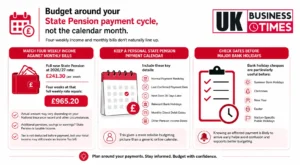
Four-weekly income and monthly household bills do not naturally line up.
A practical budget should therefore be built around the pensioner’s personal payment cycle rather than assuming each State Pension credit represents one calendar month of income.
Match Four-Weekly Income Against Monthly Bills
A pensioner receiving the full new State Pension at the 2026/27 rate has weekly entitlement of £241.30.
Four weeks at that full weekly rate equals:
£241.30 × 4 = £965.20
The actual amount received by an individual may be different because entitlement depends on the National Insurance record and other circumstances.
Pensioners with additional workplace pensions, savings income or employment income should also remember that State Pension is taxable income.
The newly published July 2026 HMRC guidance confirms that tax is not deducted from the State Pension before it is paid, but total taxable income can still create an Income Tax liability.
Keep A Personal State Pension Payment Calendar
A simple personal calendar can contain:
- Normal Payment Weekday
- Last Confirmed Payment Date
- Next Date 28 Days Later
- Relevant Bank Holidays
- Monthly Direct Debit Dates
- Other Pension Income Dates
This gives a more reliable budgeting picture than a generic online payment calendar.
Check Dates Before Major Bank Holidays
Bank holiday cheques are particularly useful before:
- Summer Bank Holidays
- Christmas
- New Year
- Easter
- Nation-Specific Public Holidays
Knowing that an affected payment is likely to arrive early can prevent an early credit from being mistaken for extra money.
What Should Pensioners Do Next?
A pensioner trying to identify the next State Pension payment should work from personal records rather than a generic calendar.
The most reliable sequence is:
- Check The Last Two National Insurance digits. Identify the normal weekday
- Find One Confirmed Normal Payment: Use a bank statement or DWP letter
- Add 28 days. Calculate the next scheduled four-week date
- Check For A Bank Holiday: Determine whether the payment should arrive earlier
- Record the Normal Scheduled Date: Do not automatically reset the cycle after an early bank holiday credit
- Check Unusual Amounts Carefully: Separate normal pension payments from arrears, adjustments or other benefits
- Contact the Pension Service If necessary, investigate a genuinely missing or unexplained payment
Conclusion
The 4-weekly State Pension payment dates are based on each pensioner’s individual four-week payment cycle rather than one national 2026 calendar.
State Pension is normally paid every 28 days, and the last two digits of the National Insurance number determine whether the usual payment day is Monday, Tuesday, Wednesday, Thursday or Friday.
Once a pensioner identifies one confirmed normal payment date, future payments can usually be estimated by adding 28 days.
Bank holidays can move an individual payment forward, while the first State Pension payment can operate differently from the later recurring schedule.
The 4.8% State Pension increase from April 2026 changed the amount eligible pensioners receive, and the phased rise in State Pension age affects when some people can start claiming.
Neither development has replaced the normal four-week payment system.
For pensioners trying to answer “When will my next State Pension payment arrive?”, the most accurate calculation remains:
Confirmed Normal Payment Date + 28 Days + Bank Holiday Check
Frequently Asked Questions
Is The UK State Pension Paid Every 4 Weeks?
Yes. Both the new State Pension and basic State Pension are normally paid every four weeks. Four weeks equals 28 days, which is why the payment should not be described as a standard monthly payment.
What Day Will My State Pension Be Paid?
The usual weekday depends on the final two digits of the National Insurance number. Numbers ending 00–19 are normally paid on Monday, 20–39 on Tuesday, 40–59 on Wednesday, 60–79 on Thursday and 80–99 on Friday.
How Do I Work Out My Next State Pension Payment Date?
Find a confirmed normal payment date and add 28 days. Then check whether the calculated date falls on a bank holiday.
If the previous payment arrived early because of a holiday, calculate from the underlying scheduled date rather than automatically using the early bank credit.
Are There 13 State Pension Payments A Year?
Thirteen four-week periods equal 52 weeks, so 13 is the normal mathematical pattern across a full 52-week period.
However, payment dates can cross tax-year boundaries in ways that mean a pensioner receives a different number of actual credits during a particular tax year. HMRC notes that 14 four-week payments can sometimes fall within one tax year.
Does My National Insurance Number Determine My State Pension Payment Date?
It determines the normal weekday, but not every calendar date. The pensioner’s own four-week cycle establishes which Monday, Tuesday, Wednesday, Thursday or Friday is the actual payment day.
What Happens If My State Pension Is Due On A Bank Holiday?
The payment will normally be made earlier, usually on the previous working day. An early bank-holiday payment does not necessarily mean the underlying four-week cycle has changed.
Who Should I Contact If My State Pension Payment Is Late?
A pensioner should first check the normal payment date, recent bank holidays, their account and DWP correspondence.
If the payment remains missing, the Pension Service is the appropriate contact in Great Britain, while Northern Ireland pensioners should follow the relevant Northern Ireland Pension Centre arrangements.