

Most train tickets in the UK are zero-rated for VAT, meaning passengers pay 0% VAT on standard railway fares.
Whether you purchase an Advance ticket, a first-class journey, a return ticket or a monthly season ticket, VAT is generally not added to the fare.
However, certain services associated with train travel may have different VAT treatments.
Booking fees, onboard catering, ticket upgrades and additional services can create confusion, particularly for businesses trying to manage expenses or reclaim VAT.
According to HM Revenue & Customs (HMRC), qualifying passenger transport is zero-rated, although separately supplied services may attract VAT.
Understanding these rules is important for passengers, employers, self-employed professionals and VAT-registered businesses that regularly pay for railway travel.
Do Train Tickets Have VAT in the UK?
No, ordinary passenger train tickets in the UK do not have VAT added to their fares because they are normally zero-rated at 0%.
This applies to most National Rail journeys, whether tickets are purchased directly from a train operator, at a railway station or through an online booking platform.
For example, if a passenger buys a train ticket from London to Manchester costing £80, the VAT on the fare will be £0.
The passenger pays £80 for the ticket, excluding any separate booking or additional service charges.
The same general VAT treatment applies to business travellers and people travelling for personal reasons.
However, there is an important distinction between paying no VAT and purchasing something that is VAT-exempt.
Train travel is generally zero-rated rather than exempt, which affects how railway operators account for VAT.
What Does Zero-Rated VAT Mean for Train Travel?
Zero-rated VAT means a qualifying service falls within the VAT system but is taxed at 0%.
Under UK VAT rules, zero-rated and exempt supplies are treated differently, even though customers do not pay VAT on either type.
| VAT Classification | VAT Rate | Meaning |
|---|---|---|
| Zero-Rated | 0% | A taxable supply with no VAT charged |
| Exempt | No VAT Charged | A supply exempt from VAT |
| Standard-Rated | 20% | VAT is normally added at the standard rate |
Railway passenger transport is generally zero-rated because it meets the requirements for qualifying public passenger transport.
A railway operator making zero-rated supplies can normally recover eligible VAT on its business purchases, subject to the usual rules.
Businesses purchasing zero-rated railway tickets, however, have no VAT on those fares to reclaim.
This distinction becomes particularly important when businesses prepare VAT returns or calculate eligible travel expenses.
Which Train Tickets Are Zero-Rated in the UK?
Most ordinary passenger railway tickets qualify for zero-rating regardless of their price, booking date or travel class.
The following categories generally have 0% VAT:
- Standard-Class Tickets: Regular single and return tickets for domestic passenger railway journeys are normally zero-rated.
- First-Class Tickets: First-class fares generally have the same VAT treatment as standard-class fares.
- Advance Tickets: Discounted tickets booked before travelling remain zero-rated.
- Off-Peak Tickets: Off-Peak and Super Off-Peak railway fares are normally charged at 0% VAT.
- Season Tickets: Weekly, monthly and annual season tickets for qualifying railway transport are generally zero-rated.
- Sleeper Train Tickets: Ordinary passenger transport involving sleeping berths can qualify for zero-rating.
- Seat Reservations: Reservations supplied as an incidental part of a qualifying railway journey can also be zero-rated.
HMRC’s VAT Notice 744A confirms that incidental services such as seat reservations, sleeping berths and certain supplements can follow the VAT treatment of the underlying passenger fare.
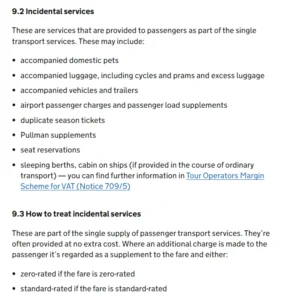
HMRC Section 9.2 and 9.3 confirms the VAT treatment of seat reservations, sleeping berths and incidental passenger transport services.
The important factor is whether the service is genuinely part of the passenger transport supply. Separately supplied accommodation, catering or entertainment may be treated differently.
Is There VAT on Train Tickets Bought Through Trainline?
Train tickets purchased through Trainline are generally zero-rated when they relate to qualifying UK passenger railway journeys.
Trainline acts as a ticket retailer and booking intermediary rather than the operator providing the journey.
For example, a £60 train ticket purchased through Trainline normally carries £0 VAT on the railway fare.
However, Trainline may charge a separate booking fee depending on the journey, ticket price and booking method.
Trainline confirms that VAT is charged on its booking fees, which means the total booking cost can contain a VAT element even though the train fare itself remains zero-rated.
Passengers should distinguish between the actual railway fare and additional charges shown during checkout.
For businesses, this distinction is particularly important because eligible VAT on separately charged services may be recoverable even though the railway fare contains no VAT.
Do You Need a VAT Receipt or Invoice for Train Tickets?
You do not normally need a VAT invoice to reclaim VAT on a UK railway fare because no VAT has been charged on the ticket.
However, keeping a receipt or proof of purchase is important when recording business travel expenses.
According to Trainline’s official guidance, passengers can download expense receipts from their accounts.
To obtain a Trainline expense receipt through the website:
- Sign In to Your Trainline Account
- Open the My Bookings Section
- Select the Relevant Journey
- Choose Manage My Booking
- Select Expense Receipt
- Download or Print the Receipt
The receipt provides booking information, payment details and any VAT charged on booking fees.
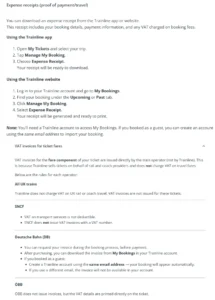
Trainline explains how customers can download expense receipts and why UK rail fares do not receive VAT invoices.
For ordinary UK train tickets, the expense receipt generally serves as proof of purchase rather than evidence of VAT paid on the journey.
Where a separate fee includes VAT, businesses should retain appropriate documentary evidence to support any eligible VAT recovery.
Is There VAT on Trainline Booking Fees and Other Extra Charges?
Although train fares are generally zero-rated, additional services may carry VAT.
Trainline confirms that VAT applies to its booking fees, but this should not be confused with a universal rule that every railway booking intermediary must charge 20% VAT.
HMRC’s travel-agent guidance allows certain initial intermediary services arranging zero-rated passenger transport to be zero-rated. The VAT treatment depends on the particular service and commercial arrangement.
Other charges requiring consideration include onboard catering, ticket delivery, parking and luggage facilities.
For example, separately supplied hot meals and drinks can attract standard-rate VAT, while certain food products may have a different treatment.
Example of VAT on a Trainline Booking
Consider a business purchasing a railway ticket with a separately charged standard-rated booking fee.
| Expense | Amount |
|---|---|
| Train Fare | £100.00 |
| VAT on Train Fare | £0.00 |
| Booking Fee Including VAT | £2.40 |
| VAT Included in Booking Fee | £0.40 |
| Total Amount Paid | £102.40 |
In this example, the booking fee contains £0.40 VAT because the assumed standard-rated fee is £2.40 including VAT.
The VAT calculation is:
£2.40 ÷ 6 = £0.40 VAT
A VAT-registered business may be entitled to reclaim the £0.40 if the purchase meets the normal input tax recovery conditions and appropriate evidence is available.
The £100 railway fare remains zero-rated, so there is no VAT to recover from that amount.
Is There VAT on Railcards and Season Tickets?
Season tickets for qualifying UK passenger rail travel are generally zero-rated.
This applies whether the passenger purchases a weekly, monthly or annual season ticket for regular journeys.
For example, an annual railway season ticket costing £2,500 would normally include £0 VAT on the transport fare.
Railcards work differently because they generally provide discounts on eligible railway tickets rather than representing a journey themselves.
Popular examples include the 16–25 Railcard, 26–30 Railcard, Senior Railcard and Two Together Railcard.
A train ticket purchased using a Railcard normally remains zero-rated because applying a discount does not change the VAT classification of the qualifying passenger journey.
However, the VAT treatment of a separately purchased Railcard or membership product should be checked against the issuer’s documentation rather than automatically assuming it is identical to the train fare.
Businesses should also remember that buying a season ticket for an employee’s ordinary commute can raise separate employment tax and benefit questions.
Is There VAT on London Underground, Oyster and Contactless Travel?
Most ordinary passenger journeys on the London Underground, London Overground, Elizabeth line and similar qualifying public transport services are zero-rated.
This means passengers generally pay 0% VAT on the transport fare, whether travelling using an Oyster card, contactless payment or an eligible Travelcard.
For example, a £4 Underground journey normally contains no VAT for a business to reclaim.
However, an Oyster top-up is not necessarily the same thing as a completed travel expense. Money added to the card may remain available for future journeys.
Businesses should record the actual cost of qualifying business travel rather than treating every top-up as an immediate business expense.
Transport for London provides online journey and payment history that can help passengers identify individual fares.
For business accounting, these records can help distinguish genuine work-related journeys from personal travel or ordinary commuting.
Is There VAT on Eurostar and International Train Tickets?
International train journeys, including Eurostar services between London and destinations such as Paris or Brussels, have different place-of-supply considerations.
HMRC states that international passenger transport taking place within the UK is zero-rated, while the portion of the journey taking place outside the UK is generally outside the scope of UK VAT.
This means a qualifying Eurostar journey does not normally attract UK VAT at 20% simply because it crosses an international border.
However, the treatment of overseas railway travel may depend on the tax rules of the countries through which the passenger travels.
For example:
- London to Paris: The UK portion of qualifying passenger transport is zero-rated, while the journey outside the UK falls outside the scope of UK VAT.
- London to Brussels: Similar UK VAT principles apply to the international railway journey.
- Rail Travel Entirely Abroad: The journey is generally outside the scope of UK VAT, although foreign VAT rules may apply.
Businesses arranging international railway travel should check the booking invoice carefully, particularly when tickets include separate services or multiple operators.
Can Businesses Reclaim VAT on Train Tickets?
VAT-registered businesses cannot reclaim VAT on ordinary zero-rated railway fares because no VAT has been paid.
For example, if a business purchases a £150 train ticket for an employee travelling to a client meeting, the ticket normally contains £0 VAT.
The business therefore cannot reclaim 20% of the fare or treat part of the £150 as recoverable input VAT.
However, qualifying business travel may still be recorded as a business expense for tax and accounting purposes.
Where additional services have been charged separately, businesses may be able to recover VAT on those expenses.
Potentially recoverable items include eligible standard-rated booking fees, certain meals purchased during qualifying business travel and other services where the usual input VAT conditions are satisfied.
Not every expense qualifies automatically. Business entertainment restrictions, private use and inadequate supporting evidence can prevent VAT recovery.
Businesses should check the VAT status shown on each invoice rather than assuming all purchases connected with a railway journey are treated the same way.
Can Self-Employed People Claim Train Tickets as Business Expenses?
Yes, self-employed individuals can generally claim qualifying railway travel costs as allowable business expenses.
HMRC includes train fares among the travel costs that sole traders and business partnerships may deduct when the journeys are genuinely connected with their business activities.
Examples of potentially allowable journeys include travelling to client meetings, attending a business conference or visiting a temporary business location.
However, ordinary commuting between home and a normal place of work is generally not an allowable travel expense.
The main distinction is between claiming the cost of business travel as a tax expense and reclaiming VAT paid on a purchase.
A self-employed professional who spends £75 travelling to a qualifying client meeting may be able to deduct the £75 as a business expense.
Because the rail fare is zero-rated, there is no VAT on the £75 to reclaim.
This difference also matters for limited companies, which must consider the normal business expense rules when calculating taxable profits and corporation tax.
How Should Businesses Record Train Tickets in VAT Returns?
Businesses should record train travel expenses according to the VAT treatment of each purchase.
Under normal VAT accounting, qualifying zero-rated railway fares are recorded as purchases with no input VAT to reclaim.
HMRC’s VAT return guidance explains that Box 4 records deductible input VAT, while Box 7 records the value of purchases and other inputs excluding VAT.
For a qualifying £100 railway fare:
- Train Fare: Record £100 as the relevant business expense.
- VAT Rate: Apply 0% to the qualifying railway fare.
- Box 4: No input VAT is recoverable on the fare.
- Box 7: Include the qualifying purchase value under normal VAT accounting.
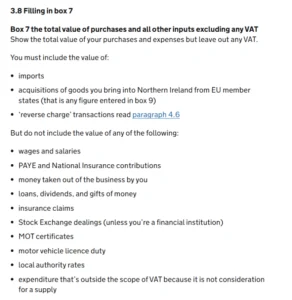
HMRC Section 3.8 explains that Box 7 records the value of purchases and expenses excluding VAT.
Where a separate booking fee includes recoverable VAT, businesses should record the net fee and input VAT separately.
For example, a £2.40 standard-rated booking fee contains a £2 net charge and £0.40 VAT.
The recoverable VAT may be recorded in Box 4 where the business satisfies the necessary conditions.
Businesses using the Flat Rate Scheme or another special accounting arrangement should follow the rules applicable to that scheme rather than automatically applying standard VAT return treatment.
Is VAT Charged on Train Ticket Refunds and Cancellation Fees?
The VAT treatment of train ticket refunds and cancellation charges depends on the nature of the transaction.
When a zero-rated railway fare is refunded, there is normally no VAT on the original fare to adjust or reclaim.
However, a separately charged administration or cancellation fee needs to be considered according to the service or contractual arrangement involved.
HMRC’s guidance on cancellation charges explains that such payments may represent consideration for an underlying supply rather than automatically falling outside VAT.
This does not mean every train ticket cancellation fee attracts 20% VAT.
A charge connected with a zero-rated passenger transport supply can have a different treatment from a separate standard-rated administration service.
Passengers should therefore check the booking provider’s refund documentation.
Businesses should also update their accounting records when tickets are refunded or cancelled, ensuring the expense reflects the actual amount retained by the supplier.
VAT Breakdown for Different UK Train Tickets and Services
The following table summarises the general VAT treatment of commonly purchased railway tickets and associated services.
| Ticket Type or Service | Typical UK VAT Treatment | VAT Reclaimable on Purchase? |
|---|---|---|
| Standard-Class Train Ticket | 0% | No |
| First-Class Train Ticket | 0% | No |
| Advance Train Ticket | 0% | No |
| Return Train Ticket | 0% | No |
| Season Ticket | 0% | No |
| Sleeper Berth as Part of Qualifying Transport | 0% | No |
| Incidental Seat Reservation | 0% | No |
| Trainline Booking Fee | VAT Charged on Fee | Potentially |
| Separately Supplied Onboard Catering | Depends on Supply | Potentially |
| London Underground Fare | 0% | No |
| Qualifying Eurostar UK Journey Portion | 0% | No |
| Separately Purchased Railcard | Check Product Treatment | Depends |
| Cancellation or Administration Fee | Depends on Nature of Charge | Depends |
The table provides general guidance rather than a universal VAT classification for every travel package.
For example, a heritage railway experience that primarily supplies entertainment, or a package combining rail transport with attraction admission, may have a different treatment from an ordinary passenger journey.
Businesses should verify unusual charges against HMRC guidance and the supplier’s supporting documentation before reclaiming VAT.
Conclusion
Most train tickets in the UK are zero-rated for VAT, meaning passengers do not pay additional VAT on standard railway fares.
This generally applies to first-class tickets, Advance fares, return tickets, season tickets and qualifying passenger transport services.
However, booking fees and separately supplied extras can carry different VAT treatments.
For businesses, the most important distinction is that VAT cannot be reclaimed on a zero-rated rail fare, even when the journey is a legitimate business expense.
Keeping accurate travel receipts, separating any additional charges and applying the correct accounting treatment will help avoid mistakes when preparing business accounts and VAT returns.
Frequently Asked Questions
Is There VAT on Train Tickets in the UK?
Most UK passenger train tickets are zero-rated for VAT at 0%, meaning no VAT is added to the railway fare.
Can You Claim VAT Back on Trainline Tickets?
You cannot reclaim VAT on zero-rated UK railway fares, but eligible VAT charged on separate booking fees may be recoverable.
Is There VAT on First-Class Train Tickets?
First-class passenger railway tickets are generally zero-rated, including qualifying fares with incidental services.
Do You Need a VAT Invoice for Train Travel Expenses?
A receipt is useful for proving a business travel expense, but no VAT is recoverable on a zero-rated railway fare.
Is There VAT on Eurostar Tickets?
Qualifying international rail transport is zero-rated for the UK portion, while travel outside the UK is outside the scope of UK VAT.
Can Self-Employed People Claim Train Travel Expenses?
Yes, qualifying business journeys may be claimed as allowable expenses, but ordinary home-to-work commuting is generally excluded.
Are Train Ticket Booking Fees Subject to 20% VAT?
Trainline charges VAT on its booking fees, but other booking services may have different VAT treatments depending on their arrangements.