
What Exactly Happened to BrewDog in March 2026?
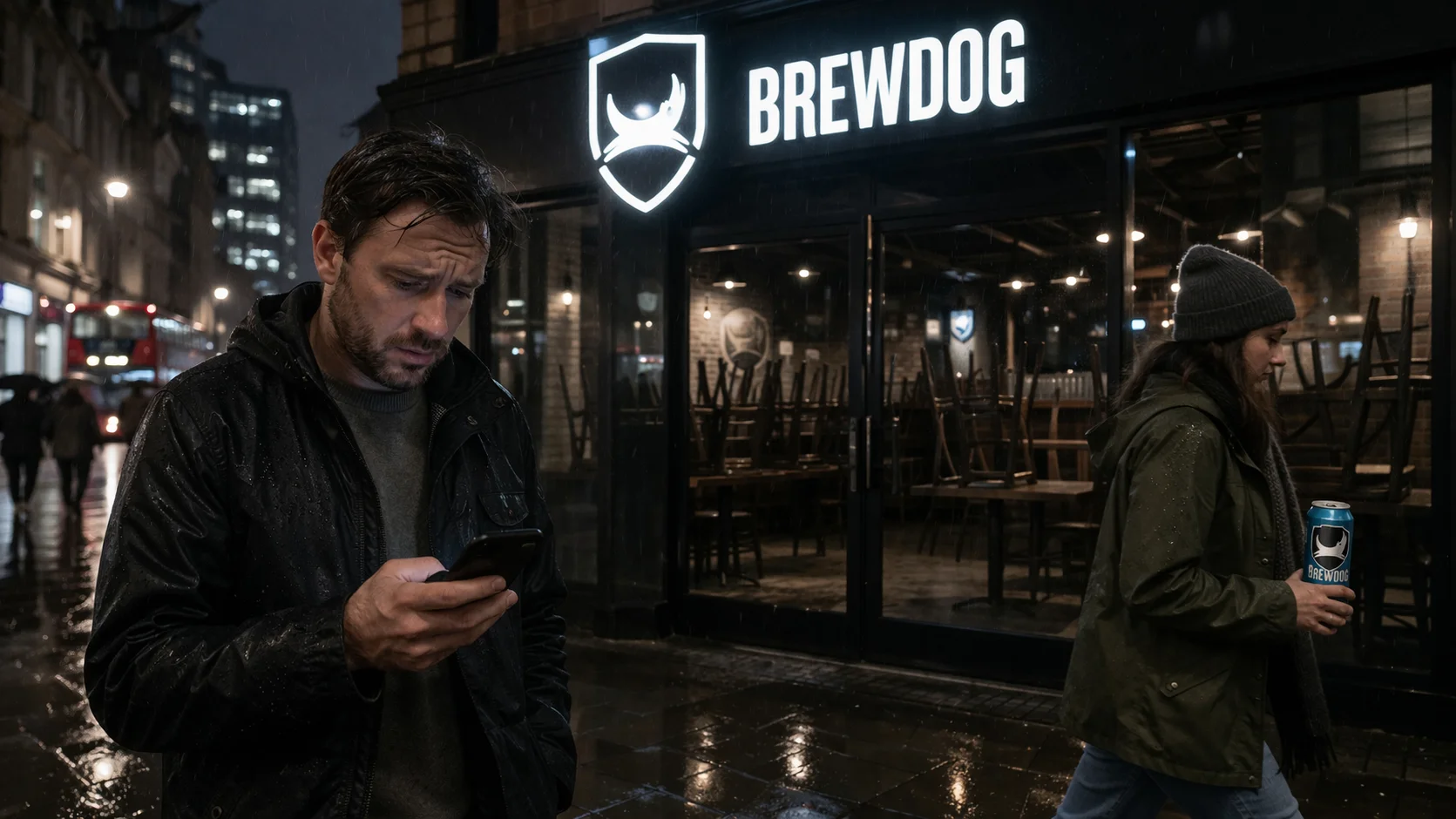
BrewDog’s collapse happened quickly in public, but the problems had been building for months behind the scenes. By early 2026, the company had already closed parts of its distillery operation, reduced staff and started looking for a buyer.
In February 2026, advisers were brought in to explore whether the company could be sold or restructured. When no buyer agreed to take over the whole business, administrators from AlixPartners stepped in.
The business formally entered administration at the start of March 2026. Shortly afterwards, a rescue deal was completed with Tilray Brands.
Under the agreement:
- Tilray bought the brewery in Ellon
- 11 bars remained open
- The BrewDog brand and recipes were included
- 38 bars were excluded and closed immediately
- 484 workers lost their jobs
The sale was worth only £33 million, a dramatic fall for a company that had once claimed to be worth more than £1 billion.
Why Did BrewDog Shut All of Its Bars Temporarily?
Before the deal was completed, BrewDog temporarily shut all of its bars for a day. Customers suddenly found bookings cancelled and bars closed without much warning.
The temporary shutdown happened because ownership of the business was changing and administrators needed time to transfer licences, stock and operations.
During that period:
- Alcohol licences had to be moved to the new owner
- Deliveries of food and beer were paused
- Staff were called into emergency meetings
- Management prepared workers for bar closures and redundancies
For employees, the closure created confusion and anxiety. Many staff did not know whether their venue would reopen or close permanently until the final sale was announced.
One former worker described the atmosphere as “like waiting for a storm to hit”. Staff reportedly arrived at work not knowing whether they still had jobs by the end of the day.
The uncertainty also affected customers. Some people turned up to bars that had suddenly shut, while others discovered online that their local BrewDog would never reopen.
In practice, the one-day closure acted as a dividing line between the old BrewDog business and the smaller version that now exists under Tilray.
Why Did BrewDog Collapse After Being Worth More Than £1 Billion?
BrewDog’s collapse was not caused by one single mistake. Instead, it came from years of aggressive expansion, expensive projects, rising costs and poor financial performance.
The company had built its reputation as a fast-growing, rebellious craft beer brand. It expanded into bars, hotels, distilleries, international breweries and even side businesses such as spirits and hospitality experiences. For a time, that growth made BrewDog look unstoppable.
However, rapid growth only works if profits continue to rise. BrewDog stopped making consistent profits after 2019. As losses increased, the company kept borrowing money and continued expanding.
By 2026, BrewDog had:
- Lost around £148 million over five years
- Built up debts estimated at £480 million to £550 million
- Faced rising wage, energy and rent costs
- Struggled to fill expensive flagship bars
The result was a company that looked successful from the outside but was under growing financial pressure behind the scenes.
How Did BrewDog’s Expansion Strategy Become a Problem?
BrewDog’s strategy was based on growing as quickly as possible. Instead of focusing only on brewing beer, the company expanded into many different areas at once.
It opened bars across the UK and overseas. It launched hotels, restaurants, distilleries and new international breweries. It invested in expensive locations such as London Waterloo, Las Vegas and Australia.
At first, these projects created excitement and publicity. Over time, however, they became costly to maintain.
The company ended up with:
- More than 100 bars worldwide
- Expensive rent bills in city-centre locations
- Hotels and venues that were difficult to make profitable
- A large number of overseas operations
Many of these sites worked well when consumer spending was strong. But after the pandemic, people spent less in bars and restaurants, while costs rose sharply.
One hospitality analyst said BrewDog had “started to believe its own hype”. The business behaved like a global giant before it had the profits to support that ambition.
“They’d started to believe their own hype. Hordes of people would cheer them on stage and it became a bit of a cult. A cult that James was happy to be the head of.”
That view reflected a growing belief that BrewDog had expanded too far and too quickly. Instead of slowing down, the company continued opening new sites even while older ones struggled.
By the time management realised the expansion had gone too far, the business already had too many expensive locations and too much debt.
Why Did BrewDog Stop Making a Profit?
BrewDog’s last profitable year was 2019. After that, the company entered a cycle of losses that it never escaped.
Several pressures hit the business at the same time:
- Higher energy bills
- Rising National Insurance contributions
- Increases in business rates
- More expensive ingredients and transport
- Falling demand in the hospitality sector
The pandemic also damaged BrewDog badly. Bars were closed for long periods and international expansion plans stalled. Even after restrictions ended, customer numbers did not fully recover.
At the same time, BrewDog was carrying huge costs from its expansion strategy.
It still had to pay for:
- Large city-centre bars
- Hotels and hospitality sites
- Loans taken out during previous years
- A government-backed Covid loan
The company also struggled to generate enough cash from new projects. Distilleries and international bars failed to produce the level of profit that management had expected.
Accounts showed BrewDog had lost around £148 million over five years. It had not generated enough profit to cover its debts or continue paying for expansion.
In hindsight, BrewDog had become too large, too complicated and too expensive to run. The business still sold a lot of beer, but that was no longer enough to keep the wider company afloat.
Did the 2017 Investment Deal Contribute to BrewDog’s Downfall?
Many people now see BrewDog’s 2017 investment deal as the moment the company changed forever.
That year, BrewDog sold part of the company to the private equity firm TSG Consumer Partners. The founders, James Watt and Martin Dickie, each reportedly received around £50 million from the transaction.
At the time, the deal looked like a huge success. It gave BrewDog access to more money, helped increase its valuation and made the company appear ready for global expansion.
However, the agreement also created enormous pressure on BrewDog to keep growing every year. The company now needed faster sales, bigger profits and a higher valuation simply to justify the deal.
Many critics believe BrewDog became trapped by its own success. Once the company accepted outside investment, it had to keep expanding even when that growth no longer made financial sense.
What Was the TSG Deal and Why Did It Matter?
In 2017, TSG Consumer Partners bought a 22% stake in BrewDog and invested more than £100 million into the company.
The deal mattered because it completely changed BrewDog’s future.
Under the agreement:
- BrewDog received fresh money for expansion
- James Watt and Martin Dickie became multimillionaires
- TSG gained significant influence over the business
- BrewDog was expected to grow much faster
The problem was that the investment came with a preferred return structure. TSG was effectively guaranteed an annual return of around 18%.
That meant BrewDog had to increase in value every year simply to keep up. If the business failed to grow quickly enough, ordinary shareholders and smaller investors would receive nothing.
One business observer later said the investment “changed everything”. Before the deal, BrewDog had been a fast-growing but relatively straightforward brewery. Afterwards, it became a business obsessed with scale.
“The TSG deal changed everything. If he’d taken the £50m, got some proper people in to run the business who knew what they were doing, rather than his ego letting him go off on a bender, we could have a different story.”
The company then pursued increasingly ambitious projects:
- More bars worldwide
- New hotels
- Distilleries
- Expansion into the United States, Australia and China
These moves made BrewDog look more valuable, but they also increased its costs and risks.
By 2026, even TSG had lost its investment. The private equity firm had put more than £200 million into BrewDog and ended up with nothing when the company collapsed.
Why Did Equity for Punks Investors End Up Losing Everything?
BrewDog’s “Equity for Punks” scheme was one of the company’s most famous ideas. It allowed ordinary fans to buy shares in the business.
More than 200,000 people invested through the scheme. Many believed they were becoming part of the BrewDog story and hoped the company would eventually float on the stock market.
Instead, almost all of those investors are now expected to lose everything.
The main reason is that shareholders are paid last when a company enters administration.
Before investors receive anything, the company must first repay:
- Banks
- Tax authorities
- Suppliers
- Major lenders
- Private equity firms
Because BrewDog owed hundreds of millions of pounds, there was no money left for ordinary shareholders.
For many people, the loss feels especially painful because BrewDog had encouraged customers to see themselves as part of a movement rather than simply investors.
“People who have BrewDog tattoos on their arms committed in a way I don’t think James ever did. The reality of where we are right now is an absolute mess.”
Some investors had put in only a few hundred pounds. Others had invested thousands. Many accepted the risk because they believed BrewDog would continue to grow.
The collapse also exposed the difference between loyalty and investment. Equity for Punks gave people discounts, invitations and a sense of belonging, but in financial terms those shares carried very little protection.
When the company failed, the investors discovered they were at the back of the queue.
Which BrewDog Bars Have Closed and Which Ones Are Still Open?
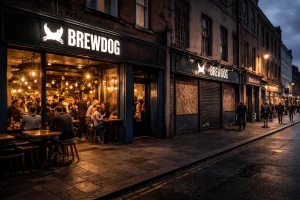
The sale to Tilray Brands did not save every BrewDog location. Only 11 bars were included in the rescue deal, while 38 others shut immediately.
The closures affected towns and cities across Scotland, England and Ireland. Some cities lost every BrewDog venue they had, while others kept one site open and closed the rest.
The closures were especially significant in Scotland because BrewDog began there and had built many of its best-known bars north of the border.
Which Scottish BrewDog Bars Closed?
Several Scottish locations shut permanently as part of the administration process.
The following bars were among those that closed:
| City or Town | BrewDog Venue | Status |
|---|---|---|
| Aberdeen | Castlegate | Closed |
| Aberdeen | Union Square | Closed |
| Glasgow | Merchant City | Closed |
| Glasgow | Argyle Street | Closed |
| Edinburgh | Cowgate | Closed |
| Inverurie | BrewDog Inverurie | Closed |
| Perth | BrewDog Perth | Closed |
| St Andrews | BrewDog St Andrews | Closed |
| Stirling | BrewDog Stirling | Closed |
Many of these venues had been popular for years, which made the closures especially surprising for customers.
In Aberdeen and Glasgow, all of the company’s city-centre bars shut apart from a small number protected by the Tilray deal. Customers in places such as Perth and St Andrews discovered their local venue had closed with almost no warning.
For some towns, the closure marked the end of BrewDog’s original Scottish expansion story. The company had once presented these bars as proof of its success. By 2026, they had become part of the cost-cutting process needed to keep the remaining business alive.
Which BrewDog Bars Are Staying Open Under Tilray?
Only a small number of bars remained open under Tilray’s ownership.
The best-known surviving sites include:
- Edinburgh DogHouse on New Street
- BrewDog Lothian Road in Edinburgh
- DogTap Ellon near the main brewery
Several other bars in England and Ireland were also included in the rescue package, although the full list has not been confirmed publicly.
| Venue | Location | Status Under Tilray |
|---|---|---|
| DogHouse Edinburgh | Edinburgh | Staying open |
| Lothian Road | Edinburgh | Staying open |
| DogTap Ellon | Aberdeenshire | Staying open |
| Selected bars in England and Ireland | Various | Staying open |
| 18 franchise bars | UK and overseas | Continue trading separately |
The 18 franchise bars were not directly owned by BrewDog, so they can continue trading as normal.
Tilray has also hinted that some bars could reopen later if they become financially viable. There have already been discussions about reopening locations in Glasgow and Aberdeen with new contracts and lower costs.
For customers, this means BrewDog has become a much smaller company. Instead of a nationwide chain with dozens of sites, it now operates a limited number of bars centred around its strongest locations.
How Many Jobs Were Lost When BrewDog Went Into Administration?
BrewDog’s collapse had an immediate effect on employees. Around 484 people lost their jobs when the business entered administration.
Although 733 jobs were saved through the sale to Tilray Brands, hundreds of staff were left without work.
The losses mainly affected employees in bars that closed.
These included:
- Bar staff
- Kitchen workers
- Managers
- Delivery and support teams
Many of those affected had worked for BrewDog for years. Some had joined because they believed in the company’s “punk” image and culture.
Trade unions criticised the company for the way the redundancies were handled. Employees said they received little warning and no clear explanation about what would happen next.
Many staff also worried about:
- Unpaid wages
- Holiday pay
- Overtime
- Access to personal belongings left in bars
Administrators said they would try to support workers by connecting them with other employers in hospitality. Even so, for many former staff, the experience felt abrupt and upsetting.
Why Were Staff Criticised Over the 15-Minute Redundancy Call?
One of the most controversial parts of BrewDog’s collapse was the way workers were informed they had lost their jobs.
Employees at closed bars were reportedly given around 25 minutes’ notice before being invited onto a video call. The call lasted only around 15 minutes.
During the meeting, staff were told:
- Their bar was closing
- Their role no longer existed
- They would receive further information later
Workers said they had little opportunity to ask questions.
The union Unite strongly criticised the process and called it “morally repugnant”. Staff said they felt shocked, humiliated and ignored.
Some employees later said the short call summed up everything that had gone wrong at BrewDog. A company that once promoted itself as different and people-focused had ended by treating workers as numbers.
Afterwards, some former staff were invited to apply for new jobs at bars reopening under Tilray. However, these would involve new contracts and conditions, which created further anger among employees.
Did BrewDog’s Workplace Controversies Damage the Business?
BrewDog’s financial problems were not the only reason for its collapse. Over the years, the company also faced repeated criticism over its workplace culture and public image.
Former employees accused the business of creating a culture of fear. Critics said staff felt pressured, undervalued and unable to speak openly.
Although these controversies did not directly cause the administration, they damaged trust in the company. BrewDog had built its success on a loyal following, but many people began to question whether the company still represented the values it promoted.
The damage affected:
- Staff morale
- Recruitment
- Public reputation
- Customer loyalty
By the time BrewDog entered administration, its image had already been weakened by years of criticism.
What Were the Main Allegations Against BrewDog and James Watt?
The strongest criticism focused on James Watt, who led the company for 17 years.
Former employees claimed BrewDog had become dominated by fear, pressure and poor behaviour from senior management.
The main allegations included:
- A toxic workplace culture
- Staff being dismissed suddenly
- Inappropriate behaviour towards female employees
- A gap between BrewDog’s public image and internal reality
In 2021, a group of former staff calling themselves Punks With Purpose published an open letter about their experiences.
Later, a television investigation repeated many of those claims and accused BrewDog of exaggerating parts of its marketing story.
The company denied wrongdoing, but the criticism continued for years.
Even after BrewDog promised to improve, some workers said very little had changed. In 2024, staff at one of its largest bars wrote another open letter complaining about conditions.
These controversies mattered because BrewDog had built its identity around being different from traditional corporations. Once people started to see the company as behaving like the businesses it used to criticise, its reputation began to unravel.
What Happens to James Watt and Martin Dickie Now?
James Watt and Martin Dickie had both stepped away from day-to-day control before BrewDog collapsed.
Watt left his role as chief executive in 2024, although he remained involved as “Captain and Co-Founder”. Dickie later reduced his involvement and focused on other projects.
Both founders are expected to lose the value of the shares they still held in BrewDog. However, they had already received significant payouts from the 2017 investment deal.
Reports suggest Watt attempted to buy the company back shortly before the administration process, although his offer was unsuccessful.
Since the collapse, both men have faced criticism from former staff and investors who believe the company expanded too aggressively under their leadership.
Even if the BrewDog brand survives under Tilray, the founders’ reputations are likely to remain closely linked to the company’s downfall.
What Does Tilray Plan to Do With BrewDog Now?
Tilray Brands says it plans to keep BrewDog alive as a smaller and more focused business.
The company now owns BrewDog’s brewery, beer brands and selected bars. Its main aim appears to be protecting the strongest parts of the business rather than rebuilding the entire old chain.
Tilray is expected to continue selling:
- Punk IPA
- Elvis Juice
- Hazy Jane
- Other core BrewDog beers
The new owner has also suggested it may:
- Reopen some bars in the future
- Expand BrewDog beer in the United States
- Use BrewDog’s distribution network internationally
- Simplify the business and reduce costs
For customers, the most important point is that BrewDog beer is unlikely to disappear from supermarkets, pubs or online shops. The bars may be fewer in number, but the brand itself is expected to continue under its new owner.
What Does the BrewDog Collapse Mean for UK Businesses and Investors?
BrewDog’s collapse is likely to become a warning for other UK businesses.
For business owners, it shows the danger of expanding too quickly without enough profit to support that growth. A company can look successful on paper while still building up unsustainable debt.
For investors, BrewDog highlights the risks of putting money into businesses because of loyalty or brand image.
The collapse also raises wider questions about the UK hospitality sector. Rising wages, rents, taxes and energy bills have made life difficult for many pub and restaurant chains.
The main lessons are clear:
- Rapid growth can become dangerous
- Crowdfunding does not guarantee safety
- Popular brands can still fail
- Hospitality remains a difficult sector in the UK
Many smaller businesses will now look at BrewDog and wonder whether they could face similar pressures if costs continue to rise.
Could BrewDog Have Been Saved?
Perhaps, but only if BrewDog had changed direction much earlier.
The company might have survived if it had:
- Opened fewer bars
- Reduced debt sooner
- Focused on brewing rather than expansion
- Avoided expensive side projects
Some critics believe BrewDog should have slowed down after 2019 instead of continuing to chase growth. Others argue that the 2017 investment deal pushed the company onto a path it could no longer escape.
By the time administrators arrived in 2026, there was no realistic way to save the whole business. Buyers were only interested in the strongest parts of BrewDog, not the full chain of bars and overseas operations.
In the end, the brand survived, but the original company did not. That may have been the best outcome available once the business had reached such a difficult financial position.
Conclusion
BrewDog’s collapse marks the end of one of the UK’s most talked-about business success stories. The company grew from a small Scottish brewery into a global brand worth more than £1 billion, but years of rapid expansion, heavy borrowing and falling profits eventually pushed it into administration.
While the original BrewDog business has gone bust, the brand itself will continue under Tilray Brands, with a smaller number of bars and its best-known beers still on sale.
For former employees and Equity for Punks investors, the collapse has brought disappointment and financial loss. For other businesses, BrewDog is likely to become a warning about the risks of growing too quickly.
The company changed the craft beer industry, but its downfall also shows that popularity and strong branding alone are not enough to guarantee long-term success.
FAQs
Did BrewDog completely shut down?
No, BrewDog did not disappear entirely. The original company went into administration, but the brand and some bars continue under Tilray Brands.
Is BrewDog still selling beer?
Yes, BrewDog beers such as Punk IPA, Elvis Juice and Hazy Jane are still expected to be sold. Tilray plans to keep the core beer range available in supermarkets, pubs and online.
Can Equity for Punks investors get their money back?
Most Equity for Punks investors are unlikely to receive any money back. Shareholders are last in line during administration and BrewDog owed too much money to other creditors.
Why did BrewDog lose so much money?
BrewDog lost money because it expanded too quickly and spent heavily on bars, hotels and overseas projects. Rising costs, lower profits and large debts made the business unsustainable.
Who owns BrewDog now?
Tilray Brands now owns BrewDog’s brewery, core beer brands and selected bars. The founders no longer control the business in the same way they did before administration.
Are BrewDog bars still open in Scotland?
Yes, a small number of BrewDog bars remain open in Scotland, including the DogHouse in Edinburgh and DogTap in Ellon. However, many Scottish sites in Aberdeen, Glasgow and other towns have closed permanently.
Could other UK pub chains face the same problem?
Yes, other pub and hospitality businesses could face similar pressure if costs continue rising. BrewDog’s collapse shows how difficult it can be to survive with high debt and falling profits.