

Switching energy suppliers in 2026 can still reduce your household energy bills, even though savings are smaller than in previous years due to ongoing market volatility.
The UK energy market remains influenced by global wholesale prices and regulatory changes, but households can still benefit by comparing deals and moving from expensive standard variable tariffs to competitive fixed deals.
According to Ofgem’s latest data, the energy price cap fell to £1,641 per year for an average household from April 2026, meaning many fixed deals now offer slightly cheaper and more predictable pricing.
While the cheapest supplier varies depending on usage and location, comparing tariffs remains one of the most effective ways to control energy costs.
Key takeaways:
- The Ofgem price cap dropped 6.7% in April 2026 to £1,641 annually for typical households.
- Fixed tariffs can offer up to 15% lower prices than the cap in some cases.
- Switching suppliers typically takes around five working days and doesn’t interrupt your energy supply.
- Dual-fuel tariffs and smart-meter tariffs may offer additional savings depending on usage.
Is It Worth Switching Energy Suppliers in 2026?

Switching energy suppliers in 2026 can still be a smart way for UK households to reduce their energy costs, especially for those currently on a standard variable tariff (SVT) that follows Ofgem’s energy price cap.
Although the price cap limits the maximum amount suppliers can charge per unit of gas and electricity, it doesn’t necessarily offer the cheapest deal available.
Many energy providers now offer fixed tariffs that are slightly cheaper than the price-capped rates, giving customers the opportunity to lock in predictable prices for 12–24 months.
Energy analysts and comparison platforms suggest that some fixed deals can currently be up to 15% cheaper than the standard capped tariff, depending on the supplier and region.
Switching suppliers is also much easier than many people assume. The process is handled entirely by the new supplier, meaning your gas and electricity supply continues without interruption.
Key benefits of switching energy suppliers in 2026 include:
- Switching usually takes around five working days to complete
- Your energy supply remains the same; only the billing provider changes
- Many tariffs allow switching without exit fees within the final 49 days of a contract
- New suppliers often provide renewable energy tariffs and smart energy management tools
However, if you are currently locked into a fixed tariff with high exit fees, it may be better to wait until the final weeks of your contract before switching.
Exit fees can sometimes range from £50 to £250 per fuel, which could offset any potential savings.
For households currently paying the price cap rate, comparing deals in 2026 remains one of the easiest ways to control energy costs and avoid overpaying for gas and electricity.
How Much Can You Actually Save with a Cheaper Energy Supplier in 2026?

The amount you can save by switching to a cheaper energy supplier in 2026 depends on several factors, including your current tariff, household energy usage, payment method, and location within the UK.
Energy bills in Britain are largely influenced by Ofgem’s energy price cap, which sets the maximum unit price suppliers can charge customers on standard variable tariffs.
As of early 2026, the average annual energy cost for a typical dual-fuel household paying by Direct Debit has been set at the following levels:
Period Average Annual Bill
January – March 2026 £1,758
April – June 2026 £1,641
July – September 2026 (forecast) ~£1,710
October – December 2026 (forecast) ~£1,718
The 6.7% reduction in April 2026, which lowered the price cap from £1,758 to £1,641, has provided some relief for households. However, market volatility and wholesale energy costs mean prices may fluctuate again later in the year.
Many fixed tariffs currently available on the market are estimated to be around £250 cheaper annually than the capped tariff, according to consumer finance analysts and comparison platforms.
Estimated potential savings by household size:
- Single-person flats: £80 – £150 per year
- Average family homes: £150 – £300 per year
- Large households: £300+ depending on usage
It is important to remember that the price cap does not limit the total amount you pay, only the unit rate and standing charges. This means your final bill will always depend on how much energy you actually use.
Because tariffs vary widely between suppliers, using a comparison tool or checking tariffs directly with providers can help households identify the cheapest gas and electricity deals available in their region.
What’s the Best Energy Tariff Type in 2026?

Choosing the right energy tariff is just as important as choosing the cheapest supplier. In 2026, UK households have access to a wide range of tariffs designed to suit different energy usage patterns, budgets, and environmental priorities.
Most energy tariffs fall into two main categories: fixed tariffs and variable tariffs, but within those categories there are several specialised options.
Below is an overview of the most common tariff types available in the UK energy market.
Tariff Type Description Best For
Fixed Tariff Unit rates and standing charges are locked for 12–24 months Households want price certainty
Standard Variable Tariff Rates follow the Ofgem price cap and change quarterly Flexible switching without exit fees
Dual-Fuel Tariff Gas and electricity are supplied by the same provider Convenience and possible discounts
Prepayment Tariff Energy is paid for in advance via meter top-ups Budget control
Tracker Tariff Rates track wholesale prices or the price cap Risk-tolerant households
Time-of-Use Tariff Different electricity prices depending on the time of day EV owners and smart meter users
Green Energy Tariff Electricity sourced from renewable energy generation Environmentally conscious households
For many households in 2026, fixed tariffs remain the most popular choice because they offer predictable pricing and protection from sudden market increases.
However, households with electric vehicles, solar panels, or flexible usage patterns may benefit from time-of-use tariffs or smart tariffs, which provide cheaper electricity during off-peak hours.
Top 10 Cheapest Gas and Electric Suppliers in the UK (2026)
1. Utility Warehouse
Utility Warehouse (UW) is one of the UK’s most distinctive energy providers because it offers bundled household services alongside gas and electricity.
Instead of focusing solely on energy supply, UW allows customers to combine multiple services such as broadband, mobile, and insurance, into a single account, often unlocking additional savings.
In 2026, Utility Warehouse promotes itself as one of the cheapest energy suppliers for customers who bundle services, offering competitive tariffs that can be cheaper than the Ofgem energy price cap when combined with other household services.
According to current pricing examples based on Ofgem’s typical domestic usage, UW’s Fixed Saver tariff is estimated at around £1,720 per year for dual-fuel customers, which is slightly below the £1,758 energy price cap for early 2026.
One of UW’s biggest advantages is its bundle savings model, where customers receive better pricing when they switch multiple services together. This approach is designed to reduce overall household bills while simplifying billing and account management.
Key Benefits of Utility Warehouse
- Tariffs are designed to be cheaper than the energy price cap when bundled
- Potential £38 savings on fixed tariffs compared with capped rates
- Up to £50 savings on variable tariffs when bundling services
- Up to £150 welcome credit for new homeowner customers
- £400 contribution toward early exit fees from your current supplier
- Access to a Cashback Card offering up to 10% cashback at selected retailers
Another attractive feature is UW’s Cashback Card programme, which allows customers to earn cashback on everyday spending at participating retailers. The cashback can be used to offset household bills, providing additional long-term savings for families.
Utility Warehouse also offers EV-friendly energy tariffs, including cheaper off-peak electricity rates between midnight and 5am, which can help reduce the cost of charging electric vehicles overnight.
Tariff Examples (Typical Usage – Dual Fuel)
| Tariff | Estimated Annual Cost | Potential Savings |
| Fixed Saver Tariff | £1,720 | £38 below price cap |
| Variable Tariff (bundled services) | £1,705 | Up to £50 below the price cap |
These prices are based on typical household energy consumption and payment by Direct Debit. Actual costs may vary depending on energy usage and location.
Why Many Households Choose Utility Warehouse?
Utility Warehouse has built a strong reputation for value-focused energy plans and bundled services, and it has received multiple industry awards for value and customer service.
The company also offers a Price Pledge, promising to refund customers if they do not save money during their first year.
For households looking to combine their utilities into a single account and take advantage of bundled discounts, Utility Warehouse can be a practical option.
Its combination of competitive tariffs, cashback incentives, and flexible service bundles makes it a popular choice for customers seeking a simpler way to manage household bills.
2. Octopus Energy
Octopus Energy is one of the fastest-growing energy suppliers in the UK and is widely recognised for its competitive pricing, renewable electricity, and innovative smart tariffs.
The company has built a strong reputation for combining fair energy pricing with advanced technology that helps households manage their electricity usage more efficiently.
Unlike many large suppliers, Octopus Energy states that it has consistently kept its standard variable tariff below the Ofgem energy price cap, helping customers avoid the highest regulated energy rates.
This approach has reportedly saved customers millions of pounds compared with traditional capped tariffs.
One of the standout features of Octopus Energy is its focus on smart energy tariffs, which allow customers to reduce bills by shifting electricity usage to cheaper off-peak periods.
These tariffs are particularly beneficial for households with electric vehicles, solar panels, heat pumps, or battery storage systems, but they can also benefit customers who want more control over their energy consumption.
Key Benefits of Octopus Energy
- Standard tariffs are often priced below the Ofgem energy price cap
- Access to innovative smart tariffs that reward flexible energy use
- 100% renewable electricity is supplied as standard for many tariffs
- Award-winning customer service and transparent pricing
- Loyalty rewards through the Octoplus membership programme
Octopus Energy also offers several specialised tariffs designed to reduce energy costs through smart technology. These tariffs track wholesale prices or provide cheaper electricity during off-peak hours, helping customers optimise their energy usage.
Popular Smart Tariffs from Octopus Energy
Tariff Key Feature Best For
Intelligent Octopus Go Six off-peak hours for cheaper overnight electricity Electric vehicle owners
Octopus Tracker Daily prices that track wholesale energy costs Customers seeking market-based pricing
Agile Octopus Half-hourly electricity prices updated daily Households are able to shift usage times
Octopus Flux Smart solar and battery export tariff Homes with solar panels and batteries
Through its Octoplus loyalty programme, customers with a smart meter and Direct Debit payments can access additional perks such as free coffees, discounted cinema tickets, and special rewards for participating in energy-saving initiatives like “Saving Sessions.”
Green Energy and Low-Carbon Technology
Octopus Energy is also heavily invested in renewable energy development, with over £6 billion invested in renewable projects across multiple countries.
The company actively promotes low-carbon technologies such as heat pumps, solar panels, and electric vehicles.
For example, households switching to an Octopus heat pump system could save around £370 per year on heating costs, while solar and battery systems paired with Octopus smart tariffs may reduce electricity bills by as much as 90% for some homes.
Why Many UK Households Choose Octopus Energy?
Octopus Energy is often recommended for customers who want competitive pricing combined with innovative energy technology.
Its focus on renewable energy, flexible tariffs, and transparent pricing has helped it become one of the most awarded energy suppliers in the UK.
For households looking for a supplier that blends green energy, smart technology, and flexible tariffs, Octopus Energy remains one of the strongest alternatives to traditional providers in the UK energy market.
3. Outfox the Market
Outfox the Market is a UK-based energy supplier known for offering some of the cheapest fixed tariffs available in the market, often priced below the Ofgem energy price cap.
The company focuses on providing transparent pricing and straightforward energy plans designed to help households reduce their gas and electricity bills.
One of the main selling points of Outfox the Market is its commitment to keeping tariffs consistently cheaper than the price cap, ensuring customers pay less than the regulated maximum price set by Ofgem.
According to current estimates based on typical domestic consumption, some of the supplier’s fixed tariffs can be around 14% cheaper than the price cap, potentially saving households approximately £249 per year on dual-fuel energy bills.
Unlike many suppliers that rely heavily on complex tariffs, Outfox the Market aims to keep things simple by offering competitive pricing, flexible contracts, and clear billing.
Key Benefits of Outfox the Market
- Fixed tariffs designed to stay below the Ofgem energy price cap
- Potential savings of around £249 per year on typical dual-fuel usage
- Transparent pricing with clear monthly costs
- Access to EV-friendly tariffs for cheaper overnight charging
- UK-based customer support with strong customer satisfaction ratings
Outfox the Market also provides an energy plan known as “Outfox the Price Cap”, which guarantees that its tariff remains at least 5% cheaper than the price cap.
If the cap falls, the tariff adjusts automatically, allowing customers to continue benefiting from lower rates.
Example Tariffs (Typical Domestic Usage)
Tariff Estimated Monthly Cost Potential Savings
1-Year Fixed Dual Fuel £125.74/month ~£249/year below price cap
1-Year Fixed Electricity £70.00/month ~£134/year below price cap
These estimates are based on Ofgem’s Typical Domestic Consumption Values, which assume annual energy usage of approximately 2,700 kWh of electricity and 11,500 kWh of gas for a medium-sized household.
EV Tariffs and Smart Energy Options
For households with electric vehicles, Outfox the Market offers special EV tariffs that provide discounted overnight electricity rates. These tariffs allow customers to charge their vehicles at lower costs during off-peak hours while supporting more efficient energy use across the national grid.
Customers can also manage their accounts easily using the provider’s mobile app, which allows users to submit meter readings, track balances, and monitor energy consumption.
Why Many Households Choose Outfox the Market?
Outfox the Market has gained popularity among UK households looking for simple, low-cost energy tariffs without complicated pricing structures.
Its focus on competitive pricing and reliable customer support has helped it earn strong ratings on review platforms such as Trustpilot.
For customers primarily focused on affordable energy and predictable monthly bills, Outfox the Market offers a straightforward alternative to larger energy suppliers while maintaining competitive tariffs below the price cap.
4. Ecotricity
Ecotricity is one of the UK’s best-known green energy suppliers and is aimed at households that want their energy bills to support renewable power rather than traditional fossil-fuel generation.
The supplier says all of its electricity is 100% green, and its gas is a mix of fossil gas and sustainable green gas, with investment also going into direct carbon removal and new renewable generation.
Unlike suppliers that focus primarily on being the absolute cheapest, Ecotricity positions itself as a purpose-led energy provider, where customer bills help fund cleaner energy infrastructure.
Its green ethos is central to its brand, and the company highlights that its electricity is also certified vegan.
For households in 2026, Ecotricity offers a mix of tariff options, including a Green Variable tariff with no fixed contract, alongside 1-year fixed green tariffs and a 1-year fixed EV tariff listed in its January 2026 principal terms.
That means customers can choose between flexibility and price certainty depending on their household needs.
Key Benefits of Ecotricity
- Supplies 100% green electricity from renewable sources, including wind, solar, hydro and offshore wind.
- Offers a Green Variable tariff with no fixed contract and no tie-in.
- Provides 1-year fixed green tariffs for customers who want greater price certainty in 2026.
- Has a 1-year fixed EV tariff designed for electric vehicle owners.
- Pays households 16p per kWh for exported excess electricity through its Smart Export Tariff.
One of Ecotricity’s main strengths is that it appeals to customers who care about the environmental impact of their supplier, not just the headline tariff price.
The company says every bill helps support the development of new forms of green energy, which gives it a different position from mainstream budget-focused providers.
Green Tariffs and Low-Carbon Features
Ecotricity’s tariff range is designed around greener household energy use. Its variable tariff allows customers to stay flexible without being locked into a long contract, while its fixed tariffs give more certainty over rates.
For EV owners, the supplier also offers a dedicated fixed EV tariff, and its smart meter guidance notes that cheaper overnight green electricity is available for electric vehicle charging on that plan.
The supplier also supports households generating their own power. Through its Smart Export Tariff, customers can receive payment for excess solar electricity exported back to the grid, at a rate of 16p per kWh, with no exit fees or end date mentioned in the indexed listing.
Why Many Households Choose Ecotricity?
Ecotricity is often chosen by households that want a greener alternative to mainstream energy suppliers. The company highlights its environmental mission, which? Eco Provider status, and customer service as key reasons to switch.
It is therefore likely to appeal most to consumers who prioritise renewable electricity, ethical energy sourcing, and long-term environmental impact alongside their household bills.
For readers comparing the top cheap gas and electric suppliers in the UK, Ecotricity may not always be the lowest-cost option on headline price alone, but it remains a strong choice for those who want a supplier built around green electricity, greener gas progress, EV support, and solar export options in 2026.
5. Sainsbury’s Energy
Sainsbury’s Energy is a UK home energy brand that focuses on combining gas and electricity supply with Nectar-based rewards and customer perks.
Rather than competing only on headline tariff price, it positions itself as a more rewarding option for households that want to earn points on their energy account and on Sainsbury’s shopping, while still accessing standard domestic energy plans
Sainsbury’s Energy is a trading name used under licence by E.ON Next Energy Limited, which means the energy supply and account management are supported by one of the major players in the UK market.
One of its biggest attractions in 2026 is the ability to earn up to triple Nectar points at Sainsbury’s for the life of an eligible tariff, alongside bonus Nectar points when joining certain fixed plans.
The site also promotes its Track & Reward tariff, which gives eligible customers up to 1,500 Nectar points every quarter on a dual-fuel plan, while promising they will not pay more than the price cap and can leave without exit fees.
Sainsbury’s Energy also adds extra value through home-energy upgrade offers. Customers can access discounts on selected energy improvements via E.ON Next, including up to £200 off solar panels and batteries and £30 off a home EV charger.
That makes it a useful option for households looking beyond day-to-day billing and into longer-term energy efficiency.
Key Benefits of Sainsbury’s Energy
- Earn up to triple Nectar points on Sainsbury’s shopping while on supply.
- Eligible customers can get bonus Nectar points when joining fixed tariffs, including up to 8,000 points on selected 24-month dual-fuel fixed tariffs during promotional periods.
- The Track & Reward 12m tariff offers up to 1,500 Nectar points every quarter for dual-fuel customers.
- Customers can access dedicated customer service by email or phone.
- Includes energy-efficiency perks such as solar, battery, and EV charger discounts through E.ON Next.
One of the strongest selling points of Sainsbury’s Energy is that it appeals to households already using the Nectar ecosystem. For shoppers who regularly spend at Sainsbury’s, the added points can improve the overall value of the tariff, especially when combined with sign-up bonuses and ongoing multiplier points.
Reward Features and Tariff Highlights
Feature What It Offers Best For
Fixed tariffs with Nectar bonuses Join eligible 12- or 24-month tariffs and receive bonus Nectar points Households wanting points plus price certainty
Track & Reward 12m tariff Variable tariff linked to the Ofgem price cap with quarterly Nectar rewards and no exit fees Customers who want flexibility and loyalty rewards
Shopping points multiplier Up to triple Nectar points at Sainsbury’s for dual-fuel customers Regular Sainsbury’s shoppers
The site also explains that Track & Reward customers must pay by monthly Direct Debit, manage the account online, and have a smart meter installed or agree to have one fitted within 90 days of the tariff start date.
That makes this plan especially relevant for households comfortable with digital account management and smart-meter-based usage tracking.
Account Management and Customer Experience
Sainsbury’s Energy places strong emphasis on ease of use. Customers can manage their accounts online, track energy usage, send meter readings, and adjust Direct Debit settings in one place.
The switch process is also presented as simple, with the site breaking it into three stages: get a quote, sign up, and link the account to a Nectar card.
For households that value convenience, this setup can make the supplier appealing. The combination of online account tools, reward tracking, and dedicated support gives it a broader lifestyle angle than a standard low-cost tariff alone.
Why Many Households Choose Sainsbury’s Energy?
Sainsbury’s Energy is likely to appeal most to customers who want a familiar household brand, reward-led value, and simple online account management.
While it may not always be the absolute cheapest supplier on a pure tariff-only comparison, it offers an attractive mix of Nectar rewards, flexible tariff options, and home-energy upgrade benefits that can improve overall value for the right customer.
For readers comparing the top cheap gas and electric suppliers in the UK, Sainsbury’s Energy stands out less for rock-bottom pricing and more for its reward-based model, supported by E.ON Next infrastructure and loyalty benefits that extend beyond the energy bill itself.
6. EDF Energy
EDF Energy is one of the UK’s largest energy suppliers, offering a mix of fixed-price tariffs, smart energy options, and low-carbon electricity generation.
For households comparing gas and electricity providers in 2026, EDF is known for combining long-term price stability with modern energy technology.
One of its key offerings is the 2-year fixed tariff, which allows customers to lock in energy rates and protect themselves from potential price increases.
This can be particularly useful in a market where Ofgem’s energy price cap changes every three months.
EDF also promotes several smart energy solutions, including tariffs that reward households for shifting electricity usage to off-peak hours, along with support for solar panels, heat pumps, electric vehicles, and smart meters.
Key Benefits of EDF Energy
- 2-year fixed tariffs for long-term price certainty
- Access to smart tariffs that reward flexible energy usage
- Sunday Saver challenge offering free electricity for reducing peak usage
- Support for solar panels, EV charging, and heat pump installations
- One of Britain’s largest generators of zero-carbon electricity
Tariff and Smart Energy Features
Feature What It Offers Best For
2-Year Fixed Tariff Locks in energy prices for a longer period Budget certainty
Smart Tariffs Cheaper electricity at certain times Flexible energy users
Sunday Saver Challenge Earn free electricity by cutting weekday peak use Smart meter customers
Price Cap Tools Compare tariffs with future price cap predictions Customers deciding whether to fix
Why Many Households Choose EDF Energy?
EDF Energy appeals to customers who want the reassurance of a large, established supplier combined with flexible tariffs and greener energy options.
While it may not always offer the lowest tariffs in every region, its fixed-price protection, smart energy programmes, and investment in low-carbon power make it a strong option for UK households looking for stability and modern energy solutions.
7. E.ON Next
E.ON Next is a major UK energy supplier offering fixed tariffs, smart energy plans, and renewable electricity options for households.
In 2026, the provider focuses on helping customers manage their energy usage through flexible tariffs and smart technology designed to reduce electricity costs.
The supplier offers both standard fixed tariffs for price certainty and smart tariffs that provide cheaper electricity during off-peak hours. These options are particularly useful for households with smart meters, electric vehicles, or solar panels.
E.ON Next also promotes home energy upgrades such as heat pumps, solar panels, battery storage, and EV chargers, allowing customers to reduce their long-term energy costs while lowering their carbon footprint.
Key Benefits of E.ON Next
- Fixed tariffs for predictable energy bills
- Smart tariffs with cheaper off-peak electricity rates
- Next Drive Smart EV tariff with lower overnight charging prices
- Export tariffs that pay households for unused solar energy
- Access to discounts on heat pumps, solar panels, and EV chargers
Tariff and Smart Energy Features
Feature What It Offers Best For
Fixed Tariffs Locks in prices for a set period Budget certainty
Next Smart Saver Lower electricity prices during off-peak hours Smart meter users
Next Drive Smart Discounted overnight EV charging Electric vehicle owners
Export Tariffs Payments for exported solar energy Homes with solar panels
Why Many Households Choose E.ON Next?
E.ON Next is popular with customers looking for a well-established supplier with flexible tariffs and smart energy tools. While it may not always offer the lowest tariff in every region, its mix of fixed pricing, EV tariffs, and renewable energy support makes it a strong option for households seeking both savings and modern energy solutions in the UK.
Which Energy Supplier Has the Lowest Tariffs in 2026?
The cheapest energy supplier in the UK can change frequently because tariffs depend on a combination of factors, including:
- Household energy usage
- Regional energy distribution costs
- Payment method (Direct Debit, prepayment, or quarterly billing)
- Wholesale energy prices
For this reason, the lowest tariff for one household may not be the cheapest option for another.
However, several suppliers regularly appear among the most competitively priced energy providers in the UK according to comparison platforms.
Suppliers frequently offering low-cost tariffs include:
- Outfox the Market
- Octopus Energy
- E Energy
- Utility Warehouse
- So Energy
Some of these suppliers specialise in low-cost tariffs, while others combine competitive pricing with renewable electricity or smart energy technology.
Because tariffs can vary depending on your postcode and energy usage, comparing offers across multiple suppliers remains the best way to find the cheapest gas and electric supplier in the UK for your household.
8. 100Green
100Green is a UK energy supplier that focuses entirely on 100% renewable electricity and green gas, making it a popular choice for households that want their energy to come from sustainable sources.
Unlike many providers that rely on carbon offsets, 100Green states that both its electricity and gas tariffs are sourced from renewable energy.
The supplier offers simple tariff options, including flexible variable plans and fixed deals that provide greater price certainty. Its tariffs are designed for customers who want environmentally friendly energy without complicated pricing structures.
Key Benefits of 100Green
- Supplies 100% renewable electricity and green gas
- Offers variable tariffs with no exit fees
- Provides 12-month fixed tariffs for price certainty
- Includes smart tariffs designed for EV charging and off-peak usage
- Recognised as a Which? Recommended Provider
Tariff and Smart Energy Features
Feature What It Offers Best For
Sparkling Variable Flexible pricing with no exit fees Flexible households
Sparkling Guarantee Fixed rates for 12 months Budget certainty
Tide Smart Multi-rate tariff with cheaper off-peak electricity Smart meter users
Tide EV Lower-cost overnight EV charging Electric vehicle owners
Why Many Households Choose 100Green?
100Green is best suited to customers who prioritise renewable energy and sustainable living. While it may not always be the cheapest supplier, its focus on fully green energy and straightforward tariffs makes it an attractive option for environmentally conscious households in the UK.
9. E Energy

E Energy, also known as E, is a UK-based energy supplier focused on affordable tariffs, smart prepayment options, and flexible energy plans.
The company aims to provide simple pricing and better control over energy usage, particularly for households using smart meters or pay-as-you-go systems.
One of its standout features is the MySmartE mobile app, which allows customers to manage their energy account, top up meters, and track usage easily.
The supplier also provides support options such as emergency credit and friendly credit hours, helping customers maintain their energy supply during low balances.
Key Benefits of E Energy
- No exit fees on tariffs
- Easy account management through the MySmartE app
- Emergency and friendly credit support
- Access to the Warm Home Discount for eligible households
Tariff and Customer Features
Feature What It Offers Best For
Flexible Tariffs No exit fees for switching Flexible households
MySmartE App Manage and top up smart meters Prepayment customers
Emergency Credit Extra support when the balance is low Budget-focused homes
Why Many Households Choose E Energy?
E Energy is a practical choice for customers who want simple tariffs, smart prepayment options, and flexible switching. Its focus on easy account management and customer support makes it suitable for households looking for straightforward energy plans in the UK.
10. Your Co-op Energy
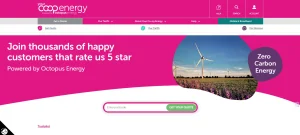
Your Co-op Energy is a UK supplier offering 100% zero-carbon electricity and gas, with a strong focus on community-owned renewable energy.
It works in partnership with Octopus Energy, combining co-operative values with Octopus-backed service and tariff support.
The supplier is designed for households that want more than just a basic tariff. Alongside standard fixed and flexible plans, it also offers a Community Power tariff, which supports renewable energy projects owned by local communities across the UK.
Key Benefits of Your Co-op Energy
- 100% zero-carbon electricity and gas
- Backed by Octopus Energy’s platform and support
- Offers a Community Power tariff linked to local renewable projects
- No exit fees on highlighted plans
- Access to Octoplus rewards for eligible smart meter customers
Tariff and Customer Features
Feature What It Offers Best For
Fixed Tariff Set energy prices for a fixed term Budget certainty
Flexible Tariff Prices move with market changes Flexible households
Community Power Tariff Supports community-owned renewable generation Eco-conscious homes
Octoplus Rewards Points and rewards through Octopus app Smart meter users
Why Many Households Choose Your Co-op Energy?
Your Co-op Energy is a good fit for customers who want fair-value tariffs, renewable energy, and community-focused supply. While it may not always be the absolute cheapest in every area, its mix of zero-carbon energy, co-operative values, and Octopus-backed service makes it a strong option for UK households in 2026.
What Is the Ofgem Energy Price Cap in 2026?
The Energy Price Cap is a regulatory mechanism introduced by Ofgem in 2019 to protect households on default or standard variable tariffs from excessive energy costs.
Rather than limiting the total bill a household pays, the cap limits the maximum unit price suppliers can charge for gas and electricity, as well as the daily standing charge for maintaining access to the energy network.
The cap is reviewed and updated every three months to reflect changes in wholesale energy prices and other industry costs.
Energy Price Cap levels in 2026
Period Annual Typical Bill
January – March 2026 £1,758
April – June 2026 £1,641
July – September 2026 (forecast) ~£1,710
October – December 2026 (forecast) ~£1,718
It’s important to understand that the price cap does not guarantee a maximum total bill. If a household uses more energy than the typical usage level assumed by Ofgem, the final annual cost will be higher.
While the cap offers consumer protection, many energy experts recommend comparing fixed tariffs, as they can sometimes provide lower rates than the capped tariff.
Which Suppliers Offer the Cheapest Dual-Fuel Deals?

Dual-fuel tariffs allow households to receive both gas and electricity from the same supplier. These plans are popular across the UK because they simplify billing and sometimes offer discounted rates.
Instead of dealing with separate companies for gas and electricity, customers receive one combined bill and manage their energy account through a single provider.
Key Benefits of Dual-fuel Tariffs
- One supplier for both gas and electricity
- Simplified billing and account management
- Potential discounts for combining fuels
- Easier switching and customer support
Several UK suppliers offer competitive dual-fuel tariffs.
Popular Dual-fuel Suppliers in 2026
- Octopus Energy
- EDF Energy
- British Gas
- E.ON Next
- Utility Warehouse
Although dual-fuel deals are convenient, they are not always guaranteed to be the cheapest option. In some cases, households may find better prices by choosing separate suppliers for gas and electricity.
For this reason, energy comparison tools remain the best way to determine whether a dual-fuel tariff offers the most cost-effective solution for your home.
How Do Wholesale Energy Prices Affect UK Bills?
Wholesale energy prices play a major role in determining how much UK households pay for gas and electricity. Energy suppliers purchase gas and electricity in bulk from global wholesale markets before selling it to consumers.
When these wholesale costs rise, suppliers typically pass those increases on to customers through higher tariffs.
Several global factors can influence wholesale energy prices. These include geopolitical tensions, supply disruptions, extreme weather conditions, and fluctuations in global demand.
For example, recent instability in international energy markets and conflicts affecting key supply routes have contributed to volatility in wholesale gas prices.
In the UK, Ofgem adjusts the Energy Price Cap every three months to reflect changes in wholesale market costs. Since wholesale energy makes up roughly 39% of a typical household’s energy bill, even small changes in market prices can have a noticeable impact on consumer bills.
Other elements that affect the price cap include:
- Network maintenance costs for energy infrastructure
- Operational costs such as billing and smart meter services
- Government environmental and social policies
- Supplier operating costs and profit margins
When wholesale prices increase, energy suppliers may raise tariffs, or the price cap may be adjusted upward in the following quarter. This is why many experts recommend comparing fixed tariffs during periods of market uncertainty, as locking in a fixed rate can help protect households from sudden price increases.
When Should You Avoid Switching Energy Suppliers?

While switching energy suppliers can often lead to savings, there are situations where changing tariffs may not be the best option.
One of the main reasons to reconsider switching is if you are currently tied to a fixed tariff with a significant early exit fee. These fees can range from £50 to £250 per fuel, meaning that leaving your contract early could cancel out any potential savings from a new deal.
Another situation where switching may not make financial sense is when wholesale prices are falling, and your existing tariff already offers competitive rates. In such cases, moving to a new tariff could lock you into higher rates if prices drop further.
You may want to avoid switching if:
- Your exit fees exceed the potential savings from a new tariff
- Your current tariff already offers lower rates than the market average
- You are within a short period of moving home, where switching might complicate billing
However, if your current tariff is a standard variable tariff controlled by the Ofgem price cap, it is usually worth comparing deals. These tariffs are often among the most expensive options available, meaning households may still benefit from exploring alternative suppliers.
Before switching, it is always advisable to calculate your potential savings over the duration of the new contract and compare that with any exit fees you might need to pay.
What Are Standing Charges and Why Do They Matter?
Standing charges are fixed daily fees that households pay to remain connected to the energy network, regardless of how much energy they actually use.
These charges cover the costs associated with maintaining the infrastructure that delivers gas and electricity to homes.
This includes maintaining the network of pipes and wires, operating energy distribution systems, and supporting metering services.
For many UK households, standing charges make up a significant portion of annual energy bills. Under the 2026 energy price cap, the average standing charge for households paying by Direct Debit is estimated to be around £315 per year before any energy is used.
Standing charges vary depending on several factors:
- Your region in the UK
- Your payment method
- The type of tariff you are on
- Your energy supplier
For example, some regions face higher infrastructure costs, which means the standing charge can vary significantly between locations.
Because these charges apply even when no energy is used, they can disproportionately affect households that consume very little gas or electricity. This has led to calls for reform, and Ofgem has proposed that suppliers introduce low-standing charge tariffs to provide alternative pricing structures for low-usage households.
Understanding both the unit rate and the standing charge is essential when comparing energy tariffs, as the cheapest tariff on paper may not always offer the lowest total annual cost.
How Long Does It Take to Switch Energy Suppliers?

Switching energy suppliers in the UK is a straightforward process that has become much faster in recent years. Most supplier switches now take around five working days once the application has been completed.
Importantly, switching suppliers does not interrupt your gas or electricity supply. The same energy infrastructure continues to deliver power to your home; the only change is the company that manages your account and billing.
The switching process typically follows three simple steps:
- Compare available tariffs: Consumers usually begin by using an energy comparison website or contacting suppliers directly to review available deals. To receive accurate quotes, you will need details such as your address, current tariff, and annual energy usage.
- Select a new supplier and tariff: Once you choose a new deal, the new supplier will begin the switching process and notify your current provider automatically.
- Confirm meter readings and complete the switch: You will normally need to submit a meter reading on the day the switch takes place. This ensures your final bill from the previous supplier is accurate.
After signing up for a new tariff, you still benefit from a 14-day cooling-off period, allowing you to cancel the switch if you change your mind.
Energy-Saving Tips to Reduce Your Bills in 2026
Although switching energy suppliers can help reduce costs, improving your household’s energy efficiency is one of the most effective ways to lower long-term energy bills.
With energy prices still relatively high, many households are looking for simple ways to reduce consumption without sacrificing comfort.
Practical ways to cut energy costs include:
- Lower your thermostat slightly: Reducing your thermostat by just one degree can save around £90 per year on average energy bills.
- Turn off appliances on standby: Devices left on standby still consume electricity. Turning them off completely could save up to £45 annually.
- Wash clothes at lower temperatures: Using cooler washing machine settings can reduce electricity consumption and save approximately £20–£25 per year.
- Improve home insulation: Upgrading loft insulation, wall insulation, or installing energy-efficient windows can significantly reduce heating costs.
- Consider renewable energy options: Installing solar panels or switching to a renewable electricity tariff can reduce both your carbon footprint and long-term energy expenses.
In addition to these steps, many households are now exploring electric vehicle tariffs, heat pump tariffs, and smart energy monitoring systems, which allow them to shift energy usage to cheaper off-peak periods.
Taking a combination of these measures alongside comparing tariffs regularly can help households maintain better control over their energy spending in 2026.
Conclusion
Choosing the cheapest energy supplier in the UK in 2026 depends on more than just headline prices. While the Ofgem energy price cap limits how much suppliers can charge on standard tariffs, many providers still offer deals that can help households reduce their energy bills.
Suppliers such as Outfox the Market and Utility Warehouse focus on lower-cost tariffs, while companies like Octopus Energy and EDF Energy offer smart technology and flexible energy plans. Meanwhile, providers including Ecotricity, 100Green, and Your Co-op Energy appeal to customers who prefer renewable energy options.
Ultimately, the best supplier depends on your energy usage, tariff type, and household needs. Comparing tariffs regularly and switching when better deals appear can help ensure you get the best value for your energy bills in 2026.
FAQs
Who is the cheapest energy supplier in the UK in 2026?
The cheapest energy supplier can vary depending on your location, tariff type, and energy usage. Providers such as Outfox the Market, Octopus Energy, and Utility Warehouse often appear among the most competitive options.
Is it worth switching energy suppliers in 2026?
Yes, switching suppliers can still reduce energy bills if you find a tariff cheaper than the Ofgem price cap. Many switches are completed within a few days and your energy supply will not be interrupted.
How long does it take to switch energy suppliers in the UK?
Most energy switches now complete in around five working days. The process is handled by the new supplier, so customers usually do not need to contact their existing provider.
What is the Ofgem energy price cap?
The Ofgem price cap limits the unit rates and standing charges suppliers can charge customers on standard variable tariffs. However, it does not cap the total bill, meaning higher usage still results in higher costs.
Can I switch energy suppliers if I have a smart meter?
Yes, you can switch energy suppliers even if you have a smart meter installed. In most cases, the meter will continue to work normally with your new supplier.
Are green energy suppliers more expensive?
Some renewable energy suppliers may charge slightly higher tariffs, but many now offer competitive pricing. Providers like Octopus Energy and Ecotricity focus on renewable electricity while remaining competitive in the market.
Will my gas or electricity supply stop during the switch?
No, switching energy suppliers does not interrupt your gas or electricity supply. The physical energy infrastructure remains the same regardless of the company you choose.