


Buying property through a limited company can offer tax advantages, particularly for UK landlords who want to reinvest rental income, manage multiple properties or reduce the impact of restrictions on mortgage interest relief.
Under this arrangement, the company legally owns the property, receives rental income and pays Corporation Tax on its taxable profits.
However, the structure also brings additional mortgage costs, Stamp Duty, accounting responsibilities and potential tax charges when profits are withdrawn.
With the government proposing higher property income tax rates from April 2027, understanding the difference between personal ownership and company ownership has become increasingly important.
This guide explains the advantages, disadvantages, costs and practical steps involved in purchasing property through a limited company.
Is Buying Property Through a Limited Company Worth It in 2027?
Buying property through a limited company may be worthwhile in 2027 for higher-rate taxpayers, landlords with substantial mortgage borrowing and investors planning to expand their portfolios.
The main advantage is that a company can generally deduct qualifying mortgage interest when calculating taxable profits.
It can also retain profits for future investment without immediately triggering personal dividend tax.
However, landlords who own just one property or need to withdraw all their rental earnings may find that additional costs reduce the financial benefits.
The decision depends on several factors:
- Personal Tax Position: Higher-rate taxpayers may benefit more from the differences in mortgage interest relief.
- Property Portfolio Size: Investors planning several purchases may find company ownership more practical.
- Mortgage Costs: Higher borrowing charges can reduce potential tax savings.
- Long-Term Investment Goals: Retaining rental profits can help fund additional properties.
- Profit Withdrawal Requirements: Taking dividends introduces another layer of taxation.
Company ownership is not automatically cheaper. Investors should compare the total tax and operating costs before purchasing.
How Will the 2027 Property Income Tax Changes Affect Landlords?
The October 2026 Budget proposed increasing the rates of Income Tax applied to property income from 6 April 2027.
The proposals would introduce the following rates for individual landlords:
| Tax Band | 2026/27 Rates | Proposed 2027/28 Property Rates |
|---|---|---|
| Basic Rate | 20% | 24% |
| Higher Rate | 40% | 44% |
| Additional Rate | 45% | 49% |
The 2026/27 figures are the standard rates applying to relevant property income in England, Wales and Northern Ireland.
Scotland has different personal Income Tax rules, and devolved arrangements may affect future property rates.
The Finance Act 2026 originally provided for property rates of 22%, 42% and 47% from April 2027.
The October 2026 Budget subsequently proposed increasing these rates to 24%, 44% and 49%, subject to further legislation.
These changes relate to property income received by individuals and other affected non-corporate taxpayers.
Rental profits earned by a limited company remain within the Corporation Tax system.
Consequently, some landlords may reconsider whether future rental investments should be held personally or through a company.
Nevertheless, incorporation does not remove tax on dividends or the costs of transferring existing properties.

Official HMRC guidance confirms the proposed property income tax rates of 24%, 44% and 49% from April 2027.
What Are the Tax Advantages of Buying Property Through a Limited Company?
The main tax advantages of limited company property ownership relate to Corporation Tax, mortgage interest deductions and the ability to retain earnings.
These benefits can be particularly valuable where rental income is reinvested rather than withdrawn for personal spending.
Corporation Tax and Mortgage Interest Relief
Limited companies pay Corporation Tax on taxable rental profits instead of personal Income Tax.
The Corporation Tax system currently includes three main treatments:
| Taxable Company Profits | Corporation Tax Treatment |
|---|---|
| £50,000 Or Less | 19% Small Profits Rate |
| Between £50,000 And £250,000 | Marginal Relief May Apply |
| Above £250,000 | 25% Main Rate |
The thresholds can be reduced where the company has associated companies or a short accounting period.
The actual tax liability therefore depends on the company’s circumstances.One important advantage concerns mortgage interest.
Individual residential landlords generally cannot deduct mortgage interest directly when calculating taxable rental profits.
Instead, they receive a basic-rate tax reduction, subject to HMRC’s rules and limitations.
Limited companies are not subject to this particular restriction and can generally deduct qualifying mortgage finance costs when calculating taxable profits.
For landlords with substantial mortgages, this difference can improve the amount remaining after tax.
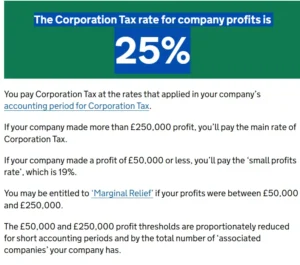
GOV.UK confirms the 19% small-profits rate, 25% main Corporation Tax rate and availability of Marginal Relief.
Retaining Profits and Dividend Tax
Another advantage is the opportunity to retain rental profits within the company.
For example, a company generating £20,000 in taxable profits and qualifying for the 19% Corporation Tax rate would have:
- Taxable Profit: £20,000
- Corporation Tax: £3,800
- Profit Remaining After Tax: £16,200
The remaining £16,200 could be retained for future property purchases, renovations or other legitimate business expenses.
However, if the shareholder withdraws those earnings as dividends, personal dividend tax may apply.
For the 2026/27 tax year, dividend rates above the £500 dividend allowance are:
| Dividend Tax Band | Tax Rate |
|---|---|
| Basic Rate | 10.75% |
| Higher Rate | 35.75% |
| Additional Rate | 39.35% |
These rates are also shown in the government’s published 2027/28 Budget tables.
This creates two potential stages of taxation: Corporation Tax on company profits and personal dividend tax when profits are distributed.
Therefore, limited company ownership is often more attractive when investors plan to retain earnings rather than withdraw all profits immediately.
What Are the Disadvantages of Buying Property Through a Limited Company?
Although a limited company can offer tax advantages, it introduces additional financial and administrative responsibilities.
The main disadvantages include:
- Higher Mortgage Costs: Limited company buy-to-let mortgages may carry higher interest rates, arrangement fees or deposit requirements.
- Additional Administration: Directors must maintain company records, submit accounts and meet Corporation Tax and Companies House filing obligations.
- Personal Guarantees: Mortgage lenders may require directors or shareholders to guarantee company borrowing.
- Dividend Tax: Withdrawing rental profits for personal use can increase the overall tax burden.
- Property Sale Taxes: Companies pay Corporation Tax on chargeable gains, and withdrawing sale proceeds may create further personal tax liabilities.
- Reduced Flexibility: Transferring a company-owned property into personal ownership can trigger additional tax and legal costs.
Limited liability is another area that requires careful consideration.
Although the company is legally separate from its directors, personal guarantees can expose individuals to repayment obligations if the company defaults on its mortgage.
Company ownership also does not automatically provide Inheritance Tax advantages.
Ordinary property investment businesses generally do not qualify for Business Relief because they mainly hold investments.
Investors should therefore assess company ownership as a long-term financial structure rather than assuming it eliminates personal risks or taxation.
How Much Does It Cost to Buy Property Through a Limited Company?
The cost of buying property through a limited company depends on the purchase price, deposit, mortgage arrangement, location and professional fees.
Apart from the property itself, investors must budget for Stamp Duty, conveyancing, company formation, accounting and continuing compliance.
Stamp Duty Rates and a £300,000 Property Example
Limited companies purchasing qualifying residential properties in England and Northern Ireland generally pay higher Stamp Duty Land Tax rates.
The current higher residential SDLT rates are:
| Property Price Band | SDLT Rate |
|---|---|
| Up To £125,000 | 5% |
| £125,001 To £250,000 | 7% |
| £250,001 To £925,000 | 10% |
| £925,001 To £1.5 Million | 15% |
| Above £1.5 Million | 17% |
These rates apply to the relevant portion of the purchase price.
Example: Limited Company Buying a £300,000 Residential Property
Assuming the standard higher residential rates apply:
| Purchase Price Portion | Tax Calculation | SDLT |
|---|---|---|
| First £125,000 | 5% | £6,250 |
| Next £125,000 | 7% | £8,750 |
| Remaining £50,000 | 10% | £5,000 |
| Total SDLT | £20,000 |
The company would therefore pay £20,000 in Stamp Duty on this purchase, before considering any other transaction costs.
Different rules apply in certain situations.
For example, a 17% flat SDLT rate can apply to qualifying corporate purchases of residential properties costing more than £500,000, although relief may be available for qualifying property rental businesses.
A further 2% non-resident surcharge may also apply where relevant.
Scotland and Wales operate separate property transaction tax systems, so investors purchasing there must calculate their costs using the applicable LBTT or LTT rules.
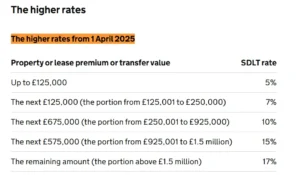
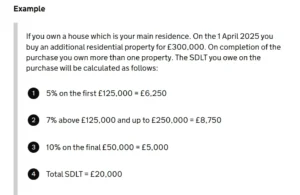
HMRC’s official higher-rate SDLT table confirms the current bands and shows a £20,000 tax calculation for a £300,000 property.
Mortgage, Legal and Accounting Costs
Stamp Duty is only one part of the overall purchase expense.
Other costs may include:
- Company Registration: Online incorporation through Companies House currently costs £100.
- Mortgage Deposit: Many buy-to-let lenders require deposits of around 25%, although requirements vary.
- Mortgage Arrangement Fees: Lenders may charge product, valuation and broker fees.
- Conveyancing Fees: A solicitor handles the legal transfer of the property into company ownership.
- Accounting Fees: Annual accounts, tax returns and bookkeeping create continuing expenses.
- Property Management Costs: Letting agents, repairs, insurance and maintenance must be considered.
For example, a 25% deposit on a £300,000 property would be £75,000. Combined with £20,000 in SDLT, the investor would require £95,000 before legal fees, lender charges and other expenses.
Companies owning UK residential property worth more than £500,000 should also consider the Annual Tax on Enveloped Dwellings (ATED).
Qualifying commercial rental businesses may claim relief that reduces their ATED charge to nil, but an annual Relief Declaration Return may still be required.
How Do You Buy Property Through a Limited Company?
Buying property through a limited company involves establishing the appropriate business structure, arranging finance and completing the purchase in the company’s name.
Investors can create a new company specifically for property ownership or, where suitable, use an existing business.
Setting Up an SPV and Choosing the Correct SIC Code
A Special Purpose Vehicle (SPV) is a limited company established for a particular business activity, such as holding and letting investment property.
Many specialist buy-to-let lenders prefer SPVs because their activities are restricted to property-related transactions.
The usual setup process involves:
- Register the Company: Incorporate the business through Companies House.
- Appoint Directors and Shareholders: Establish who manages and owns the company.
- Choose the Appropriate SIC Code: Identify the company’s property-related business activity.
- Complete Identity Verification: Meet applicable Companies House requirements.
- Open a Business Bank Account: Keep company transactions separate from personal finances.
- Arrange Property Finance: Apply for a suitable limited company mortgage.
- Complete the Purchase: Ensure the property is purchased and registered in the company’s name.
Common property-related SIC codes include:
| SIC Code | Business Activity |
|---|---|
| 68100 | Buying And Selling Of Own Real Estate |
| 68209 | Other Letting And Operating Of Own Or Leased Real Estate |
| 68320 | Management Of Real Estate On A Fee Or Contract Basis |
For a company holding residential property and receiving rental income, 68209 is commonly relevant.
However, investors should select codes that accurately describe their business activities and meet their lender’s requirements.
Limited Company Mortgage Requirements
A limited company can apply for a buy-to-let mortgage, although the assessment differs from an individual mortgage application.
Lenders may examine:
- Company Structure: Whether the company is an SPV or an established trading business.
- Director Credit History: The financial background of the individuals involved.
- Rental Income: Whether expected rent satisfies the lender’s affordability assessment.
- Deposit Availability: Evidence showing the source of funds.
- Personal Guarantees: Whether directors or shareholders must provide additional security.
Some investors fund their company deposits through a director’s loan.
Under this arrangement, an individual lends money to the company, and the transaction is recorded in its director’s loan account.
The company can ordinarily repay genuine loan principal without treating it as a dividend, although interest paid to the director and other arrangements can have separate tax consequences.
Borrowers should confirm that their proposed funding structure is acceptable to their mortgage lender.
Can You Transfer an Existing Property Into a Limited Company?
Yes, an existing personally owned property can be transferred into a limited company. However, the transaction can create substantial tax liabilities.
Because the company is legally separate from its owner, transferring a property is generally treated as a disposal by the individual and an acquisition by the company.
The main costs may include:
- Capital Gains Tax: A transfer to a connected company can be assessed using the property’s market value.
- Stamp Duty: The company may be liable for SDLT based on the applicable transaction rules.
- Mortgage Refinancing: An existing personal mortgage may need to be repaid and replaced.
- Legal Fees: Conveyancing and ownership documentation are required.
- Early Repayment Charges: Existing mortgage terms may impose additional charges.
For example, a landlord who bought a property for £180,000 and later transfers it to a company when it is worth £300,000 may face a chargeable capital gain.
The actual taxable gain will depend on eligible costs, reliefs and the landlord’s circumstances.
Capital Gains Tax, Stamp Duty and Incorporation Relief
HMRC’s Incorporation Relief rules may allow qualifying business owners to defer Capital Gains Tax when transferring an entire business and its assets to a company in exchange for shares.
However, the relief is not automatically available simply because someone owns a rental property.
The property activity must qualify as a business for the relevant rules, and the conditions concerning the transfer of business assets must be satisfied.
Importantly, Incorporation Relief concerns Capital Gains Tax. It does not automatically eliminate Stamp Duty or mortgage-related costs.
For this reason, purchasing a new property directly through a limited company can be more straightforward than transferring an existing personally owned property.
Investors considering incorporation should obtain specialist tax advice before proceeding.
Is It Better to Buy Property Personally or Through a Limited Company?
Neither ownership method is automatically better for every landlord.
Personal ownership offers simpler administration and more direct access to rental earnings.
Company ownership may provide tax advantages when mortgage interest is significant or profits are retained for future investment.
| Comparison Factor | Personal Ownership | Limited Company Ownership |
|---|---|---|
| Tax On Rental Profits | Personal Income Tax | Corporation Tax |
| Mortgage Interest Relief | Basic-Rate Tax Reduction | Generally Deductible |
| Access To Rental Profits | Direct Personal Income | Company Profits Must Be Extracted |
| Administrative Requirements | Generally Simpler | Additional Company Filings |
| Mortgage Availability | Wider Personal Buy-to-Let Market | Specialist Company Products |
| Property Sale Tax | Capital Gains Tax | Corporation Tax On Chargeable Gains |
| Reinvesting Profits | Profits Are Personally Taxed | Profits Can Be Retained In Company |
| Best Suited To | Investors Seeking Simplicity | Investors Retaining Profits Or Expanding Portfolios |
Tax and Rental Profit Comparison With Examples
Consider a landlord receiving £30,000 in annual rental income from a residential investment property.
The property has £5,000 in allowable running expenses and £10,000 in mortgage interest.
Assume the landlord’s relevant rental income is entirely taxable at the 40% higher rate in 2026/27.
For the company example, assume the business qualifies for 19% Corporation Tax and the shareholder has already used their dividend allowance.
| Annual Calculation | Personal Ownership | Limited Company |
|---|---|---|
| Rental Income | £30,000 | £30,000 |
| Running Expenses | £5,000 | £5,000 |
| Mortgage Interest | £10,000 | £10,000 |
| Cash Profit Before Tax | £15,000 | £15,000 |
| Taxable Rental Profit Before Relevant Tax | £25,000 | £15,000 |
| Initial Tax Calculation | £10,000 Income Tax | £2,850 Corporation Tax |
| Mortgage Interest Tax Reduction | £2,000 | Not Applicable |
| Tax Remaining | £8,000 | £2,850 |
| Profit Remaining After Initial Tax | £7,000 | £12,150 |
Under these assumptions, the company retains £12,150 after Corporation Tax, compared with £7,000 after personal Income Tax.
However, the £12,150 belongs to the company.
If all of it were paid as a dividend to a higher-rate shareholder and taxed at 35.75%, the additional dividend tax would be approximately £4,344.
The shareholder would then receive approximately £7,806 after both layers of tax.
That compares with £7,000 under personal ownership, before accounting for any differences in mortgage charges, accounting fees or other company expenses.
This is a simplified 2026/27 example. It excludes several individual circumstances, including changes in tax bands, personal allowances, other income, financing arrangements and property-specific reliefs.
The calculation illustrates why a limited company may be attractive, but also why investors should compare total costs instead of Corporation Tax rates alone.
Conclusion
Buying property through a limited company can be beneficial for UK landlords who want to reinvest profits, manage substantial mortgage borrowing or build long-term rental portfolios.
The proposed 2027 property income tax changes may make company ownership worth reconsidering for some individual landlords.
However, higher mortgage charges, Stamp Duty, dividend tax and administrative costs can reduce the overall savings.
The most suitable ownership structure depends on personal tax circumstances, borrowing requirements, property value and future investment plans.
A detailed financial comparison, supported by qualified tax and mortgage advice, is essential before committing to a purchase.
Frequently Asked Questions
Can I Buy My First Property Through a Limited Company?
Yes. A newly registered limited company can purchase property, provided it has sufficient funds and meets the relevant legal and mortgage requirements.
Can I Live in a Property Owned by My Limited Company?
Yes, but personal occupation can create significant tax consequences, including potential benefit-in-kind charges, and may breach buy-to-let mortgage conditions.
How Much Deposit Do I Need for a Limited Company Property?
Many lenders require around 25% of the purchase price, although deposit requirements depend on the property, lender and borrowing circumstances.
Can I Buy Property Through a Limited Company Without a Mortgage?
Yes. A limited company can purchase property using available company funds, shareholder investment or properly documented loans without obtaining a mortgage.
Do Limited Companies Pay More Stamp Duty?
Companies purchasing residential property in England and Northern Ireland generally pay the higher SDLT rates, which include a 5 percentage-point surcharge.
What Happens When a Limited Company Sells Its Property?
The company normally pays Corporation Tax on any chargeable gain. Shareholders may face further tax if the proceeds are subsequently distributed to them.
Can I Buy Property Through an Existing Limited Company?
Yes. However, using an existing trading company may affect mortgage eligibility, risk exposure and tax planning compared with establishing a separate property SPV.