


The UK government budget surplus reached a record-breaking £30.4bn in January, marking the highest monthly surplus since records began in 1993.
Driven largely by rising tax income, particularly capital gains tax and self-assessed income tax, the figure significantly exceeded forecasts and offered a timely boost ahead of the Spring Statement.
In short, the surplus reflects a sharp increase in revenue rather than a dramatic fall in spending.
Key highlights:
- £30.4bn January surplus, nearly double last year’s figure
- Tax receipts reached £133.3bn, up 13.8% year-on-year
- Capital gains tax revenues surged to nearly £17bn
- Debt interest payments fell by around £5bn compared to last January
- Year-to-date borrowing remains high at £112.1bn
While the headline figure is strong, deeper analysis reveals a more nuanced fiscal picture.
What Does the Latest UK Government Budget Surplus Figure Actually Show?

The latest data from the Office for National Statistics (ONS) shows that the UK government recorded a £30.4bn budget surplus in January, meaning the government received more in revenue than it spent during the month. In fiscal terms, this represents negative public sector net borrowing.
This figure is particularly notable for three reasons. First, it is the highest January surplus since monthly records began in 1993. Second, it is nearly double the £15.4bn surplus recorded in January last year. Third, it significantly outperformed independent forecasts, which had projected a surplus closer to £23.8bn–£24bn.
However, it is essential to understand that this is a monthly snapshot, not an annual balance. The UK still runs a substantial deficit across the financial year.
January Surplus Comparison:
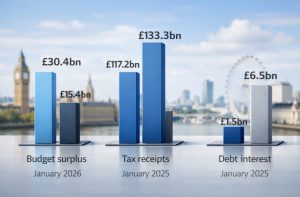
| Metric | January 2026 | January 2025 | Difference |
|---|---|---|---|
| Budget surplus | £30.4bn | £15.4bn | +£15bn |
| Tax receipts | £133.3bn | £117.2bn (approx.) | +13.8% |
| Debt interest | £1.5bn | ~£6.5bn | -£5bn |
Grant Fitzner, Chief Economist at the ONS, explained:
“January – which is traditionally a strong month for self-assessed tax receipts – saw the highest surplus since monthly records began. Revenue was strongly up on the same time last year.”
The key takeaway is that revenue growth, rather than austerity-style spending reductions, drove this surplus.
Why is January Traditionally a Strong Month for the UK Public Finances?
January is unique in the UK fiscal calendar. It is the deadline month for self-assessment tax payments, meaning a large influx of income tax receipts arrives in a single period.
Self-employed individuals, company directors, landlords and those with capital gains liabilities settle significant tax bills at this time. As a result, government revenue tends to spike.
This pattern explains why January frequently produces a surplus while other months record borrowing. Therefore, the existence of a January surplus alone does not necessarily indicate structural fiscal improvement.
However, this year’s surplus exceeded typical seasonal norms due to the scale of tax receipts and reduced interest costs.
How Did Capital Gains Tax Contribute to the Record Uk Government Budget Surplus?

Capital gains tax (CGT) played a decisive role in boosting the UK government budget surplus this year.
Capital Gains Tax Surge Before Policy Changes
CGT receipts reached nearly £17bn in January, roughly £7bn higher than a year earlier. This surge is widely attributed to investors disposing of assets ahead of anticipated changes announced in the Autumn Budget.
Many taxpayers accelerated asset sales to avoid higher future tax liabilities. This behavioural shift created a temporary spike in revenue.
Jason Hollands of Evelyn Partners noted that the increase likely reflects investors reacting to expected policy adjustments. In effect, tax policy timing influenced taxpayer behaviour.
Volatility of CGT and Sustainability Concerns
While the surge is significant, CGT is one of the most volatile revenue streams. It depends heavily on:
- Asset market conditions
- Investor confidence
- Policy expectations
- Equity and property transactions
Because of this volatility, economists caution against treating the CGT boost as a permanent improvement in the UK’s fiscal base.
Did Income Tax and National Insurance Receipts Significantly Boost Tax Income?
Beyond capital gains tax, core and more stable tax streams also strengthened considerably, reinforcing the revenue-driven nature of the surplus.
National Insurance contributions increased by £2.9bn year-on-year, while income tax receipts rose by £3.6bn compared with the same month last year. These increases are especially important because they reflect broader labour market and wage dynamics.
A crucial driver is the ongoing freeze in income tax thresholds, introduced in 2022. As wages rise, even modestly, more individuals are pulled into higher tax brackets. This phenomenon, known as fiscal drag, allows the government to collect more revenue without raising headline tax rates.
In practical terms, this has gradually increased tax income from PAYE earners and employers alike, quietly boosting public finances. It illustrates how structural tax design can generate sustained revenue growth over time
How Did Lower Debt Interest Payments Influence the January Surplus?
Revenue was not the only contributor. Lower debt interest payments significantly improved the monthly balance.
The UK spent approximately £1.5bn on debt interest in January, around £5bn less than the same month last year.
This decline stems from two main factors:
- Lower inflation reducing payments on inflation-linked gilts
- Stabilisation in borrowing costs
Grant Fitzner noted:
“Spending was little changed, due to lower debt interest payments largely offsetting higher costs on public services and benefits.”
Debt interest is one of the most sensitive components of public finances. When inflation falls, payments linked to retail prices index (RPI) bonds decline, easing fiscal pressure.
What Does the Year-to-date Borrowing Data Reveal About the Wider Fiscal Position?

While January’s UK government budget surplus made headlines, the broader financial year tells a more measured story.
Borrowing Across the Financial Year
From April to January, government borrowing totalled £112.1bn. This is:
- 11.5% lower than the same period last year
- Below the Office for Budget Responsibility (OBR) forecast of £120.4bn
- Still among the highest levels on record
Economists suggest borrowing for the full year may reach around £130bn, slightly below earlier forecasts but still substantial.
Debt-to-GDP Ratio and Long-Term Pressure
The UK’s national debt stands at roughly £2.9 trillion, equivalent to 92.9% of GDP – levels not seen since the early 1960s.
Broader Fiscal Snapshot
| Indicator | Latest Figure |
|---|---|
| Year-to-date borrowing | £112.1bn |
| National debt | £2.9tn |
| Debt-to-GDP ratio | 92.9% |
| Forecast full-year borrowing | ~£130bn |
James Murray, Chief Secretary to the Treasury, stated:
“We have the right plan to build a stronger, more secure economy… borrowing this year is forecast to be the lowest since before the pandemic.”
Despite improvements, debt levels remain elevated, limiting fiscal flexibility.
Is the Current UK Government Budget Surplus a One-off Event or a Sign of Long-term Improvement?
Economists broadly agree that January’s performance contains significant seasonal and temporary elements.
Retail sales rose by 1.8% in January, the largest increase since May 2024, suggesting a modest economic rebound. However, GDP growth has been weak, expanding by only 1.3% in 2025, with expectations of around 1% this year.
Paul Dales of Capital Economics commented:
“The economy started the year looking a lot healthier and will give the chancellor something positive to point to.”
Yet he also cautioned that borrowing has not fallen dramatically over the full year, and some retail boosts may prove temporary.
The consensus view is that while the surplus is encouraging, it does not signal a structural shift into sustained fiscal surplus territory.
How Does Rising Tax Income Affect UK Businesses and Households?

Rising tax income has real-world implications. For households, fiscal drag means more workers are entering higher tax brackets without explicit rate rises. For businesses, higher National Insurance contributions increase payroll costs.
Retail sales data indicates resilient consumer demand, particularly in jewellery, art and technology sectors. However, unemployment has risen to 5.2%, with youth unemployment significantly higher.
Businesses face a complex environment of:
- High tax burden (approaching 38% of GDP)
- Moderate consumer demand
- Sluggish investment growth
- Potential interest rate adjustments
While retail sales resilience is encouraging, labour market pressures remain a key concern for firms.
What Challenges Could Threaten Future Budget Surpluses?
Several risks could reverse the momentum seen in January. Economic growth remains anaemic. Business investment is weak. Wage growth has slowed, and unemployment has reached a five-year high.
Key Economic Risks:
| Risk Factor | Potential Impact |
|---|---|
| Slower GDP growth | Lower tax receipts |
| Rising unemployment | Higher welfare spending |
| Market volatility | Reduced CGT revenue |
| Inflation rebound | Higher debt interest costs |
If asset markets weaken or inflation resurges, capital gains tax receipts and debt interest dynamics could quickly shift, narrowing fiscal headroom.
What Should You Expect from the Upcoming Spring Statement Following This Surplus?

The Spring Statement is unlikely to contain major tax announcements, but the surplus provides valuable political and fiscal breathing room.
Chancellor Rachel Reeves has committed to fiscal rules requiring day-to-day spending to be funded through tax receipts rather than borrowing. January’s data strengthens her argument that the government remains on track, though headroom remains limited.
Market reaction has been cautiously positive. Gilt yields eased slightly after the release, reflecting expectations of potentially lower borrowing requirements.
Market Reaction Indicators
| Indicator | Movement |
|---|---|
| 10-year gilt yield | Down to 4.36% |
| Retail sales (Jan) | +1.8% |
| PMI output index | 53.9 |
The OBR’s updated forecasts will provide clearer guidance on growth projections and fiscal sustainability.
Ultimately, the durability of the UK government budget surplus will depend not on one strong month, but on sustained economic momentum and disciplined fiscal management.
Conclusion
The record UK government budget surplus of £30.4bn reflects a powerful combination of rising tax income, strong capital gains receipts, fiscal drag and lower debt interest costs. It provides welcome breathing space for policymakers and positive headlines ahead of the Spring Statement.
However, the broader fiscal landscape remains challenging. Borrowing across the year is still high, national debt remains elevated, and economic growth is modest.
In essence, January’s surplus is encouraging but not transformative. The real test will be whether revenue strength can be sustained without relying on one-off tax timing effects or favourable inflation dynamics.
FAQs About UK Government Budget Surplus
What is the difference between public sector net borrowing and the national debt?
Public sector net borrowing measures the gap between government spending and income in a given period. The national debt is the accumulation of all past borrowing.
Why are capital gains tax receipts so volatile?
CGT depends heavily on asset transactions and investor behaviour, which fluctuate with market conditions and tax policy expectations.
Does a monthly surplus reduce overall debt immediately?
Yes, a surplus reduces borrowing for that month, but it only marginally affects the overall debt stock when annual borrowing remains high.
What role does the OBR play?
The Office for Budget Responsibility independently forecasts public finances and assesses fiscal sustainability.
How does fiscal drag increase tax income?
When thresholds are frozen, wage growth pushes more income into higher tax bands, raising government revenue without changing rates.
Are lower debt interest payments guaranteed to continue?
No. If inflation or interest rates rise again, debt servicing costs could increase.
Can retail sales improvements significantly strengthen public finances?
Retail growth supports VAT receipts and economic momentum, but sustained growth is needed to meaningfully transform fiscal outcomes.