


Wireless connectivity has become a fundamental part of modern business operations. Employees rely on Wi-Fi to access cloud platforms, communicate with colleagues and manage daily tasks, while customers expect reliable connections when visiting shops, hotels and other commercial spaces.
In warehouses, healthcare facilities and manufacturing environments, wireless networks also support equipment and processes that businesses depend on to operate efficiently.
Despite its importance, Wi-Fi infrastructure is often overlooked until problems begin to affect productivity. Slow connections, dropped calls and areas with poor coverage can create frustration for employees and customers alike.
These issues may appear minor at first, but repeated disruptions can lead to wasted time, delayed services and unnecessary operational costs.
As businesses introduce more connected devices and digital tools, maintaining reliable wireless performance requires more than installing additional access points.
Organisations need to understand how their buildings, equipment and working practices affect network performance. This is where careful planning and professional assessment can make a meaningful difference.
Understanding the Importance of a Wireless Site Survey
A wireless network must do more than provide a visible signal. It needs to deliver sufficient coverage, capacity and performance across the areas where people and devices depend on it.
A connection that works well in an empty meeting room, for example, may struggle when the room is full of employees using laptops, smartphones and video conferencing applications.
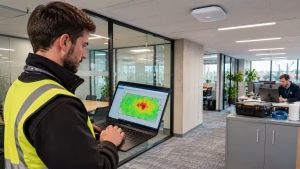
A wireless site survey provides a structured assessment of the radio frequency environment within a building or outdoor area. It examines factors such as signal strength, interference, access point placement and network capacity.
The findings help businesses understand where connectivity is reliable, where weaknesses exist and what changes may improve performance.
This is particularly useful for organisations planning a new home office, expanding into additional premises or investigating recurring Wi-Fi problems.
Rather than relying on assumptions or purchasing extra equipment without a clear diagnosis, decision-makers can use measured information to guide their next steps.
The result is a more informed approach to wireless infrastructure, with improvements based on the actual conditions of the site.
How Poor Wi-Fi Can Affect Business Productivity
Connectivity problems do not always cause a complete network outage. In many workplaces, the more common issue is inconsistent performance.
Employees may experience slow file transfers, interrupted video meetings or difficulty accessing cloud-based applications in certain areas of a building.
Although each incident may only last a few minutes, repeated interruptions can affect concentration and reduce the amount of work completed throughout the day.
Staff may also develop informal workarounds, such as moving to a different room to find a stronger signal. Over time, these small inefficiencies can become part of the working routine.
The impact can be greater in environments where employees depend on mobile devices.
Warehouse teams may use handheld scanners to track stock movements, while retail staff rely on connected systems to check product availability and process transactions.
If wireless coverage is inconsistent, routine activities can become slower and more difficult to coordinate. Businesses should therefore consider connectivity as part of their wider productivity strategy.
Reliable infrastructure allows employees to use digital tools as intended, without regularly having to work around technical limitations.
Identifying Interference and Wireless Coverage Gaps
One of the challenges of wireless networking is that many performance issues are not immediately visible. A device may show that it is connected to Wi-Fi, yet the actual experience can still be slow or unreliable.
Radio frequency interference is one possible cause. Other wireless networks, Bluetooth devices, microwaves and certain types of electronic equipment can affect the radio environment.
Building materials can also influence signal behaviour. Concrete walls, metal structures and high shelving may weaken or obstruct signals, creating areas where coverage is inconsistent.
Access point placement is another important consideration. Installing equipment without understanding the building layout can result in overlapping coverage, poor distribution or insufficient capacity in busy areas.
Professional assessment can help distinguish between these problems. Signal measurements and spectrum analysis provide a clearer view of the wireless environment, making it easier to identify the source of performance issues.
This is more effective than assuming every connection problem can be resolved by increasing signal strength.
In some cases, repositioning equipment, adjusting channels or improving network design may deliver better results than adding more access points.
Planning Wireless Infrastructure Around Business Needs
Every business premises has different connectivity requirements. An open-plan office, a multi-storey hotel and a large distribution warehouse will place very different demands on a wireless network.
For offices, the priority may be supporting video meetings, cloud applications and a high number of connected employee devices.
Warehouses may require consistent coverage across long aisles, high storage racks and areas where mobile equipment is used.
Retail and hospitality businesses need dependable connections for payment terminals, stock systems and guest services. These differences make planning essential.
A wireless network should be designed around how a space is used, rather than simply how large it is.
For new buildings and major refurbishments, predictive surveys can help estimate signal coverage before equipment is installed.
Using floor plans and information about building materials, specialists can model potential access point locations and identify areas that may need additional attention.
For existing premises, passive surveys measure the wireless environment as it currently operates. Active surveys can also assess real-world performance, including throughput, roaming and packet loss.
Combining the appropriate methods gives businesses a more complete understanding of their requirements.
Supporting Customer Experience and Service Delivery
Reliable connectivity is not only an internal operational concern.
It can also influence how customers experience a business. In retail environments, wireless systems support payment processing, stock checks and other services that help transactions run smoothly.
In hotels and hospitality venues, guests increasingly expect dependable internet access as part of their overall experience. Poor connectivity can lead to complaints and may affect how customers view the quality of a service.
Healthcare and education environments have additional requirements. Staff may depend on wireless devices to access important information, while students and visitors use connected services throughout the premises.
In these settings, coverage and performance need to be considered alongside security and access management. Businesses should look beyond basic signal availability when evaluating customer-facing connectivity.
The network must be able to handle realistic levels of activity, including periods of peak demand.
Testing performance under appropriate conditions helps reveal whether the infrastructure can support the number of users and devices likely to connect at the same time.
Managing Capacity as Connected Devices Increase
The number of devices using business networks continues to grow. Laptops and smartphones are now joined by printers, scanners, security cameras, sensors and other connected equipment.
Many organisations also rely on cloud-based applications that require consistent connectivity throughout the working day.
This creates additional pressure on wireless infrastructure. A network that performed adequately several years ago may no longer meet current demands, particularly if the building layout or number of users has changed.
Capacity planning helps address this challenge. It considers how many devices are likely to connect, which applications they use and where demand is concentrated.
For example, a large conference room may require greater wireless capacity than a smaller office with only a few employees.
Businesses should also consider how their infrastructure will support future requirements. Wi-Fi 6, Wi-Fi 6E and Wi-Fi 7 offer developments in wireless technology, but upgrading equipment alone does not guarantee better performance.
The wider network design, access point placement, compatible devices and surrounding radio environment all influence the outcome.
A planned approach helps organisations avoid unnecessary spending while ensuring that infrastructure can support changing business needs.
Making Better Technology Investment Decisions
Wireless problems can encourage businesses to make quick purchasing decisions.
Adding access points or replacing equipment may seem like the simplest solution, but without understanding the underlying issue, these changes may not deliver the expected improvement.
An assessment provides evidence that can help prioritise investment. It may reveal that existing equipment is suitable but poorly positioned, that certain channels are affected by interference or that busy areas require additional capacity.
This information allows decision-makers to compare potential improvements and allocate budgets more effectively. It can also help reduce the risk of investing in hardware that does not address the actual cause of poor performance.
For organisations managing several sites, consistent assessment methods can support more informed infrastructure planning across different locations.
Findings can be used to identify recurring issues, establish design standards and plan upgrades according to operational priorities.
Technology investment should be based on measurable requirements, not simply the assumption that newer equipment will solve every problem.

Maintaining Wireless Performance Over Time
A wireless network should not be treated as a fixed installation. Business premises change as teams grow, offices are rearranged and new equipment is introduced.
These developments can affect signal coverage and capacity, even when the original network design was suitable.
Regular reviews help organisations identify changes that may affect performance. A new partition wall, additional machinery or a larger number of connected devices can alter the way wireless signals behave within a space.
It is also useful to review network performance after significant changes, such as office relocations, refurbishments or infrastructure upgrades.
Post-installation validation can confirm whether the deployed network meets the agreed design requirements.
Businesses should maintain accurate network documentation and keep records of access point locations, configurations and previous assessment findings. This makes future troubleshooting and planning more straightforward.
Conclusion
Wireless connectivity is now closely linked to how businesses operate, serve customers and support employees.
As organisations become more dependent on connected devices and digital applications, inconsistent Wi-Fi can create problems that extend beyond the IT department.
Understanding the wireless environment is an important first step towards improving performance.
By identifying coverage gaps, interference and capacity limitations, businesses can make more informed decisions about infrastructure design and technology investment.
A planned approach to wireless networking helps organisations reduce avoidable disruption, support changing operational demands and create a more dependable environment for long-term growth.