


The teaching assistant pay rise for 2026/27 is 3.3% for eligible employees covered by National Joint Council for Local Government Services pay arrangements.
The settlement applies from 1 April 2026, meaning staff whose employer implemented the higher rates later should receive applicable back pay from that date.
The increase forms part of the wider school support staff pay rise for 2026. However, it should not be interpreted as one universal salary increase for every teaching assistant in the UK.
Pay depends on the employer, contractual arrangements, local grading, hours worked and whether the employee works term time only.
What Is The 2026/27 Teaching Assistant Pay Rise?
The 2026/27 settlement is a permanent 3.3% increase to NJC pay points 3 to 43 and relevant NJC allowances, covering the pay year from 1 April 2026 to 31 March 2027.
Agreement was reached on 24 August 2026 after several months of negotiations between local government employers and the recognised unions.
The increase is consolidated into salary rather than being paid as a temporary bonus. That means eligible staff continue to benefit from the higher salary rate once it has been incorporated into their pay.
The original union claim was significantly higher. UNISON, GMB and Unite had sought an increase of at least £3,000 or 10%, whichever was greater, together with a £15 minimum hourly rate and other changes to conditions. The employers instead made a 3.3% offer, which was ultimately accepted.
Earlier UNISON pay discussions involving council and school staff show how far apart the two sides initially were.
The settlement is also relevant against the backdrop of the UK minimum wage increase for 2026, which raised the National Living Wage for workers aged 21 and over to £12.71 an hour from April 2026.
Pressure from the statutory wage floor is one reason the lower end of the NJC pay spine continues to receive close attention.
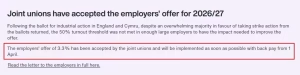
UNISON confirms that the 3.3% employers’ offer was accepted and is being implemented with back pay from 1 April 2026.
Who Is Eligible For The Teaching Assistant Pay Rise?
Teaching assistants employed on NJC or Green Book terms and conditions are generally covered by the 3.3% settlement.
The NJC provides the national collective bargaining framework for around 1.4 million local government employees in England, Wales and Northern Ireland.
In schools, the position can depend on the employer.
Maintained-school teaching assistants are commonly employed on local authority arrangements linked to the NJC.
Academies and multi-academy trusts may also follow NJC terms, but academies can have different contractual arrangements.
Staff should therefore check their employment contract, pay grade or payroll communication rather than assuming the award automatically applies.
The teaching assistant pay increase is also different from the award for classroom teachers.
Teachers in England received a separate 3.5% increase from 1 September 2026, with a further 3% applying from September 2027. Teacher pay is governed through a different framework.
The distinction is important because searches for school pay rises can mix support staff and teachers together. Earlier teacher pay rise 2026 coverage followed that separate teacher-pay process.
The position is not identical throughout the UK either. Scotland operates separate local-government pay negotiations and is not covered by this NJC settlement.
Although the NJC agreement covers relevant workers in Northern Ireland, implementation there has faced separate funding issues.
On 3 November 2026, Northern Ireland’s Education Minister said the nationally agreed 3.3% support-staff award had not yet been approved for implementation because of the Executive budget position.
How Much Will Teaching Assistants Earn After The Pay Rise?
There is no single national teaching assistant salary because schools and local authorities place roles on different grades and spinal column points.
Official 2026 NJC rates show that spinal column point 3 increased to £25,614 a year, while higher points increase progressively up the pay spine.
These figures are full-time rates and do not mean every teaching assistant receives the corresponding annual salary.
| NJC Pay Point | 2025/26 Annual Rate | 2026/27 Annual Rate | Annual Increase |
| 3 | £24,796 | £25,614 | £818 |
| 5 | £25,583 | £26,427 | £844 |
| 10 | £27,694 | £28,608 | £914 |
| 20 | £32,597 | £33,673 | £1,076 |
| 30 | £40,777 | £42,123 | £1,346 |
| 43 | £54,495 | £56,293 | £1,798 |
The table shows national NJC points rather than a dedicated teaching assistant salary scale. A teaching assistant’s actual grade is determined by the relevant employer and job evaluation arrangements.
Teaching Assistant Salary And Pay Scale Differences
Two teaching assistants doing broadly similar work can receive different salaries because their employers may use different grades, local pay structures and working patterns.
Location can also matter. Some employers operate London or other local allowances, while progression between spinal column points may affect salary independently of the annual teaching assistant pay rise.
Gross salary should not be confused with take-home pay. Income Tax, National Insurance, pension contributions, student loan deductions and other payroll adjustments can reduce the amount actually received.
The current UK tax and National Insurance guide for 2026/27 explains how the main deductions operate.
Term-Time And Pro-Rata Pay
Many teaching assistants work term-time-only contracts, which is why advertised full-time equivalent salaries can be substantially higher than the annual salary actually paid.
Under NJC guidance, term-time-only pay is normally calculated using contracted hours, working weeks and a proportionate holiday entitlement.
The resulting annual amount is commonly divided into 12 monthly payments.
A current government-listed teaching assistant vacancy illustrates the difference. A role working 31.5 hours a week for 38 weeks advertised an actual starting salary of £18,647 against an FTE salary starting at £26,016.
This means a teaching assistant should not simply take an advertised FTE figure, add 3.3% and assume that amount will become their annual earnings. The employee’s contracted hours and paid weeks still matter.
Will Teaching Assistants Receive Back Pay?
Eligible workers covered by the settlement are entitled to the new NJC rates from 1 April 2026.
Where an employer did not implement the rise immediately, the difference between the previous and new rates should be calculated from the effective date.
There is no single UK-wide payroll date for the arrears.
For example, Devon County Council said maintained-school staff using its payroll service would receive the increase and back pay in September 2026. Oxfordshire said its affected school staff would receive the backdated award in October.
This demonstrates why two eligible teaching assistants can receive their arrears in different months even though the effective date is the same.
A larger-than-usual salary payment can also affect means-tested benefits in the relevant assessment period. Workers receiving Universal Credit should check how reported earnings appear in their account.
The interaction between earnings and benefits is particularly relevant alongside the latest Universal Credit benefit rates and earnings rules.
The broader cost of household essentials may also affect how significant the increase feels in practice. UK Business Times’ coverage of cost-of-living support in 2026 provides additional context on the financial pressures facing households.
If the teaching assistant pay rise does not appear on a payslip, the employee should check which pay agreement applies, compare the old and new rate and ask the employer’s payroll or HR team when the award and arrears are being processed.
What Is The Next Teaching Assistant Pay Rise For 2027?
Another teaching assistant pay rise has not yet been agreed for 2027/28 under the NJC process.
What has been confirmed is a new two-year union pay claim for 2027/29, submitted on 16 November 2026.
For the first year, UNISON, GMB and Unite are seeking 8% or £3,000, whichever is greater, across NJC spinal column points.
For the second year, the claim calls for an increase of RPI inflation plus 3.6% or £3,000, whichever is greater. The unions are also seeking a minimum hourly rate of £15.
Those figures are demands rather than confirmed salary increases.
A useful distinction is:
2026/27: 3.3% Is Agreed
2027/28: 8% Or £3,000 Is A Union Claim
Until employers respond and negotiations conclude, headlines suggesting teaching assistants have already been awarded an 8% pay rise for 2027 would be inaccurate.
The comparison with other workforces also needs care because their settlements use different review systems and effective dates.
For example, the police pay rise for 2026 was 3.5% from September for officers in England and Wales, while private-sector employers have set their own rates, including the separate Asda pay rise for 2026.
How Could The SSSNB Affect Teaching Assistant Pay?
The School Support Staff Negotiating Body, or SSSNB, represents a more fundamental change to how pay and conditions could be determined for teaching assistants in England.
The Employment Rights Act provides for a statutory negotiating body bringing together employee and employer representatives.
Its remit includes minimum pay, terms and conditions as well as advice on training and career progression.
The government says the system will cover around 800,000 school support staff employed by local authorities, governing bodies and academy trusts in England. Teaching assistants are expressly included among the roles within its intended scope.
Crucially, the SSSNB does not replace the 3.3% teaching assistant pay rise for 2026/27.
Existing arrangements continue for the 2026/27 financial year, and contractual outcomes produced through the SSSNB are expected to take effect from 2027/28 at the earliest.
The system is designed to establish national minimum standards rather than impose a maximum salary on every school.
Government guidance states that existing terms cannot be worsened through the new statutory minimums and employers can continue offering more favourable arrangements.
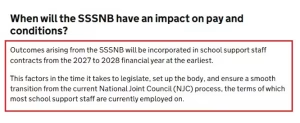
GOV.UK confirms that the SSSNB will cover teaching assistants in England and that negotiated outcomes will enter contracts from 2027/28 at the earliest.
Conclusion
The teaching assistant pay rise for 2026/27 is confirmed at 3.3% for staff covered by the relevant NJC arrangements, with the increase effective from 1 April 2026 and applicable arrears due where implementation happened later.
Actual teaching assistant earnings can still vary considerably because local grades, academies, working hours and term-time contracts affect annual pay.
Staff should therefore check their own contract and payslip rather than treating a national FTE salary as their guaranteed income.
The next stage is less certain. Unions have submitted a substantially higher 2027/29 claim, but that is not yet an agreed pay rise.
At the same time, the SSSNB is preparing to introduce a new statutory negotiating framework for school support staff in England, with the first contractual effects expected from 2027/28 at the earliest.
Frequently Asked Questions
How Much Is The Teaching Assistant Pay Rise In 2026?
The confirmed NJC teaching assistant pay rise is 3.3% for 2026/27 for eligible staff, effective from 1 April 2026.
When Will Teaching Assistants Receive The Pay Rise?
The effective date is 1 April 2026, but actual payroll implementation varies between employers. Staff whose increase was processed later should receive applicable arrears.
Will Teaching Assistants Receive Back Pay?
Eligible NJC staff should receive the difference owed from 1 April 2026 where the increased rates were not applied immediately.
Does Every Teaching Assistant Get The Same Pay Rise?
No. The 3.3% settlement applies to employees covered by the relevant NJC arrangements. Academies and other employers may operate different contractual pay structures.
Do Term-Time Teaching Assistants Receive The Full-Time Salary?
Usually not. Term-time and part-time salaries are commonly calculated on a pro-rata basis according to contracted hours, paid weeks and holiday entitlement.
What Is The Teaching Assistant Pay Rise For 2027?
No final 2027/28 NJC award has been agreed. Unions have submitted a claim seeking 8% or £3,000, whichever is greater, for the first year of the 2027/29 claim.
Will The SSSNB Change Teaching Assistant Pay?
Potentially. The SSSNB will negotiate minimum pay and conditions for eligible school support staff in England, with contractual outcomes expected from 2027/28 at the earliest.