

Yes. If you are self-employed in the UK, you can generally claim qualifying business petrol costs as an allowable expense, provided the fuel relates to your work. You cannot claim the private-use part of your petrol costs.
There are two main ways eligible self-employed people can deal with vehicle expenses: claim the business proportion of their actual vehicle costs, including fuel, or use HMRC’s simplified mileage expenses instead.
HMRC lists fuel, vehicle insurance, repairs, servicing, parking, hire charges, vehicle tax and breakdown cover among costs that can potentially qualify as self-employed business travel expenses. Non-business travel is excluded.
The important point is that claiming petrol does not necessarily mean submitting every fuel receipt and getting that money back. Your allowable expenses are deducted when calculating taxable business profit.
Petrol Receipts or Mileage – How Can Self-Employed People Claim Vehicle Costs?

If you are wondering whether to claim petrol when self-employed or simply record your business mileage, the difference between the two methods matters.
Option 1: Claim Actual Petrol and Vehicle Expenses
Under the actual-cost method, you work out the allowable business portion of your vehicle running expenses.
Potential costs can include:
- petrol or diesel
- vehicle insurance
- repairs and servicing
- vehicle tax
- breakdown cover
- parking
- qualifying hire charges
HMRC confirms that these types of expenses can be allowable where they relate to your self-employed business.
If a vehicle is used for both business and personal journeys, you cannot simply claim every petrol receipt as a business expense. You need to separate the business element from the private element.
For example, if part of your vehicle use is personal, only the relevant business share of allowable costs can be deducted. HMRC applies the same general principle to expenses used for both business and personal purposes: only the business cost is allowable.
Option 2: Claim Simplified Mileage
Eligible sole traders and qualifying partnerships can instead calculate vehicle expenses using HMRC’s flat mileage rates.
Rather than adding up petrol, insurance, repairs and other vehicle running costs, you record your qualifying business mileage and multiply it by the applicable rate.
HMRC describes simplified mileage as an alternative to calculating the actual costs of buying and running a vehicle, including insurance, repairs, servicing and fuel.
For many self-employed people, this can make record-keeping considerably simpler.
Can You Claim Petrol and Mileage at the Same Time?
You should not claim your petrol costs separately on top of the simplified mileage amount for the same vehicle.
That is because the mileage rate already substitutes for the actual costs of running the vehicle, including fuel.
If, for example, your simplified mileage calculation gives you a £3,000 vehicle expense, you cannot normally add your petrol receipts to that £3,000 and claim them again as another vehicle running expense.
However, HMRC says other qualifying travel costs, such as parking and separate train journeys, can still be claimed in addition to simplified vehicle mileage where the normal expense rules are satisfied.
What Is the Self-Employed Mileage Rate for 2026/27?
A major change applies to the self-employed mileage allowance for 2026/27.
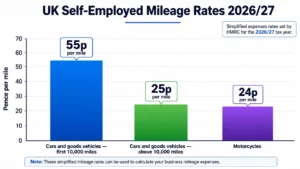
For qualifying cars and goods vehicles, the rate for the first 10,000 business miles has increased to 55p per mile.
| Vehicle and business mileage | 2026/27 simplified mileage rate |
|---|---|
| Cars and goods vehicles — first 10,000 miles | 55p per mile |
| Cars and goods vehicles — above 10,000 miles | 25p per mile |
| Motorcycles | 24p per mile |
HMRC confirmed in June 2026 that the first 10,000-mile rate for cars and goods vehicles was increasing from 45p to 55p. The change applies retrospectively from 6 April 2026, the beginning of the 2026/27 tax year. The rate above 10,000 miles remains 25p.
For example, if you record 8,000 qualifying business miles during 2026/27:
8,000 × £0.55 = £4,400
Your simplified vehicle expense would therefore be £4,400, assuming you are eligible to use the method and all 8,000 miles qualify.
If you drove 12,000 qualifying business miles, the calculation would be:
- First 10,000 miles × 55p = £5,500
- Remaining 2,000 miles × 25p = £500
- Total simplified vehicle expense = £6,000
Why Do Some Websites Still Say 45p Per Mile?
You may still encounter articles saying the HMRC mileage allowance for self-employed drivers is 45p for the first 10,000 miles.
That figure was correct before 6 April 2026.
HMRC’s current guidance shows 55p per mile for the first 10,000 qualifying miles during the 2026/27 tax year and 45p for the equivalent mileage before 6 April 2026.
The tax year therefore matters. If you are preparing figures for an earlier period rather than 2026/27, do not automatically apply the newest mileage rate.
What Counts as Business Mileage When You’re Self-Employed?
Business mileage for self-employed people broadly needs to relate genuinely to carrying on the business rather than personal travel.
Business Journeys You May Be Able to Claim
Depending on the circumstances, business journeys might include driving to:
- meet a client or customer
- travel between customer sites
- collect business supplies
- make business deliveries
- attend a business appointment
- travel between qualifying work locations
The important connection is that the journey is being made for the purposes of your business.
Journeys You Usually Cannot Claim
You cannot normally claim vehicle expenses for journeys that are personal rather than business-related.
HMRC specifically excludes non-business driving and travel between home and work from its general self-employed travel-expense guidance.
Whether a particular journey constitutes business travel can sometimes depend on the precise working arrangement, especially where someone works at changing locations.
If a journey is difficult to classify, check the relevant HMRC guidance or seek professional tax advice rather than assuming every work-related drive qualifies.
Can I Claim Petrol if I Use My Car for Business and Personal Trips?
Yes, you may still be able to claim self-employed petrol expenses when the same vehicle is used privately, but you must separate business use from personal use when claiming actual costs.
Suppose your figures for the year are:
- Total vehicle mileage: 12,000 miles
- Business mileage: 7,200 miles
- Personal mileage: 4,800 miles
- Total petrol expenditure: £2,400
In this simple example, 60% of the recorded mileage relates to business use.
If mileage is a reasonable way of dividing the fuel cost in the circumstances, 60% of £2,400 would be:
£2,400 × 60% = £1,440
That illustrates a possible business share of the petrol expenditure rather than a £2,400 petrol claim.
The same business/private distinction can be relevant when working out other actual vehicle running expenses. The method used to divide costs should be reasonable and supported by your records.
Petrol Receipts vs Mileage: Which Could Give You the Larger Claim?
Neither actual vehicle costs nor simplified mileage will always produce the larger allowable expense.
Consider Sam, a fictional self-employed tradesperson who drives 7,200 qualifying business miles during 2026/27.
Suppose Sam’s annual vehicle running costs are:
| Vehicle cost | Annual amount |
|---|---|
| Petrol | £2,400 |
| Insurance | £900 |
| Servicing and repairs | £750 |
| Vehicle tax | £200 |
| Breakdown cover | £100 |
| Total | £4,350 |
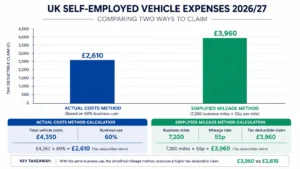
Suppose 60% of the vehicle’s use relates to the business.
A simplified illustration of the business share of those costs would be:
£4,350 × 60% = £2,610
Now compare that with simplified mileage:
7,200 business miles × 55p = £3,960
In this example, the simplified mileage calculation is higher.
But that does not mean mileage is always the better option. A different vehicle with higher insurance, fuel, repair or other allowable running costs could produce a different result.
There is another important restriction: once you use simplified mileage for a particular vehicle, HMRC says you must continue using the flat-rate method for that vehicle for as long as it remains in use in your business.
You also cannot use simplified mileage for a vehicle where certain capital-cost claims have already been made.
HMRC provides a simplified-expenses checker that can help sole traders and eligible partnerships compare simplified expenses with actual costs, although HMRC notes limitations to what the checker can calculate.
Does Claiming £1,000 of Petrol Mean You Get £1,000 Back?

No. This is one of the most important points to understand about claiming petrol on tax when self-employed.
An allowable expense normally reduces the profit on which your tax is calculated. HMRC does not simply reimburse you for the full value of the expense.
For example, imagine a business has:
Turnover: £40,000
Allowable business expenses:£10,000
Its taxable business profit before considering other relevant tax adjustments would be £30,000 rather than £40,000.
HMRC uses this example essentially in its guidance to explain how allowable expenses reduce taxable profit.
So, if £1,000 of vehicle expenses is allowable, the basic effect is that taxable business profit is reduced by £1,000. It does not mean a £1,000 cash payment automatically arrives from HMRC.
The actual tax effect depends on your wider income, allowances, tax position and other circumstances.
Do I Need Petrol Receipts or Mileage Records?
Good records are important whichever vehicle-expense method you use.
If You Claim Actual Vehicle Costs
Keep evidence supporting the expenses you include in your accounts. Depending on what you claim, this may include:
- petrol or diesel receipts
- insurance records
- repair invoices
- servicing invoices
- breakdown-cover costs
- vehicle-tax records
- mileage or other evidence supporting your business/private allocation
Do not assume a petrol receipt alone establishes that the whole purchase was a business expense. Where a vehicle has mixed use, your records should also support the business portion being claimed.
If You Claim Mileage
The focus shifts from individual fuel costs to reliable business-mile records.
You should keep a mileage log showing enough information to demonstrate that the journeys were genuinely for business purposes.
HMRC’s simplified-expenses guidance expressly requires users to keep records of their business miles and then apply the relevant flat rates at the end of the tax year. The resulting expense is included in the total expenses reported through Self Assessment.
A practical mileage log might record the date, destination, purpose of the journey and number of business miles travelled.
Mileage or Actual Vehicle Costs – Which Option Should You Consider?
The right comparison depends on how much you drive and what your vehicle actually costs to run.
| Your situation | Method worth examining |
|---|---|
| High fuel, repair and insurance costs | Actual costs |
| Economical vehicle with relatively low running costs | Simplified mileage |
| High annual business mileage | Compare carefully |
| Vehicle has substantial private use | Compare business proportions |
| You prefer simpler vehicle records | Simplified mileage |
The table should not be treated as a rule that determines which method you must use. Eligibility, previous claims for the vehicle and the individual facts all matter.
Because choosing simplified mileage for a vehicle generally commits you to continuing that method while the vehicle remains in the business, the decision can have consequences beyond a single tax return.
Can Sole Traders, Partnerships and Limited Companies Use the Same Rules?
No. Business structure matters.
HMRC says simplified expenses can be used by:
- sole traders
- business partnerships that do not have companies as partners
They cannot be used by limited companies or business partnerships involving a limited company.
A limited company director using a personal vehicle for business is therefore dealing with a different tax framework from a sole trader calculating self-employed mileage expenses.
This distinction matters because employee and company mileage rules are often discussed alongside self-employed mileage rates online, even though the underlying tax treatment is not identical.
If you operate through a limited company, do not automatically apply sole-trader simplified-expense rules to your company.
Common Petrol and Mileage Claim Mistakes to Avoid
A petrol or mileage claim can become inaccurate when business and private expenses are mixed or when rules from different tax years are combined.
Common mistakes include:
- Claiming personal petrol as a business expense: Only qualifying business expenditure is relevant.
- Adding petrol to a simplified mileage claim: The mileage rate already substitutes for vehicle running expenses such as fuel, servicing and insurance.
- Using the old 45p rate for 2026/27: The first 10,000-mile rate for cars and goods vehicles increased to 55p from 6 April 2026.
- Failing to separate private and business use: Mixed-use vehicles need an appropriate business allocation when actual costs are claimed.
- Keeping no mileage evidence: Business-mile records are fundamental when using simplified expenses.
- Thinking the expense is refunded in full: Allowable expenses reduce taxable business profit; they are not normally pound-for-pound repayments.
- Applying sole-trader rules to a limited company: Limited companies cannot use the self-employed simplified-expenses regime.
- Trying to switch methods freely for an existing vehicle: Once flat rates are used for a vehicle, HMRC requires them to continue while that vehicle remains in use in the business.
How to Work Out Your Petrol or Mileage Claim?
Calculate and Compare
- Identify business use: Record your qualifying business mileage and separate it from private journeys.
- Calculate the relevant method: If eligible, compare simplified mileage with the allowable business proportion of actual vehicle costs before committing to a method for a vehicle.
- Keep your evidence: Maintain records supporting the mileage or actual expenses included when preparing your business accounts and Self Assessment.
Remember that eligibility and previous treatment of the vehicle can restrict the methods available to you.
Conclusion – Can You Claim Petrol on Tax When Self-Employed?
So, can I claim petrol on tax if I’m self-employed? In many cases, yes, but only to the extent that the cost qualifies as a genuine business expense and you use an appropriate method for calculating your vehicle costs.
If you claim actual expenses, you can potentially include the allowable business portion of petrol alongside other qualifying vehicle costs such as insurance, servicing and repairs.
Alternatively, eligible sole traders and partnerships can use simplified mileage. For the 2026/27 tax year, the rate for cars and goods vehicles is 55p per mile for the first 10,000 qualifying business miles and 25p thereafter. Motorcycles remain at 24p per mile.
You should not claim petrol separately on top of simplified mileage for the same vehicle running costs, and you should keep sufficient records to support whichever approach applies.
The best option depends on your mileage, actual vehicle expenditure, private use, previous treatment of the vehicle and individual tax circumstances.
Frequently Asked Questions
Can I claim all my petrol if I’m self-employed?
Not automatically. If petrol is used for both business and personal journeys, only the allowable business element can normally be included when claiming actual vehicle costs. HMRC excludes non-business travel from allowable self-employed travel expenses.
Can I claim petrol receipts on my Self Assessment?
Qualifying business fuel expenditure can form part of your allowable vehicle costs if you use the actual-cost method. Keep records supporting both the expense and, where necessary, the division between business and private use.
Can I claim petrol and mileage when self-employed?
You cannot normally add actual petrol costs to a simplified mileage claim for the same vehicle because fuel is one of the vehicle running costs the mileage rate replaces.
What is the self-employed mileage rate for 2026/27?
For cars and goods vehicles, HMRC’s simplified rate is 55p per mile for the first 10,000 qualifying business miles and 25p thereafter. The motorcycle rate is 24p per mile. The higher 55p rate applies retrospectively from 6 April 2026.
Do I need petrol receipts if I claim mileage?
Simplified mileage is calculated from business miles rather than your individual fuel expenditure. Your key evidence is therefore an accurate record of qualifying business mileage.
Can I claim petrol for travelling from home to work?
HMRC’s general self-employed expenses guidance says travel between home and work cannot be claimed, alongside other non-business travel. Some travel situations can be fact-specific, so check HMRC guidance if your work involves changing or temporary locations.
Can I claim insurance, repairs and servicing as well as petrol?
Potentially, yes, when using actual vehicle costs and where the expenses qualify as business expenditure. HMRC lists insurance, repairs, servicing and fuel among potential allowable vehicle expenses.
If you use simplified mileage, these vehicle running costs are instead represented by the mileage rate and are not separately added to the claim.
Does claiming petrol mean HMRC gives me the money back?
No. An allowable petrol or vehicle expense generally reduces the taxable profit of your self-employed business. It is not normally reimbursed pound-for-pound by HMRC.