

HMRC savings tax letters are notices sent when HM Revenue and Customs believes someone has tax to pay on interest earned from savings.
The document may be a PA302 Simple Assessment, P800 tax calculation, PAYE tax-code notice or Self Assessment calculation, so the correct response depends on what has actually arrived.
Receiving a letter does not automatically mean HMRC’s calculation is correct.
A recipient should identify the type of notice, compare HMRC’s savings-interest figure with bank records, check which tax-free allowances apply and act before the deadline shown.
The issue has become more important in 2026 as higher savings balances and interest earned outside tax-free accounts leave more people exceeding their Personal Savings Allowance.
Why Is HMRC Sending Savings Tax Letters in 2026?
HMRC is issuing Simple Assessment letters relating to the tax year from 6 April 2025 to 5 April 2026.
Around 1.8 million Simple Assessment letters are expected to be issued overall. That figure covers all reasons for Simple Assessment and should not be interpreted as 1.8 million people being taxed specifically on savings.
A PA302 may be issued where tax is due on:
- Savings interest
- Pension income
- Dividends
- A second source of income
- Excess tax-free allowances
- Income that cannot be dealt with adequately through a PAYE tax code
Working-age taxpayers began receiving the 2026 letters from 30 June, while the pensioner programme began during August.
HMRC subsequently confirmed that calculations involving bank and building-society interest for 2025/26 would begin being issued from late September 2026, with further savings-interest cases continuing through the autumn.
This timing matters because banks and building societies report annual interest figures to HMRC after the end of the tax year.
Savings interest has generally been paid gross since 2016. Banks normally do not deduct Income Tax before paying it, so HMRC may need to collect tax later where a saver exceeds the tax-free amounts available to them.
Which HMRC Savings Tax Letter Has Been Sent?
“HMRC savings tax letter” is not the official name of one document. Several different HMRC notices can involve savings interest.
Understanding the document first prevents a taxpayer from following the wrong payment or challenge procedure.
| Document | What It Usually Means | Normal Next Step |
|---|---|---|
| PA302 Simple Assessment | HMRC has calculated tax that cannot be collected automatically | Check, challenge if necessary and pay by the deadline |
| P800 tax calculation | PAYE reconciliation shows an underpayment or overpayment | Check the calculation and how HMRC intends to settle it |
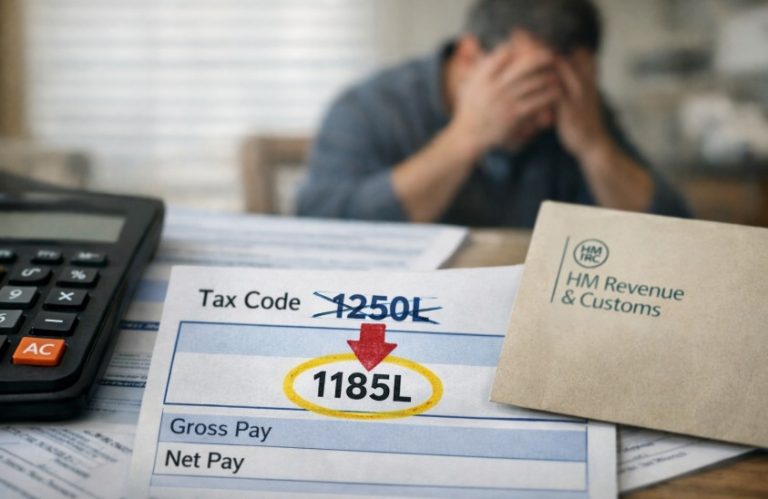
| PAYE tax-code notice | HMRC is using PAYE to collect estimated or previous savings tax | Check the savings estimate used |
| Self Assessment calculation | Savings income has been included in a tax return | Check the return and tax calculation |
| P800 refund | HMRC calculates that too much Income Tax was paid | Check the figures and refund instructions |
Anyone wanting more detail on the mechanics can read how HMRC collects tax on savings interest.
PA302 Simple Assessment
A PA302 is a direct tax calculation made by HMRC.
It normally shows:
- Taxable income used in the calculation
- Tax already collected
- Savings or other untaxed income
- Tax-free allowances used
- The remaining amount due
- Payment instructions
- The payment deadline
A taxpayer does not usually need to submit a Self Assessment return solely because a PA302 has been issued.
HMRC may use Simple Assessment where tax cannot be collected through PAYE, where a relatively large amount is owed, commonly £3,000 or more, or where untaxed State Pension or other income creates a liability.
Someone who believes a PA302 contains incorrect information should normally contact HMRC within 60 days.
P800 Tax Calculation
A P800 is produced after HMRC compares the Income Tax collected through PAYE with the amount it believes should have been paid.
It may show:
- An underpayment
- An overpayment
- A refund
- No additional liability
Savings interest can be included in this reconciliation.
Where an underpayment can reasonably be collected through PAYE, HMRC may change a future tax code rather than demand a separate lump-sum payment.
PAYE Tax-Code Notice
HMRC can alter an employee’s or pensioner’s tax code to collect tax relating to savings interest.
The important issue is that the amount included in a current tax code can be an estimate based on the previous year’s interest.
That estimate may be wrong if the saver has:
- Closed an account
- Withdrawn a large balance
- Moved money into an ISA
- Received an unusually high one-off interest payment
- Changed savings provider
- Substantially increased or decreased their savings
An unexpected tax-code reduction should therefore be checked rather than assumed to be correct.
Self Assessment Calculation
Someone already required to submit Self Assessment should normally include taxable savings interest in the tax return.
Where savings and investment income exceeds £10,000, HMRC generally requires the amount to be reported through Self Assessment.
Other circumstances can independently create a Self Assessment requirement, so £10,000 should not be treated as the only test.
Can HMRC Send Two Simple Assessments for the Same Tax Year?

Yes.
This is particularly important during the 2026 savings-interest exercise.
A taxpayer may already have received a Simple Assessment for 2025/26 before HMRC received the final bank and building-society interest data.
HMRC can subsequently issue another Simple Assessment once that savings information is available.
The later notice can show the total tax liability for the year, including tax that appeared on the earlier assessment.
Therefore, if part or all of the earlier PA302 has already been paid, the taxpayer should check those payments before assuming that the entire figure shown on the second notice remains outstanding.
Keeping both letters and payment confirmations is important where more than one assessment is issued.
What Information Should an HMRC Savings Tax Letter Contain?
The exact layout depends on the document, but a savings-related HMRC calculation may include:
| Information | What to Check |
|---|---|
| Personal details | Name, address and tax reference |
| Tax year | Confirm the correct 6 April to 5 April period |
| Savings interest | Compare with annual bank interest statements |
| Other income | Check wages, pensions, dividends and other taxable income |
| Tax-free allowances | Check Personal Allowance, starting rate and PSA |
| Tax already paid | Compare with PAYE or Self Assessment records |
| Amount due | Confirm the calculation |
| Collection method | Direct payment or PAYE tax-code adjustment |
| Deadline | Note both challenge and payment dates |
| Payment reference | Check it belongs to the correct assessment |
A genuine HMRC letter can still contain a wrong figure. Authenticity and mathematical accuracy are separate issues.
How Does HMRC Know How Much Savings Interest Someone Received?
UK banks and building societies report savings-interest information to HMRC.
HMRC can use this data to:
- Calculate tax liabilities
- Change PAYE tax codes
- Produce P800 calculations
- Issue Simple Assessments
- Compare reported interest with Self Assessment returns
The amount HMRC receives can include interest from numerous accounts and providers.
It can also include accounts that were closed during the tax year.
Why Can HMRC’s Savings Figure Be Wrong?
Possible reasons include:
- Duplicate information
- Interest allocated to the wrong tax year
- Incorrect joint-account allocation
- Previous estimates remaining in HMRC records
- Closed accounts appearing in estimated current-year interest
- Tax-free ISA interest being included incorrectly
- Accounts being incorrectly matched to a taxpayer
- Differences in when interest becomes payable or accessible
This is why the figure should be reconciled against the taxpayer’s own records rather than accepted automatically.
How Reliable Is HMRC’s Bank-Account Data Matching?
HMRC receives enormous quantities of financial information, but receiving data and correctly matching it to an individual taxpayer are not the same thing.
The Association of Taxation Technicians highlighted a significant limitation in 2025: HMRC had acknowledged that around one fifth of bank accounts could not be successfully matched to an individual taxpayer record.
The same professional body also cited estimates suggesting that approximately 893,000 additional taxpayers could become liable for tax on savings by 2028/29, influenced by frozen savings allowances and higher interest income.
These figures explain two apparently contradictory situations:
- A taxpayer can receive a calculation containing interest they do not recognise.
- Another taxpayer can exceed their tax-free savings allowance but receive no automatic HMRC calculation.
The responsibility for checking whether tax is due ultimately remains with the taxpayer.
More detail on when someone may need to act personally is covered in whether savings interest must be reported to HMRC.
How Are Joint Savings Accounts Taxed?
Joint accounts are a common source of incorrect savings calculations.
Banks generally report jointly held interest equally between the named account holders.
For example, where an account owned equally by two people produces £1,200 of interest, the normal starting position is:
| Account Holder | Interest |
|---|---|
| First holder | £600 |
| Second holder | £600 |
HMRC should not normally tax both account holders on the full £1,200.
However, the detailed rules depend on who owns the money beneficially and on the relationship between the account holders.
What Happens With Married Couples and Civil Partners?
Where spouses or civil partners live together and hold the account jointly, the normal Income Tax rule treats the interest as belonging 50/50.
This rule can apply even where one spouse originally contributed more of the money.
What If a Married Couple Really Owns the Account Unequally?
A married couple or civil partners can potentially use Form 17 where their underlying beneficial interests in the account and its income are genuinely unequal.
For example, their actual ownership might be:
- 70% and 30%
- 60% and 40%
- 100% and 0%
Form 17 does not allow a couple simply to choose whatever tax split produces the lowest bill.
The declaration must reflect the genuine beneficial ownership of both the underlying property and the income arising from it.
Both spouses or civil partners must sign the declaration, supporting evidence may be required, and HMRC must normally receive it within 60 days of the declaration being made.
Until an effective declaration applies, the normal 50/50 rule can continue.
What About Joint Accounts Held by People Who Are Not Married?
The special 50/50 spouse rule does not apply in the same way to siblings, friends, parents and adult children or other joint owners.
Their tax position generally follows their actual beneficial entitlement to the funds and interest.
This can become legally complex where one person supplied all the money but another person was added to the account simply for convenience.
How Much Savings Interest Can Someone Earn Tax-Free?

Three separate tax provisions can protect savings income.
They should not be confused with each other.
Personal Allowance
The standard Personal Allowance is £12,570 for 2026/27, although not everyone is entitled to the full amount.
If wages, pensions and other taxable income have not used all of the Personal Allowance, the unused portion may potentially cover savings interest.
Starting Rate for Savings
People with relatively low non-savings income can qualify for a starting rate for savings of up to £5,000.
The £5,000 band is reduced by £1 for every £1 of relevant other income above the Personal Allowance.
Someone whose other income is £17,570 or more will not normally receive any starting rate for savings.
Personal Savings Allowance
The Personal Savings Allowance depends on the taxpayer’s Income Tax position.
| Income Tax Position | Personal Savings Allowance |
|---|---|
| Basic-rate taxpayer | £1,000 |
| Higher-rate taxpayer | £500 |
| Additional-rate taxpayer | £0 |
The Personal Savings Allowance is effectively a 0% tax band for qualifying savings income.
It is not the same as an ISA allowance.
Which Savings Interest Is Taxable and Which Is Tax-Free?
Not every return described as “savings” is treated in the same way.
| Savings or Investment Return | Normally Taxable? | Key Point |
|---|---|---|
| Ordinary bank-account interest outside an ISA | Yes | Counts as savings income |
| Building-society interest outside an ISA | Yes | Counts towards taxable savings |
| Fixed-term savings bond interest | Usually | Timing can depend on when interest becomes accessible |
| Credit-union interest | Usually | Generally savings income |
| Peer-to-peer lending interest outside an ISA | Usually | May be taxable savings income |
| Corporate bond interest | Usually | Normally taxable |
| UK government gilt interest for a UK resident | Usually | Interest and capital gains have different rules |
| Taxable NS&I savings products | Yes | Not every NS&I product is tax-free |
| Foreign savings interest for a UK resident | Potentially | Separate foreign-income rules may apply |
| Cash ISA interest | No | Protected within the ISA |
| Innovative Finance ISA qualifying returns | No | Protected by ISA rules |
| Premium Bond prizes | No | Tax-free prizes rather than savings interest |
| Certain NS&I Savings Certificates | No | Qualifying products are tax-free |
One common mistake is assuming all NS&I products are tax-free. They are not.
Premium Bond prizes and specified tax-free NS&I products receive favourable treatment, while interest on other NS&I savings products can be taxable.
How Is Tax on Savings Interest Calculated?
Consider a basic-rate taxpayer receiving £1,400 of taxable savings interest.
Assume that the person does not have unused Personal Allowance or starting-rate-for-savings capacity.
| Calculation | Amount |
|---|---|
| Taxable savings interest | £1,400 |
| Personal Savings Allowance | £1,000 |
| Remaining taxable interest | £400 |
| Tax at 20% | £80 |
The illustrative tax bill is therefore £80.
A higher-rate taxpayer receiving the same £1,400 would normally have a £500 Personal Savings Allowance, leaving £900 potentially taxable.
The real calculation can differ where:
- Interest changes the taxpayer’s tax band
- The starting rate for savings applies
- Personal Allowance remains unused
- Some interest is inside an ISA
- The individual has Scottish non-savings income
- Pension contributions or other reliefs affect the wider tax calculation
Is an HMRC Savings Tax Letter a Formal Tax Investigation?
Usually, no.
Receiving a PA302 Simple Assessment, P800 tax calculation, tax-code notice or routine savings-interest query does not by itself mean HMRC has opened a formal tax investigation.
A formal enquiry into an individual Self Assessment return under Section 9A of the Taxes Management Act 1970 is a separate procedure.
For a Section 9A enquiry, HMRC must give the taxpayer written notice that it intends to enquire into the return.
A Simple Assessment is instead a method for HMRC to calculate tax where it believes tax is due without requiring the taxpayer to calculate that liability through a return.
That does not prevent HMRC from carrying out compliance work later if information suggests that income has been omitted or an incorrect return has been submitted.
The key point is that a routine savings-tax calculation should not automatically be treated as an accusation of tax evasion or as notice of a formal Section 9A enquiry.
What Happens If an HMRC Savings Tax Bill Is Not Paid?
Ignoring a confirmed tax liability can become expensive.
A Simple Assessment can be subject to late-payment penalties as well as late-payment interest.
Late-Payment Penalties
Under the relevant late-payment regime, penalties can reach:
| How Late the Tax Remains Unpaid | Potential Penalty |
|---|---|
| 30 days after the relevant due date | 5% of the unpaid tax |
| 6 months | Additional 5% of the amount still unpaid |
| 12 months | Further 5% of the amount still unpaid |
This means an amount remaining unpaid long enough can potentially attract three separate 5% charges.
Late-payment interest is separate from these penalties.
Interest normally accrues on a daily basis from the applicable late-payment interest start date until the tax is paid.
Can HMRC Charge a 30%, 70% or 100% Penalty?
Potentially, but these percentages should not be misunderstood.
For standard onshore inaccuracies in returns or other documents supplied to HMRC, the maximum behaviour-based Schedule 24 penalties can be:
| Behaviour | Standard Maximum Penalty |
|---|---|
| Careless inaccuracy | 30% of potential lost revenue |
| Deliberate but not concealed | 70% |
| Deliberate and concealed | 100% |
These are maximum rates, not automatic penalties.
Receiving a PA302 because a bank reported savings interest does not automatically trigger a 30%, 70% or 100% penalty.
Whether an inaccuracy penalty applies depends on what was reported to HMRC, what the taxpayer knew, their behaviour and the quality and timing of any disclosure.
Different rules can also apply to offshore matters or failures to notify HMRC.
Someone who discovers omitted interest should therefore correct the position promptly rather than wait for HMRC to identify it.
What Is the Simple Assessment Payment Deadline?
For the 2025/26 tax year, a Simple Assessment received before 31 October 2026 will normally need to be paid by 31 January 2027.
Where a relevant Simple Assessment is issued on or after 31 October 2026, the payment deadline is generally three months from the date of the letter.
The date printed on the PA302 should always take priority when checking when payment is required.
HMRC allows taxpayers to make smaller payments before the deadline provided the full amount is paid on time.
Someone unable to pay should contact HMRC about payment support before allowing the deadline to expire.
What Should Someone Do If HMRC’s Savings Figure Is Wrong?
The first step is to calculate the interest independently.
The taxpayer should collect annual interest certificates, online statements and closing statements from every relevant savings provider.
They should then:
- Confirm the tax year.
- Add together taxable interest from all accounts.
- Include interest from accounts closed during the year where appropriate.
- Remove qualifying ISA interest.
- Check taxable and tax-free NS&I products separately.
- Check the appropriate share of joint-account interest.
- Compare the resulting total with HMRC’s figure.
HMRC can be asked for details of the interest information it holds.
When disputing a calculation, the taxpayer should be able to explain what HMRC has included, what the correct figure is and how that figure has been calculated.
For a Simple Assessment, the calculation should normally be challenged within 60 days.
What If Savings Tax Is Due but No HMRC Letter Arrives?
No letter does not automatically mean no tax is due.
Banks report savings information to HMRC, but automatic data matching is not perfect.
An employee or pension recipient who has tax to pay on savings interest and has not received a calculation by 31 March following the relevant tax year should not assume HMRC has deliberately decided that nothing is owed.
Anyone unsure about their reporting obligation can check whether HMRC needs to be notified about savings interest.
Someone already completing Self Assessment should report taxable savings interest through the return.
Why Should Pensioners Check Savings Tax Letters Particularly Carefully?
Pensioners can be especially exposed to savings-tax calculations because several income streams may interact.
Someone may receive:
- State Pension
- Workplace or private pension income
- Interest from substantial cash savings
- Fixed-term savings interest
- Investment income
A pensioner who previously paid no tax on savings can cross the Personal Savings Allowance simply because deposit rates or account balances increased.
The State Pension also uses part or all of the Personal Allowance even though the State Pension itself is normally paid without PAYE deductions at source.
This can leave less unused allowance available against savings interest.
Pensioners should therefore check both the savings figure and the pension figure included in a PA302.
This is particularly relevant following previously identified problems with pension information used in HMRC calculations.
A pensioner receiving a Simple Assessment should therefore reconcile:
- State Pension entitlement
- Private pension income
- Tax already deducted
- Savings interest
- Personal Savings Allowance
- Any previous payment made for the same tax year
rather than checking only the headline amount due.
What If Someone Lives Abroad and Receives an HMRC Savings Tax Letter?
Living outside the UK does not automatically mean a UK savings-tax letter can be ignored.
The position can depend on:
- UK tax residence
- Whether the interest has a UK source
- The type of investment income
- The country of residence
- Any Double Taxation Agreement between that country and the UK
- Whether the income falls within the special rules for non-resident investment income
UK-source bank interest and other investment income can be treated differently for non-residents compared with UK residents.
Domestic rules can limit the UK tax liability on certain investment income, while a Double Taxation Agreement may reduce or eliminate UK tax or determine which country has primary taxing rights.
The taxpayer’s country of residence may also tax the same income and provide corresponding double-tax relief.
British expatriates should therefore avoid assuming either that HMRC is automatically correct or that UK savings interest is automatically tax-free simply because they now live abroad.
International financial information can also be exchanged between tax authorities under arrangements including the Common Reporting Standard, so overseas residence does not necessarily prevent HMRC from receiving account information.
How Can Savers Reduce Future Savings Tax Exposure?
Once the current HMRC calculation has been resolved, it can be sensible to review how savings are structured for future tax years.
Use an ISA
Interest generated inside a qualifying ISA does not use the Personal Savings Allowance.
For 2026/27, the overall adult ISA subscription allowance remains £20,000.
A saver with substantial cash outside an ISA can consider moving eligible new savings into a Cash ISA within the applicable subscription limits.
For investments, a “Bed and ISA” transaction involves selling investments held outside an ISA and repurchasing them within an ISA. The original disposal can itself have Capital Gains Tax consequences, so it should not be described as a tax-free transfer.
Consider Genuine Transfers Between Spouses or Civil Partners
An outright transfer of cash or investments to a spouse or civil partner can potentially mean future income belongs to the receiving spouse.
This may be useful where one spouse has unused tax allowances or is taxed at a lower rate.
However, ownership must genuinely transfer. Merely changing whose Personal Savings Allowance is used on paper is not sufficient.
Transfers between spouses and civil partners can have favourable Capital Gains Tax treatment in many circumstances, but the detailed tax position should be checked where substantial investments are involved.
Review Pension Contributions
Eligible pension contributions can affect adjusted net income and Income Tax bands.
In some circumstances, contributions may prevent a taxpayer from moving into a higher tax band or bring adjusted income back into a range where a larger Personal Savings Allowance applies.
For example, moving from higher-rate to basic-rate status can potentially change the Personal Savings Allowance from £500 to £1,000, depending on the person’s full calculation.
Pension tax planning has its own contribution limits and restrictions, so it should not be undertaken solely to avoid a small savings-interest bill. More detail is available on ways pension taxation can be managed in the UK.
Consider Tax-Free Savings Products
Premium Bond prizes are free of UK Income Tax and Capital Gains Tax.
Some NS&I Savings Certificates are also tax-free.
However, returns, access conditions and inflation risk should still be considered. A tax-free product is not automatically financially better than a taxable account offering a substantially higher return.
Review Future Allowance Changes
Savers holding significant sums outside tax wrappers should also keep an eye on forthcoming tax changes that could alter how savings income interacts with the Personal Allowance and other income.
Examined the announced Personal Allowance allocation changes affecting savings income from 2027.
The objective should be legitimate tax planning rather than attempting to conceal taxable interest.
How Can Someone Check Whether an HMRC Savings Tax Letter Is Genuine?
Savings-tax letters can involve significant amounts, making them attractive material for scammers.
Before paying, a recipient should independently check the notice.
Useful checks include:
- Sign in to the Personal Tax Account independently rather than using an unexpected email or text link.
- Check whether the assessment appears in the taxpayer’s HMRC records.
- Compare the tax year and reference with previous HMRC correspondence.
- Treat requests for passwords, security codes or online-banking credentials as suspicious.
- Check the payment reference carefully before transferring money.
- Contact HMRC independently where the payment method or wording appears unusual.
A genuine HMRC letter does not guarantee the calculation itself is correct.
The authenticity of the document and the accuracy of the tax bill must be considered separately.
What Should Someone Not Do After Receiving an HMRC Savings Tax Letter?
A recipient should avoid several common mistakes.
They should not ignore the notice simply because they believe the figure is wrong. Challenge and payment deadlines can continue to apply unless HMRC confirms otherwise.
They should not immediately pay an unfamiliar demand without checking the notice.
They should not include qualifying ISA interest when recalculating taxable savings.
They should not assume every NS&I return is tax-free.
They should not forget interest from accounts closed during the tax year.
They should not accept a duplicated joint-account figure without investigating it.
They should not assume that challenging a PA302 automatically postpones the payment deadline.
And they should not assume no tax is due merely because HMRC has failed to send a letter.
What Should Someone Do After Receiving an HMRC Savings Tax Letter?
The practical process is:
- Identify whether the document is a PA302, P800, tax-code notice or Self Assessment calculation.
- Confirm the tax year.
- Gather interest statements for every savings account.
- Separate taxable savings from ISA and other tax-free returns.
- Check joint-account ownership.
- Apply the Personal Allowance, starting rate for savings and Personal Savings Allowance where relevant.
- Compare the result with HMRC’s figure.
- Check whether another assessment for the same year has already been paid.
- Challenge incorrect information within the applicable deadline.
- Pay the confirmed liability or contact HMRC about payment difficulties before the payment date.
Records of the letter, calculations, bank statements, payments and correspondence should be retained.
Frequently Asked Questions
Why has HMRC sent a letter about savings interest?
HMRC may believe taxable savings interest exceeded the allowances available and that the resulting tax was not fully collected through PAYE or Self Assessment.
Is a PA302 a formal HMRC investigation?
No. A PA302 Simple Assessment is a tax calculation, not by itself a formal Section 9A enquiry into a Self Assessment return.
Can HMRC charge penalties for not paying a savings tax bill?
Yes. Where the relevant late-payment rules apply, 5% penalties can arise after 30 days, six months and 12 months, alongside late-payment interest.
Is all NS&I interest tax-free?
No. Premium Bond prizes and certain NS&I products are tax-free, but other NS&I savings products can produce taxable interest.
Can joint savings interest be split other than 50/50?
Potentially. Married couples and civil partners normally face the 50/50 rule, but a valid Form 17 can reflect genuinely unequal beneficial ownership. Other joint owners are generally taxed according to their actual entitlement.
What happens if HMRC sends a second PA302 for 2025/26?
The later assessment can include the total tax for the year after new information such as bank interest is received. Any amount already paid against an earlier assessment should therefore be checked before making another payment.
Does someone living abroad still need to deal with an HMRC savings letter?
Yes. Non-residence does not make the letter irrelevant. UK-source interest, non-resident investment-income rules and any applicable Double Taxation Agreement need to be considered.
Does Cash ISA interest count towards the Personal Savings Allowance?
No. Qualifying Cash ISA interest is already tax-free and does not use the Personal Savings Allowance.
What should someone do if HMRC’s interest figure is wrong?
The taxpayer should reconcile annual interest statements, identify the incorrect amount and contact HMRC promptly with supporting evidence. A Simple Assessment should normally be challenged within 60 days.
What happens if tax is due but HMRC sends no letter?
The taxpayer may still need to act. HMRC data matching is not perfect, and someone who knows tax is due should not assume that the absence of a calculation removes the liability.