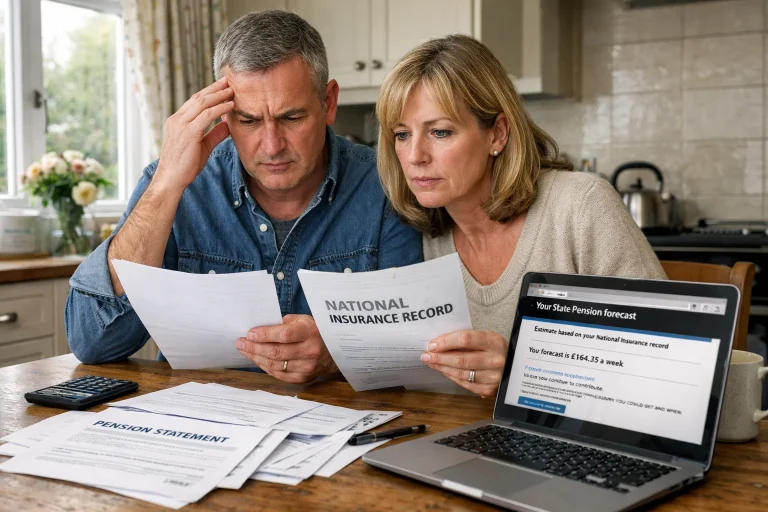


An Aviva workplace pension is a retirement savings arrangement set up through an employer. Employees normally contribute through payroll, employers add their own contribution, and eligible pension contributions can receive tax relief.
For many automatic-enrolment schemes, the statutory minimum contribution is 8% of qualifying earnings, with at least 3% coming from the employer.
However, individual schemes can use higher contribution rates or calculate contributions using a different definition of pensionable pay.
Aviva provides several types of workplace pension rather than one standard product. These include Group Personal Pensions, Group Self-Invested Personal Pensions, the Aviva Master Trust and trust-based arrangements for larger employers.
The pension money is invested, so its value can rise or fall and retirement outcomes are not guaranteed.
What Types Of Aviva Workplace Pension Are Available?
Employers searching for an Aviva workplace pension may encounter several different products.
| Pension Option | Main Purpose |
| Group Personal Pension (GPP) | Contract-based pension suitable for businesses of different sizes, particularly small and medium-sized employers |
| Group Self-Invested Personal Pension (GSIPP) | Gives members wider investment choices and additional flexibility |
| Aviva Master Trust | Trust-based multi-employer scheme overseen by an independent trustee board |
| Own Rules Trust | Support for employers running their own trust-based pension arrangement |
| Alternative Pension Solutions | Includes options such as Group AVC arrangements and Section 32 Buy-Out solutions |
Aviva says it provides workplace pensions for more than 20,000 UK businesses and has more than 4.8 million workplace pension members.
The right arrangement depends on factors such as business size, administration requirements, investment choice and the level of governance an employer wants.
What Is The Difference Between Contract-Based And Trust-Based Pensions?
A contract-based workplace pension is normally arranged with a pension provider. Each employee has an individual contract with the provider. Aviva’s GPP is an example.
A trust-based pension is governed by trustees who have legal responsibilities towards members. The Aviva Master Trust is one example of this type of structure.
Aviva explains that contract-based schemes are regulated primarily by the Financial Conduct Authority, while trust-based occupational schemes fall under The Pensions Regulator.
Contract-based schemes normally use an Independent Governance Committee to assess value for money, while trustees perform governance duties in trust-based schemes.
For businesses, this distinction can affect administration, investment oversight, communications and governance responsibilities.
Who Must Be Automatically Enrolled In 2026?
For the 2026/27 tax year, employers generally have to automatically enrol workers who:
- Are Aged Between 22 And State Pension Age
- Usually Work In The UK
- Are Classed As Workers
- Earn At Least £10,000 A Year
The 2026/27 qualifying earnings band remains £6,240 to £50,270.
Workers earning more than £6,240 but below £10,000 are not normally automatically enrolled, but they can ask to join. Where the relevant conditions are met, the employer must contribute.
Someone earning £6,240 or less can also ask to join, although the employer is not normally legally required to contribute.
What Is Pension Re-Enrolment?
Automatic-enrolment duties do not end once employees have been enrolled.
Approximately every three years, employers must assess certain employees who previously left the pension scheme or reduced their contributions and re-enrol those who meet the requirements.
Employers must also complete a re-declaration of compliance. The Pensions Regulator warns that failing to meet these duties can result in enforcement action.
How Much Goes Into An Aviva Workplace Pension?
Under the standard automatic-enrolment minimum, total pension contributions are normally at least 8% of qualifying earnings, including at least 3% from the employer.
Some businesses offer more generous employer contributions or contribution matching.
For schemes based on qualifying earnings, contributions are normally calculated on earnings between £6,240 and £50,270 in 2026/27, rather than every pound of salary.
Individual Aviva schemes may instead use basic salary, total pensionable salary or another approved contribution basis.
Salary Sacrifice, Net Pay And Relief At Source
How contributions appear on a payslip depends on the pension arrangement.
Relief at source means contributions are normally deducted after tax and the pension provider claims basic-rate tax relief. Higher or additional-rate taxpayers may need to claim additional relief where eligible.
Net pay means the pension contribution is taken from gross pay before Income Tax is calculated.
Salary sacrifice is different. The employee agrees to reduce contractual cash salary and the employer pays an equivalent amount into the pension. This can sometimes reduce employee and employer National Insurance costs.
Salary sacrifice can also affect matters such as mortgage affordability calculations, statutory payments and some employment benefits, so the wider impact should be considered.
What Does An Aviva Workplace Pension Cost Employers?

Employers should consider more than the statutory pension contribution when budgeting for a workplace pension.
Aviva identifies possible costs including scheme set-up, pension administration, payroll integration or middleware, professional advice and internal staff time.
Its employer guidance says workplace pension annual management charges are commonly around 0.3% to 0.75%, depending on the provider and scheme. This is a general workplace-pension range rather than a fixed charge applying to every Aviva scheme.
Employers should therefore obtain scheme-specific pricing rather than assuming one standard Aviva fee.
Payroll integration may also be relevant. Aviva’s GPP can work with payroll systems including PensionSync and BrightPay, helping automate employee information and pension contribution submissions.
What Investment Options Does Aviva Offer?
Investment choice depends on the workplace pension product.
Aviva says its GPP can provide access to over 200 funds from around 30 fund managers, covering different asset classes and risk levels.
Default investment strategies include options such as My Future Focus, while other workplace arrangements may use My Future or My Future Vision.
Members may also have access to environmental, social and governance investment choices and Shariah-compliant funds. Aviva says ESG considerations are integrated into its investment processes across workplace pension strategies.
Members should check their own scheme because access to individual funds can vary.
How Can Members Manage Their Aviva Workplace Pension?
Depending on the scheme, members may use MyAviva, the MyAviva app or another workplace platform.
Available features can include checking pension values, reviewing investments, updating personal details, accessing pension documents and using retirement-planning tools.
The MyAviva app is available through Apple’s App Store and Google Play. Aviva notes that mobile data charges may apply.
Members should register through official Aviva services rather than following pension-login links from unexpected emails or text messages.
Who Checks Whether Aviva Workplace Pensions Offer Value For Money?
Contract-based workplace pensions can be overseen by an Independent Governance Committee, or IGC.
Aviva’s IGC operates independently and assesses areas including costs and charges, service quality, governance and overall value for money. It can raise concerns with Aviva and ultimately with the FCA if issues are not adequately addressed.
Trust-based schemes instead rely on trustees and professional advisers for this oversight.
Aviva also reports financial-strength ratings of AA- from S&P, Aa3 from Moody’s and A+ from AM Best for relevant rated entities. These ratings indicate the agencies’ assessments of financial strength and should not be treated as guarantees of investment returns.
Aviva’s workplace pension business also received recognition at the Pensions Age Awards and Corporate Adviser Awards in 2025.
What Support Is Available Beyond The Pension Account?
Workplace pension support can extend beyond account administration.
Depending on the employer and pension arrangement, Aviva provides educational resources, online events, webinars and workplace workshops designed to help employees understand pension saving and retirement planning.
Employers can also access communication materials covering areas such as pension registration, investment awareness, retirement dates and retirement planning.
How Do The Lump Sum Allowances Affect An Aviva Pension In 2026?
The old Lifetime Allowance has been replaced by rules including the Lump Sum Allowance and Lump Sum and Death Benefit Allowance.
For 2026/27:
| Allowance | Standard Amount |
| Lump Sum Allowance | £268,275 |
| Lump Sum And Death Benefit Allowance | £1,073,100 |
A person can usually take up to 25% of pension savings tax-free, subject to the available Lump Sum Allowance. Different limits can apply where someone holds valid pension protection.
Amounts taken above the applicable tax-free allowances can be subject to Income Tax.
The tax position can become especially important when combining workplace pensions, private pensions and State Pension income. More detail on withdrawal taxation is available in this coverage of how pension income is taxed.
What Happens When An Employee Leaves Their Job?

Leaving an employer does not normally mean losing an Aviva workplace pension.
Existing pension savings generally remain invested, although the former employer will normally stop contributing after employment and payroll processing end.
The member may be able to leave the pension with Aviva, transfer it to another eligible pension or eventually take benefits when pension-access rules allow.
Transferring should not automatically be treated as beneficial. Charges, investment choices, guarantees, protected pension ages and other benefits should be checked first.
The workplace pension is also separate from the government pension system. The 2026 State Pension rates and eligibility rules depend largely on a person’s National Insurance record rather than the value of their Aviva pension.
What Happens To An Aviva Pension If You Move Abroad?
Moving overseas does not normally make an existing UK workplace pension disappear.
The pension can generally remain invested in the UK, although future contributions, tax relief and retirement withdrawals can become more complicated once a person is resident in another country.
Local tax rules and double-taxation agreements may also affect pension income.
Anyone permanently moving abroad should update their contact details and check the tax and pension rules applying in both the UK and their new country.
How Can You Contact Aviva About A Workplace Pension?
Aviva uses different member support teams depending on the pension plan prefix.
| Pension Plan Prefix | Member Phone Number | Opening Hours |
| TK, SP | 0800 145 5744 | Monday To Friday, 8am–6pm |
| F | 0345 602 9221 | Monday To Friday, 8:30am–6pm |
| PP, TL, SM, SQ | 0800 158 3142 | Monday To Friday, 8am–6pm |
| GS | 0345 604 9915 | Monday To Friday, 8am–5:30pm |
Aviva also provides a chatbot that can offer initial support around the clock.
Telephone calls may be recorded or monitored and Aviva states that recordings are retained for a minimum of five years.
Employers have separate support routes. Aviva currently lists 0800 092 9951 for areas including MyAvivaBusiness and installation support, while billing, member additions and contribution administration can be handled through 0800 158 2570.
Conclusion
An Aviva workplace pension can cover anything from a straightforward Group Personal Pension to a larger trust-based or self-invested arrangement.
For employees, the key points to check are contribution levels, charges, investment choices, tax treatment and retirement options.
Employers also need to consider scheme type, payroll integration, administration costs, automatic-enrolment thresholds and three-year re-enrolment duties.
The pension provider name alone does not determine whether a particular arrangement suits an individual or business. Scheme-specific documents should be checked before changing contributions, investments or transferring pension savings.
Frequently Asked Questions
Can An Employee Opt Out Of An Aviva Workplace Pension?
Yes. Someone automatically enrolled can normally opt out using the formal procedure. If the valid opt-out is completed within the statutory one-month period, contributions can generally be refunded.
Can Someone Rejoin After Opting Out?
Yes. Employers normally have to allow eligible workers to ask to rejoin, although contribution obligations depend on earnings, age and other automatic-enrolment conditions.
Can Employees Increase Their Aviva Pension Contributions?
Many schemes allow higher regular contributions or additional payments. Whether this is arranged through payroll, HR or the pension platform depends on the employer’s scheme.
Does Aviva Offer Sustainable Or Shariah Pension Funds?
Yes. Aviva provides ESG-related and Shariah-compliant investment options within parts of its workplace pension range, although availability depends on the scheme.
What Is The Aviva Independent Governance Committee?
The IGC is an independent body that assesses value for money within applicable contract-based workplace pension arrangements and can challenge Aviva over areas such as charges, services and governance.
Can You Keep An Aviva Workplace Pension If You Move Abroad?
Generally, yes. Existing savings can normally remain invested, but contributions, tax relief and withdrawals can be affected by UK rules, overseas tax law and double-taxation agreements.