

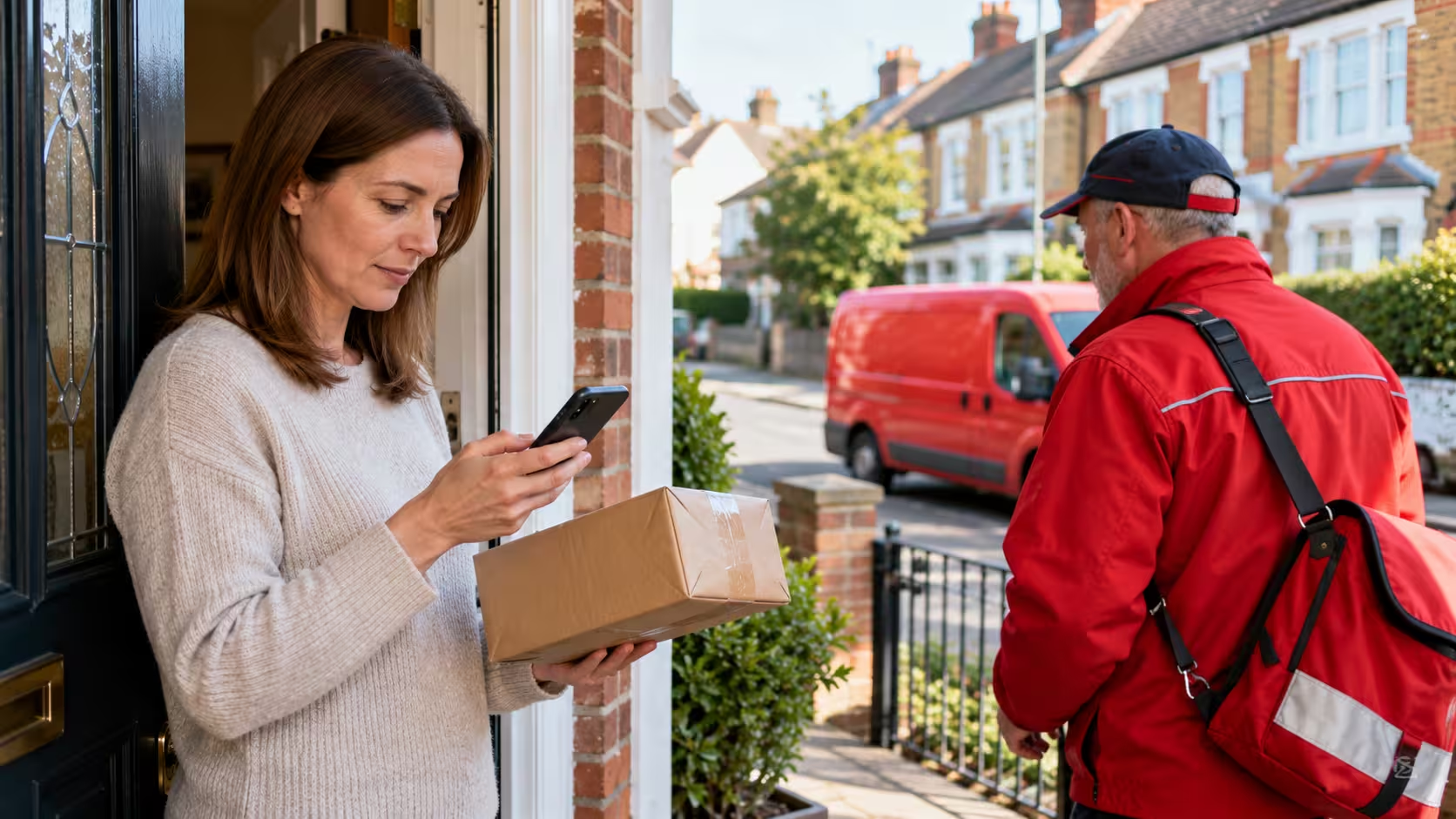
An eTarget Limited parcel is a delivery displaying the name eTarget Limited as a sender or associated business.
Companies House confirms that E-TARGET LIMITED is a registered UK company, but its records do not establish that it operates parcel fulfilment services or supplies Amazon, eBay or TikTok sellers. Always verify the individual delivery before making payments.
Receiving an unexpected parcel or Royal Mail notification mentioning eTarget Limited can create confusion, particularly when the name does not match a recent online purchase.
Our review of Companies House records, publicly available company information and UK parcel security guidance identified an important distinction: a registered company is not necessarily the business responsible for a particular shipment.
E-TARGET LIMITED exists as a registered British company, but its official business classification relates to management consultancy rather than parcel delivery.
That does not automatically make a parcel bearing the eTarget name suspicious. Modern e-commerce can involve several businesses between checkout and delivery.
What Is eTarget Limited in the UK?
E-TARGET LIMITED is a private limited company registered with Companies House under company number 07242152.
The company was incorporated on 4 May 2010 and is currently recorded as active.
Its registered business activity falls under SIC code 70229, covering management consultancy activities other than financial management.
However, searches for eTarget Limited frequently relate to parcels, delivery notifications, Royal Mail tracking and unfamiliar sender names.
These should be treated as separate matters.
The existence of E-TARGET LIMITED does not independently establish that the company:
- Operates a parcel fulfilment warehouse.
- Provides shipping services for Amazon or eBay sellers.
- Dispatches products purchased through TikTok Shop.
- Has a formal delivery partnership with Royal Mail.
- Sells a particular range of consumer products.
Such relationships would require evidence from the company, retailer, courier or shipment documentation.
What Do Companies House Records Confirm About eTarget Limited?
Our company-record review identified the following registered information.
| Company information | Verified details |
|---|---|
| Registered name | E-TARGET LIMITED |
| Company number | 07242152 |
| Company status | Active |
| Company type | Private limited company |
| Incorporation date | 4 May 2010 |
| Registered office | Peershaws, Berewyk Hall Court, White Colne, Essex, CO6 2QB |
| SIC code | 70229 |
| Registered activity | Management consultancy activities other than financial management |
| Current director | Christine Frances Joyce |
| Last accounts made up to | 31 May 2025 |
| Next accounts due | 28 February 2027 |
| Last confirmation statement | 1 May 2026 |
The details can be checked through the official Companies House record for E-TARGET LIMITED.
Important: The word active refers to the company’s registration status. It does not establish continuous trading activity since incorporation or verify the nature of its current commercial operations.
What Does SIC Code 70229 Mean?
A Standard Industrial Classification (SIC) code describes the type of economic activity declared by a company.
Code 70229 relates to management consultancy activities other than financial management.
It is not specifically a classification for courier operations, warehousing, parcel delivery or e-commerce fulfilment.
However, SIC codes do not necessarily describe every commercial activity undertaken by a business.
Therefore, this classification neither proves nor completely rules out involvement in a particular shipping arrangement.
It simply means parcel fulfilment cannot be established from the registered SIC code.
What Do Micro-Entity Accounts Reveal?
Companies House filing history shows micro-entity accounts for financial years ending from May 2018 through May 2025.
Micro-entity reporting allows qualifying small companies to submit simplified accounts under the applicable accounting rules.
These filings generally contain less financial information than full company accounts.
They do not ordinarily establish:
- The identities of individual customers.
- Specific marketplace partnerships.
- Which products the company sells.
- Its complete supplier network.
- Whether it operates a parcel distribution centre.
A company filing micro-entity accounts should not automatically be described as either financially successful or unsuccessful.
Companies House also states that it does not check the accuracy of information filed on its register.
Consequently, registration and accounts filings should be considered documentary evidence, not an independent commercial endorsement.
Who Owns eTarget Limited?
Companies House identifies Christine Frances Joyce as the current director and active person with significant control of E-TARGET LIMITED.
The register records her as holding at least 75% of the company’s shares and voting rights, alongside the right to appoint or remove directors.
Stephen Joyce was previously a director and person with significant control, but those positions changed.
What Is the Companies House Filing Timeline?
| Date | Recorded development |
|---|---|
| 4 May 2010 | E-TARGET LIMITED incorporated |
| 7 March 2018 | Christine Frances Joyce notified as a person with significant control |
| 2018–2025 | Micro-entity accounts for these financial years appear in the filing history |
| 25 October 2025 | Stephen Joyce resigned as a director |
| 25 February 2026 | Accounts for the year ended 31 May 2025 filed |
| 1 May 2026 | Date of latest confirmation statement |
| 16 July 2026 | Stephen James Joyce ceased to be a person with significant control |
| 5 August 2026 | PSC cessation and updated control information filed |
| 28 February 2027 | Next accounts filing deadline |
These records clarify the company’s registered ownership and reporting history.
They do not demonstrate that the registered company operates the parcel service described on some third-party websites.
What Is Verified and Unverified About eTarget Limited Parcels?
The distinction between established information and unconfirmed claims is central to our review.
| Claim | Evidence status | Explanation |
|---|---|---|
| E-TARGET LIMITED exists | Verified | Registered at Companies House |
| Company number is 07242152 | Verified | Official company identifier |
| Incorporated in May 2010 | Verified | Incorporation record |
| Company is currently active | Verified | Registered company status |
| Christine Joyce is the current director | Verified | Officers register |
| SIC code is 70229 | Verified | Registered classification |
| Company operates a fulfilment warehouse | Unverified | No supporting confirmation established |
| Company ships Amazon products | Unverified | No confirmed partnership identified |
| Company handles eBay or TikTok Shop orders | Unverified | No confirmed commercial agreement identified |
| All eTarget parcels originate from company 07242152 | Unverified | Sender identity requires shipment-specific evidence |
| All eTarget delivery messages are scams | Not established | Each communication must be assessed separately |
Our assessment is that a matching company name is weaker evidence than an independently verified order and tracking reference.
Consumers should therefore avoid assuming either that every parcel is legitimate or that every unfamiliar sender is fraudulent.
Why Might You Receive an eTarget Limited Parcel?
An unfamiliar parcel sender can arise for several ordinary reasons.
The business named on a shipping label may be different from the retailer that accepted the customer’s payment.
This can happen because a single purchase involves multiple commercial organisations.
Third-Party Marketplace Sellers
Online marketplaces allow independent businesses to sell products through a central platform.
Customers may remember purchasing an item through Amazon or eBay without remembering the individual merchant’s trading name.
The seller may also use another business to prepare shipping labels or arrange delivery.
However, this general e-commerce arrangement does not prove that E-TARGET LIMITED provides those services.
Overseas Orders and Logistics Providers
International purchases may pass through exporters, freight operators, customs intermediaries and domestic couriers.
A business involved in one stage of the shipment may appear as the sender in delivery information.
This is a possible explanation for an unfamiliar company name, not a confirmed explanation for any particular eTarget Limited parcel.
Gifts, Replacements or Delayed Purchases
Other possibilities include:
- A gift sent by a friend or family member.
- A forgotten online purchase.
- A replacement for a previously returned item.
- A delayed international shipment.
- A subscription product or repeat order.
- A delivery intended for another address.
Reviewing recent purchase histories is usually more reliable than searching the sender’s name alone.
Why Does eTarget Limited Appear With Royal Mail?
Some recipients search for eTarget Limited Royal Mail after seeing the two names together in a delivery notification.
Royal Mail may be identified as the carrier while another organisation appears as the sender.
This does not automatically establish a formal partnership between those businesses.
The most useful information is the individual parcel’s tracking number.
Consumers should enter that number directly through Royal Mail’s official website, rather than following an unfamiliar message link.
If a valid tracking record exists, compare its delivery information with the orders in your shopping accounts.
A tracking reference that matches a genuine order is considerably more useful than an unexplained business name.
Is an eTarget Limited Parcel a Scam?
There is no verified basis for classifying every parcel displaying the eTarget Limited name as fraudulent.
Equally, finding a similarly named registered company does not establish that a message or shipment is trustworthy.
Fraudsters can impersonate genuine couriers, retailers and company names.
The relevant question is not simply whether eTarget Limited exists.
It is whether the specific parcel, message or payment request can be independently verified.
What Are the Warning Signs of a Suspicious Parcel Message?
Take extra care when a notification contains:
- A link to an unfamiliar website.
- A request for card details to release a parcel.
- Threats that the item will immediately be destroyed.
- Pressure to act within an unusually short period.
- Requests for passwords or verification codes.
- A tracking reference that cannot be matched to a purchase.
- An unexpected request to scan a QR code.
Although spelling mistakes can be warning signs, well-written messages can also be fraudulent.
A professional appearance is not proof of legitimacy.
How Can You Identify a Genuine Royal Mail Fee Versus a Scam Message?
One important correction concerns Royal Mail delivery charges.
It would be misleading to state that every redelivery or parcel payment request is fraudulent.
Genuine charges can arise from insufficient postage or customs processing.
However, Royal Mail distinguishes between different types of communication.
For underpaid postage, Royal Mail says it leaves a grey Fee to Pay card rather than requesting payment through an email or text.
For customs charges, Royal Mail may also send an SMS or email notification where the sender supplied the recipient’s contact information.
Its official guidance on Royal Mail scams and suspicious messages explains these distinctions.
Real Versus Suspicious Royal Mail Messages
| Feature | More consistent with genuine contact | Suspicious warning sign |
|---|---|---|
| Underpaid postage | Grey Fee to Pay card | Unexpected text demanding payment through an unfamiliar link |
| Customs charges | Verifiable charge through Royal Mail's official service | Payment requested through an imitation website |
| Tracking | Reference checked independently | Link to a strange or shortened domain |
| Personal information | No request for passwords | Request for passwords, PINs or authentication codes |
| Payment process | Official Royal Mail payment channel | Unrelated payment portal |
| Message tone | Clear delivery information | Threats or extreme urgency |
Example of a Suspicious Parcel Text
Illustrative suspicious message:
Royal Mail: Your eTarget Limited parcel could not be delivered. Pay £1.95 immediately using the link provided or your item will be returned today.
Warning signs include the unexpected payment demand, urgent language and any link that does not lead to a verified Royal Mail service.
Illustrative legitimate situation:
A customer receives a grey Royal Mail Fee to Pay card, checks the information independently on Royal Mail’s website and confirms that an identifiable parcel has an outstanding postage charge.
The difference is not merely the presence of a fee. It is whether the communication and payment process can be verified.
If a payment request arrives unexpectedly, open Royal Mail’s website yourself and check the parcel or fee information there.
What Happens if an eTarget Limited Parcel Comes From Overseas?

International parcels can attract legitimate customs charges.
These costs depend on the goods, their value, origin and how VAT was handled when the purchase was made.
For UK consumers, the distinction between low-value and higher-value consignments is important.
Customs Charges Explained
| Situation | General UK treatment |
|---|---|
| Non-excise goods worth £135 or less bought from an overseas seller | VAT is generally handled at the point of sale under the relevant rules |
| Goods worth more than £135 | Import VAT and potentially Customs Duty may become payable |
| Genuine gifts worth £39 or less | Generally exempt from import VAT |
| Excise goods | Additional rules and charges can apply |
| Carrier handling charges | May be payable where the courier processes customs charges |
For goods imported into Great Britain, Customs Duty generally applies to qualifying non-excise consignments exceeding £135, with exceptions and different arrangements for particular goods.
Northern Ireland has additional rules involving goods from outside the UK and EU.
Consumers should check the original order confirmation before paying any unexpected customs demand.
The fact that an international parcel attracts a legitimate charge does not establish the identity of the company named on its label.
What Should You Do if You Receive an eTarget Limited Parcel You Did Not Order?
An unexpected parcel does not automatically indicate identity theft.
However, it is important to investigate because unsolicited deliveries can sometimes be linked to a practice known as a brushing scam.
What Is a Brushing Scam?
A brushing scam involves sending goods to someone who did not purchase them.
In some cases, dishonest sellers use delivery information to support fabricated transactions or customer reviews.
For example, a recipient might receive a small, inexpensive product despite never ordering it.
The delivery may then be used to make an online transaction appear genuine.
However, receiving an unexpected parcel is not sufficient evidence to conclude that brushing has occurred.
Other explanations, including mistakes and gifts, should be investigated first.
How Should You Respond to a Suspected Brushing Scam?
- Check Your Orders: Review recent purchases, subscriptions and household orders.
- Inspect The Label: Record the sender information and tracking number without scanning unknown QR codes.
- Check Your Accounts: Look for unfamiliar transactions or purchases.
- Protect Your Login Details: Change passwords if you suspect account access has been compromised.
- Contact The Marketplace: Report an unexplained delivery through the marketplace’s official account support.
- Preserve Evidence: Keep photographs of the label, packaging and any suspicious messages.
- Report Suspected Fraud: Use the appropriate UK fraud reporting service if there is evidence of fraud.
A brushing incident may indicate that someone’s name and address are being used without permission, but it does not automatically establish that their financial accounts have been accessed.
Can You Keep an Unsolicited Parcel?
Under UK consumer protection rules, a trader generally cannot demand payment for goods genuinely supplied without a consumer’s request or agreement.
However, an accidental delivery addressed to somebody else is a different situation.
Do not assume that a neighbour’s package or a wrongly delivered item becomes your property.
If the parcel is addressed to another person, contact the carrier or arrange an appropriate return.
Citizens Advice also provides guidance for consumers who receive unsolicited goods.
How Can You Verify an eTarget Limited Parcel Step by Step?
Our recommended verification process focuses on connecting the shipment to an identifiable purchase.
Step 1: Examine the Parcel Label
Check the visible information, including:
- Sender name and return address.
- Carrier name.
- Tracking or barcode reference.
- Recipient name.
- Postcode and delivery address.
- Customs or shipment reference, where applicable.
Do not assume the return address identifies the original retailer.
Step 2: Check Amazon, eBay and Other Order Histories
Open your online shopping accounts directly.
Look for recent orders with matching:
- Tracking numbers.
- Dispatch dates.
- Delivery estimates.
- Product descriptions.
- Seller information.
If you purchased from an independent marketplace seller, contact that seller through the marketplace account.
Step 3: Verify the Courier Independently
Visit the carrier’s official website by typing the address yourself.
Do not use an unexpected text-message link.
Enter the tracking number and review the available information.
Where Royal Mail is the carrier, compare its tracking record with your legitimate purchase confirmation.
Step 4: Investigate Any Unexpected Charges
If the parcel is being held because of postage or customs charges, confirm the demand through the courier’s official payment service.
Additional details about legitimate charges are covered in the explanation of Royal Mail Fee to Pay notices and payment requirements.
Never provide banking passwords or one-time security codes to release a parcel.
Step 5: Report Suspicious Text Messages
Forward suspicious delivery texts to 7726, the free UK scam-text reporting service.
Suspicious emails can be forwarded to report@phishing.gov.uk for investigation by the National Cyber Security Centre.
Royal Mail also accepts suspicious-message reports at reportascam@royalmail.com.
Keep a screenshot of the original message where possible.
Step 6: Report Fraud Through the Current Service
Report Fraud replaced Action Fraud on 4 December 2025 as the national fraud and cybercrime reporting service for England, Wales and Northern Ireland.
Consumers can report suspected fraud through:
Official website: reportfraud.police.uk
Telephone: 0300 123 2040
People in Scotland should continue to report fraud and cybercrime to Police Scotland, using 101 where appropriate.
If payment details have already been provided to a suspicious website, contact your bank immediately.
What Are Your Rights if an eTarget Limited Parcel Never Arrives?
When a consumer purchases goods from a business, the seller is generally responsible for ensuring that those goods are delivered as agreed.
The presence of another company’s name on the dispatch label does not automatically transfer the retailer’s contractual responsibilities.
Under the Consumer Rights Act 2015, the seller generally bears the risk until goods reach the consumer or a person authorised to receive them.
The position may differ if the consumer independently arranged their own carrier or authorised delivery to a particular safe place.
What if the Parcel Is Missing?
If tracking shows delivery but nothing arrived:
- Check the agreed delivery address and any authorised safe place.
- Save the tracking history and available delivery photographs.
- Contact the retailer or marketplace seller.
- Explain that the order has not been received.
- Request investigation, redelivery or a refund where appropriate.
The seller should ordinarily investigate problems with the carrier it arranged.
A similar distinction between courier tracking and retailer responsibility matters when dealing with an Evri parcel that arrives with missing contents.
What if the Wrong Product Arrives?
If the item received does not match the product ordered, contact the seller through the original purchasing platform.
Keep photographs of the packaging and product.
The Consumer Rights Act 2015 requires goods sold by traders to correspond with their description.
Depending on the circumstances, consumers may be entitled to a replacement, repair, price reduction or refund.
Can You Request a Refund From Your Bank?
Where a retailer refuses to resolve a valid complaint, payment protections may provide another route.
Chargeback may be available for eligible debit or credit card transactions.
Section 75 of the Consumer Credit Act may apply to qualifying credit card purchases where the cash price is more than £100 and no more than £30,000, subject to the statutory conditions.
The correct process depends on the payment method and circumstances.
How Can You Contact eTarget Limited Safely?
Anyone searching for an eTarget Limited contact number should be cautious about third-party directories.
Companies House records the registered office of E-TARGET LIMITED as:
Peershaws, Berewyk Hall Court, White Colne, Essex, CO6 2QB
A registered office is a company’s formal address for statutory correspondence.
It should not automatically be treated as a parcel collection point, warehouse or customer-service department.
Our review did not establish a verified customer-service phone number or email address linking the registered company to the parcel operations described online.
Consumers should therefore avoid relying on unverified contact numbers.
For a particular delivery, the safest starting point is usually the retailer or marketplace account through which the item was purchased.
If formal correspondence with E-TARGET LIMITED is necessary, its current registered address should first be checked on Companies House.
Frequently Asked Questions
What Does eTarget Limited Sell?
No independently verified product catalogue has been established for E-TARGET LIMITED, company number 07242152. Its registered activity is management consultancy.
Is eTarget Limited a Real Company?
Yes. E-TARGET LIMITED is an active UK private limited company registered under number 07242152.
Does eTarget Limited Work With Amazon?
A formal commercial relationship between E-TARGET LIMITED and Amazon has not been verified. Check the individual Amazon order rather than assuming a partnership.
Why Have I Received an eTarget Limited Text Message?
The message may refer to a delivery, but its authenticity cannot be determined from the company name. Verify the tracking information independently.
Is eTarget Limited Connected to eBay?
There is no verified evidence establishing an official fulfilment relationship between E-TARGET LIMITED and eBay. Marketplace orders should be checked individually.
Does an eTarget Limited Parcel Mean My Identity Has Been Stolen?
No. An unexpected parcel does not automatically indicate identity theft, although unexplained deliveries should prompt a review of shopping accounts and financial activity.
Can I Refuse an Unexpected Parcel?
You can generally decline an unwanted delivery. If a parcel has already arrived, check whether it was genuinely unsolicited or delivered in error before deciding what to do.
Is eTarget Limited a Royal Mail Delivery Company?
Companies House does not classify E-TARGET LIMITED as a courier or postal operator. The company name appearing beside Royal Mail does not establish a formal delivery partnership.