
If you have received a Royal Mail Fee to Pay card or letter, it usually means Royal Mail is holding an item because postage was underpaid, invalid postage was used, or customs charges are due before the item can be released.
The amount can vary considerably. A letter with insufficient postage may attract a small fixed charge, while an international parcel can include import VAT, Customs Duty and a Royal Mail or Parcelforce handling fee.
The most important points are:
- Royal Mail currently charges different fees according to the item size and reason for the shortfall
- A medium parcel exceeding 61cm × 46cm × 46cm or 20kg, including packaging, can attract a £10 fee
- Royal Mail’s standard customs handling fee is £8
- Parcelforce’s standard customs handling fee is £12
- Goods valued above £900 require a full customs declaration and can attract a £25 handling fee
- Royal Mail generally holds items for 18 calendar days
- Parcel Locker items have a separate 3-day initial holding period
- Royal Mail currently has a workaround for some customs Fee to Pay cards whose barcode is not recognised
What Does a Royal Mail Fee to Pay Mean?
A Royal Mail Fee to Pay notice means an item cannot yet be released because an outstanding charge needs to be dealt with. For UK mail, the issue is often insufficient or invalid postage.
This can happen when the sender:
- Paid for the wrong size or weight
- Did not use enough postage
- Used no postage
- Used a counterfeit stamp
- Used a non-barcoded stamp where it is no longer valid
- Sent an item outside the permitted dimensions for the selected service
International items are different. Border Force may assess import VAT or Customs Duty, and Royal Mail can pay the amount before collecting it from the recipient along with its handling charge.
The person receiving the item therefore may not have caused the problem, even though the Fee to Pay notice arrives at their address.
Why Did You Receive a Royal Mail Fee to Pay Notice?

There are several common reasons.
Insufficient Postage
The sender may have paid for a letter, large letter or parcel category that does not match the actual size or weight of the item.
No Postage or Counterfeit Postage
Royal Mail can treat an item as unpaid when it has no valid postage or when the stamp is identified as counterfeit.
Non-Barcoded Stamps
Older non-barcoded definitive stamps are no longer accepted in many circumstances. Using one can therefore result in an additional charge.
Oversized or Overweight Parcels
Medium parcels have maximum dimensions and weight limits.
Royal Mail currently applies the £10 fee where a medium parcel exceeds one or more of these limits:
- Length over 61cm
- Width over 46cm
- Depth over 46cm
- Weight over 20kg
Royal Mail states that these measurements include the packaging, so the outer box, wrapping and protective materials count towards the limits.
Customs Charges
Items arriving from outside the UK may be assessed by Border Force for import VAT or Customs Duty.
Royal Mail does not decide the tax itself. It collects the customs amount after it has been calculated by the relevant authorities and adds the applicable handling fee.
How Much Is a Royal Mail Fee to Pay?
The amount depends on the type of item and why the postage was rejected or underpaid.
| Item | Reason | Current Charge |
|---|---|---|
| Letter or Large Letter | No postage or counterfeit stamp | £5.00 |
| Letter or Large Letter | Insufficient postage | £1.50 |
| Letter or Large Letter | Non-barcoded stamp | £2.50 |
| Small Parcel | No postage or counterfeit stamp | £7.00 |
| Small Parcel | Insufficient postage | £3.50 |
| Small Parcel | Non-barcoded stamp | £3.50 |
| Medium Parcel | Insufficient postage | £1.50 plus incremental postage, rounded to the nearest 10p |
| Medium Parcel | Over 61cm × 46cm × 46cm or 20kg | £10.00 |
| Royal Mail Customs Handling | Customs processing | £8.00 |
| Parcelforce Customs Handling | Standard customs processing | £12.00 |
| Goods Above £900 | Full customs declaration and clearance | £25.00 |
The customs amounts in the table are handling fees. Import VAT or Customs Duty can be added separately depending on the goods.
What Happens With Goods Worth More Than £900?
High-value goods are handled differently. Where the goods are valued at more than £900, Royal Mail states that a full customs declaration is required.
A £25 handling fee applies, and the customs declaration is processed in-house by the Parcelforce Worldwide Central Clearance Bureau, commonly referred to as the CCB.
This applies regardless of which postal service was originally used. That explains why somebody receiving an expensive imported item may see a £25 handling charge rather than the normal £8 Royal Mail or £12 Parcelforce charge.
The £25 handling amount should also not be confused with the actual tax bill. VAT or Customs Duty assessed on the goods can still be charged separately.
What Does a Royal Mail Fee to Pay Card Look Like?
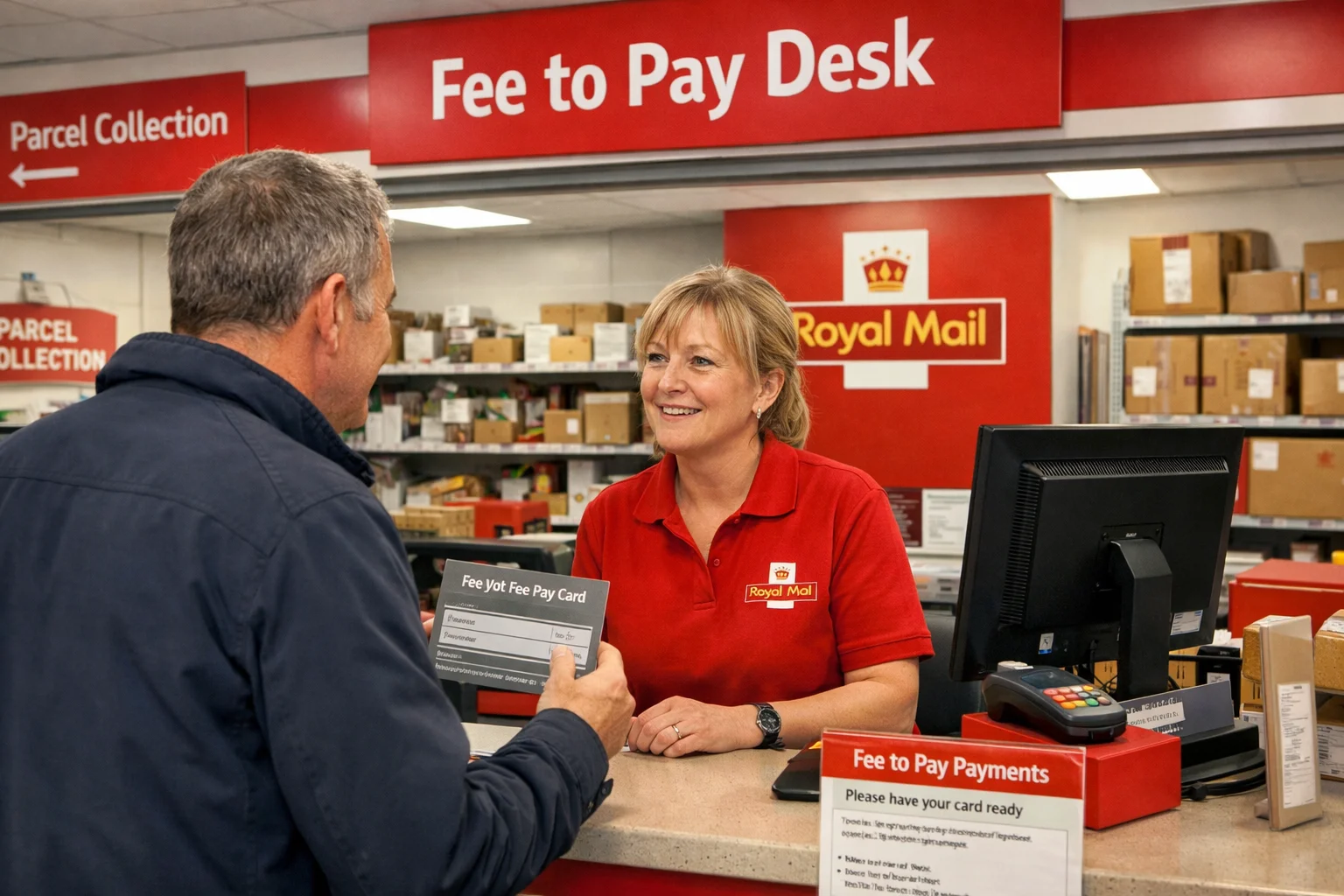
A physical Fee to Pay notice is commonly a grey Royal Mail card or letter.
A typical card may contain:
- Royal Mail branding
- The words Fee to Pay
- A payment reference
- A barcode
- The amount due
- The reason the fee has been applied
- Information explaining how to make payment or arrange delivery
Some Fee to Pay cards have been described as containing a 16-digit payment reference, although card designs and payment processes can change.
The barcode and payment reference are particularly important because they allow the item to be matched with the payment.
A card that looks different is not automatically fraudulent. Royal Mail can also issue Fee to Pay information by letter or through certain electronic notifications.
What matters more is whether the reference can be verified through official Royal Mail channels.
How Can You Pay a Royal Mail Fee?
The safest and clearest option is the official Royal Mail Pay a Fee service.
Royal Mail currently allows customers to pay online either as a guest or through an account.
Before starting, have:
- The information shown on the Fee to Pay card, letter, SMS or email
- The barcode or relevant card details
- A UK credit or debit card, or PayPal
Paying Online
Enter the details from the notice through Royal Mail’s official payment service and follow the instructions.
Once the fee has been dealt with, the item can normally move forward for delivery or collection.
Collecting From a Customer Service Point
Where collection is available, follow the instructions on the card and check the Customer Service Point details before travelling.
Opening hours vary, so checking the location first can prevent an unnecessary journey.
What About Paying by Phone?
The number 0345 774 0740 is widely used for Royal Mail Customer Services and can be useful if somebody needs assistance with a Fee to Pay notice.
However, Royal Mail’s current online Fee to Pay page primarily directs customers through its online payment process rather than listing telephone payment as the standard method.
For that reason, anyone receiving an unexpected phone call demanding immediate payment should not simply provide card details to the caller.
Instead, end the call and independently access Royal Mail through its official website or verified customer-service details.
Royal Mail Fee to Pay Barcode Not Recognised: What Should You Do?
As of August 2026, Royal Mail is displaying a live notice about a problem affecting a small number of Parcelforce customers with customs-charge Fee to Pay cards or letters.
In some cases, the barcode number is not being recognised by the payment system.
Royal Mail’s current workaround is:
- Choose Customs Charge
- Look for the Don’t have a barcode number section
- Select Enter Card Details
- Enter the requested information manually
- Continue through the payment instructions
This issue does not necessarily mean the card is invalid or fraudulent. If the card concerns a customs charge and the barcode produces an error, trying the manual card-details route may resolve the problem.
How Long Does Royal Mail Hold a Fee to Pay Item?
Royal Mail’s current redelivery information states that items are generally held for 18 calendar days before being returned to the sender.
That means the older advice that Royal Mail routinely holds Fee to Pay items for 18 to 21 days should no longer be relied upon as a general rule.
The actual deadline attached to the item should always be checked on the notice.
What Happens With Parcel Locker Items?
Parcel Locker items work slightly differently. Royal Mail states that an item placed in a Parcel Locker is held there for 3 calendar days.
If it is not collected within that period, it is returned to the relevant Customer Service Point, where it can then be held for a further 18 calendar days.
How Much Notice Is Needed for Redelivery?
Royal Mail currently requires 48 working hours’ notice for a redelivery.
If the item is needed sooner, collection from the relevant Customer Service Point may be the quicker option where collection is permitted.
How Can You Tell if a Royal Mail Fee to Pay Notice Is Genuine?
Delivery-fee scams are common because criminals know that many people are expecting parcels. Instead of judging a message only by how professional it looks, verify the request independently.
A genuine Fee to Pay notice should normally contain enough information for the payment or item to be checked through Royal Mail.
Useful checks include:
- Manually visit the official Royal Mail website instead of following an unexpected payment link
- Check the barcode or payment reference
- Confirm that the amount and reason for the fee make sense
- Check whether you are actually expecting an item
- Verify any tracking reference independently
- Be cautious if a caller demands immediate card details
- Avoid paying through websites that do not use the official Royal Mail domain
Scammers can copy company logos, colours and writing styles. A familiar-looking message is therefore not enough to prove it is genuine.
What Should You Do if You Do Not Recognise the Sender?

Receiving a Fee to Pay notice does not necessarily mean the parcel is fraudulent.
It could be:
- An online order using a different company name
- A gift from a friend or relative
- A replacement product
- A marketplace order
- An item with underpaid postage
- A parcel sent to the wrong address
If you still cannot identify it, you do not have to pay simply because a card has arrived.
Can You Find Out Who Sent the Item Before Paying?
The Fee to Pay card itself does not normally provide the sender’s full identity.
If there is a tracking reference, Royal Mail tracking may provide additional clues about the parcel’s journey, such as where it entered the postal network or its country of origin.
It may still not reveal the sender’s name.
Tracking can also show Royal Mail processing facilities rather than a retailer or individual. For example, seeing a Princess Royal Parcel Hub tracking update generally indicates that the parcel has passed through part of Royal Mail’s distribution network rather than identifying who originally sent it.
Before paying an unfamiliar charge, it can therefore help to:
- Review recent purchases
- Check marketplace order histories
- Ask family or friends whether they sent anything
- Look up the tracking reference
- Compare the destination details with your address
If the parcel remains completely unfamiliar, allowing it to be returned may be preferable to paying for an item you do not want.
How Do You Collect a Fee to Pay Item From Royal Mail?
Royal Mail requires identification when mail is collected from a delivery office or participating Post Office. Take the Fee to Pay card and suitable identification.
Accepted identification can include:
- Credit or debit card
- Bank or building society cheque or savings book
- Valid passport
- Driving licence
- NHS medical card
- Certain recognised photo identity cards
If someone else is collecting the item, Royal Mail normally asks them to bring the card plus identification in the name of the person to whom the item is addressed.
Where that is unavailable, the person collecting may need:
- The Fee to Pay card
- Their own photo identification
- Evidence showing they live at the address where the card was delivered
Royal Mail says only original, recent documents should be used.
What if the Customs Charge Looks Wrong?
Royal Mail does not calculate the underlying import VAT or Customs Duty. Those amounts are assessed by Border Force on behalf of HM Revenue & Customs.
A customs charge may deserve further investigation if:
- The declared value appears incorrect
- VAT was already charged when the item was purchased
- The parcel has been classified incorrectly
- The goods qualify for an exemption
- The item was declared as commercial goods when it was not
- The tax calculation appears to use the wrong value
Keep invoices, receipts, marketplace order details and payment confirmations because they may be needed as evidence.
GOV.UK provides information about tax and customs for goods sent from abroad, including the process for seeking a refund where Royal Mail or Parcelforce handled the parcel.
Why Have You Been Charged VAT if You Already Paid VAT at Checkout?
This is particularly confusing for people buying goods from overseas sellers through marketplaces.
Under current UK VAT rules, goods located outside the UK and sold through an online marketplace to customers in Great Britain can have VAT collected at the point of sale where the total consignment is valued at £135 or less.
In those circumstances, the marketplace normally collects and accounts for the VAT.
That means somebody who has already paid VAT at checkout should not automatically assume that a later import VAT demand is correct.
Possible reasons for a second charge include:
- The seller supplied incorrect customs information
- The VAT payment was not properly recorded
- The marketplace’s tax details were not transmitted with the parcel
- The total consignment was actually worth more than £135
- The item falls under a different VAT or customs rule
- The customs declaration contained an incorrect value
If VAT appears to have been charged twice, keep the original invoice or marketplace receipt showing the VAT paid.
Do not assume the Royal Mail handling fee and import VAT are the same thing. A customs notice can contain both the tax assessed by Border Force and Royal Mail’s separate processing charge.
Can You Refuse a Royal Mail Fee to Pay Item?
You are not required to accept an item simply because Royal Mail has issued a Fee to Pay notice. If you do not recognise the parcel, do not want it or do not believe paying the charge is worthwhile, you can leave the fee unpaid.
After the applicable retention period, Royal Mail will normally return the item to the sender where possible.
This can be particularly useful when:
- The sender cannot be identified
- The parcel was unsolicited
- The value of the item is less than the charge
- You believe the item was sent to the wrong person
- You no longer want the purchase
If the item was bought from a retailer, contact the seller as well. The sender may need to resolve the postage problem or refund any charge that resulted from its mistake.
Can Someone Else Pay or Collect the Item?
A Fee to Pay charge can generally be dealt with even when the intended recipient is not personally available, provided the correct item and address details are supplied.
Collection has stricter identification requirements. Royal Mail states that somebody collecting mail for another person should bring the relevant card together with appropriate identification.
If identification in the recipient’s name is unavailable, additional proof of the collector’s identity and address may be required.
What Happens After the Fee Is Paid?

After the charge has been successfully dealt with, the item can move forward for delivery or collection.
The exact timing depends on:
- The type of item
- Where it is being held
- When the payment was processed
- The requested redelivery date
- Local Royal Mail operations
- Whether additional customs processing is needed
Remember that Royal Mail requires 48 working hours’ notice for a requested redelivery. If tracking has not changed immediately after payment, that does not necessarily mean the item has been lost.
Final Thoughts on Royal Mail Fee to Pay Notices
A Royal Mail Fee to Pay card usually means there is an identifiable postage or customs problem rather than a random additional delivery charge. The most useful first step is to establish why the fee has been applied.
For domestic post, check whether the issue is missing, insufficient or invalid postage or whether the parcel exceeded Royal Mail’s size and weight limits.
For international items, separate the customs tax from the postal operator’s handling fee. Royal Mail currently charges £8 for Royal Mail products, while Parcelforce products normally carry a £12 customs handling fee.
Goods above £900 require a full customs declaration and a £25 handling charge through Parcelforce’s Central Clearance Bureau.
Recipients should also use the current retention rules rather than older 18-to-21-day estimates. Royal Mail generally holds items for 18 calendar days, while Parcel Locker items remain in the locker for three days before moving to a Customer Service Point.
Most importantly, verify unexpected payment requests independently. Use Royal Mail’s official website, check the reference or tracking details and avoid providing payment information to an unsolicited caller or unfamiliar website.
FAQs
How Do I Know if a Royal Mail Fee to Pay Card Is Real?
Check the barcode or reference through Royal Mail’s official website and make sure the payment request uses official Royal Mail channels. Do not rely only on logos or professional-looking formatting.
How Long Does Royal Mail Hold a Fee to Pay Item?
Royal Mail currently states that items are generally held for 18 calendar days. Parcel Locker items are held for three days before being moved to a Customer Service Point for a further 18 days.
Why Is Royal Mail Charging £10 for My Medium Parcel?
The £10 fee applies when a medium parcel exceeds 61cm × 46cm × 46cm or 20kg, with the packaging included in those measurements.
What Happens if My Fee to Pay Barcode Does Not Work?
For affected customs-charge cards, Royal Mail currently advises selecting Customs Charge, choosing Enter Card Details under the option for customers without a barcode and completing the details manually.
Why Is There a £25 Customs Handling Fee?
Goods valued above £900 require a full customs declaration. Royal Mail says this is processed by Parcelforce Worldwide’s Central Clearance Bureau and carries a £25 handling fee.
Can I Find Out Who Sent a Fee to Pay Parcel?
The card itself may not identify the sender. Tracking information can sometimes provide clues about the item’s origin or postal journey, but it may not reveal the sender by name.
Can I Call Royal Mail About a Fee to Pay Card?
Royal Mail Customer Services can be contacted on 0345 774 0740 for assistance. For payment, the current official Fee to Pay page primarily directs customers to Royal Mail’s online payment service.
Why Am I Being Charged VAT When I Already Paid VAT Online?
For many overseas marketplace consignments worth £135 or less, VAT is collected at checkout. If you appear to have been charged again, keep the invoice showing VAT paid and investigate whether the customs declaration or marketplace information was incorrect.