

The Sainsbury’s Delivery Pass is a paid subscription for customers who regularly order groceries online.
Instead of paying the advertised delivery fee each time, pass holders receive one delivery per day without a separate delivery charge when their order meets the qualifying conditions.
As of August 2026, Sainsbury’s offers Anytime and Midweek passes. The current qualifying spend is £50 per order after multibuy offers, product promotions and Nectar Price discounts. This threshold increased from £40 on 7 April 2026.
Sainsbury’s Delivery Pass at a Glance
| Feature | Current Details |
|---|---|
| Anytime Monthly Pass | £7.50 per month |
| Anytime 6-Month Pass | £43 |
| Anytime 12-Month Pass | £80 |
| Midweek Monthly Pass | £4 per month |
| Midweek 12-Month Pass | £50 |
| Anytime Delivery Days | Seven days a week |
| Midweek Delivery Days | Tuesday, Wednesday and Thursday |
| Qualifying Spend | £50 after applicable product offers and Nectar Price discounts |
| Delivery Allowance | One qualifying Delivery Pass delivery per day |
| Orders Below £50 | £7.50 standard delivery charge may apply |
| Eligible Service | Sainsbury’s Online Groceries |
Sainsbury’s states that the pass applies to online grocery orders and not to non-food orders.
What Is a Sainsbury’s Delivery Pass?

A Sainsbury’s Delivery Pass replaces individual delivery charges with a recurring monthly payment or a longer upfront subscription.
It is mainly aimed at households that use Sainsbury’s online grocery service frequently enough for their normal delivery charges to add up to more than the cost of the pass.
A Delivery Pass does not reduce the price of the groceries themselves. Nectar Prices, promotions and other eligible discounts continue to operate separately.
What Does the Sainsbury’s Delivery Pass Include?
Depending on the pass selected, customers can receive:
- One Qualifying Delivery Per Day
- Delivery On The Days Covered By The Selected Pass
- No Separate Delivery Charge On Qualifying Grocery Orders
- Access Through The Customer’s Sainsbury’s Online Grocery Account
- A Money-Saving Guarantee Subject To Sainsbury’s Terms
The Anytime pass covers all seven days of the week, while Midweek is restricted to Tuesdays, Wednesdays and Thursdays.
What Does a Delivery Pass Not Guarantee?
A Sainsbury’s Delivery Pass does not mean every online order will automatically be delivered without a charge.
It does not guarantee:
- Delivery On An Order Below The Required £50 Threshold
- Availability Of A Particular Delivery Slot
- More Than One Pass-Funded Delivery On The Same Day
- Free Click & Collect
- Discounts On The Grocery Products Themselves
- Delivery Of Non-Food Orders Through The Grocery Pass
Delivery slots remain subject to availability. Sainsbury’s currently allows available grocery slots to be viewed up to 21 days in advance under its standard delivery terms.
How Much Is the Sainsbury’s Delivery Pass in 2026?
Sainsbury’s currently charges between £4 per month and £80 per year, depending on whether a shopper chooses a Midweek or Anytime Delivery Pass and the subscription period selected.
How Much Is a Delivery Pass at Sainsbury’s?
The current Sainsbury’s Delivery Pass prices are:
| Pass | Subscription | Price |
|---|---|---|
| Anytime | Monthly | £7.50 |
| Anytime | 6 Months | £43 |
| Anytime | 12 Months | £80 |
| Midweek | Monthly | £4 |
| Midweek | 12 Months | £50 |
The annual Anytime pass works out at about £6.67 per month when its £80 cost is spread across 12 months. The annual Midweek pass works out at about £4.17 per month.
Sainsbury’s Anytime Delivery Pass Cost
The Sainsbury’s Anytime Delivery Pass costs £7.50 monthly, £43 for six months or £80 for 12 months.
It provides one qualifying delivery per day across all seven days of the week, provided the order reaches the current £50 qualifying value.
This option offers the greatest flexibility for households that cannot restrict their online grocery shop to particular weekdays.
Sainsbury’s Midweek Delivery Pass Cost
The Sainsbury’s Midweek Delivery Pass currently costs £4 per month or £50 for 12 months.
It covers qualifying deliveries on Tuesday, Wednesday and Thursday. Orders booked for other days are charged at the delivery rate displayed by Sainsbury’s.
It can therefore make more sense for households whose shopping routine is flexible enough to stay within those three days.
Midweek vs Anytime Sainsbury’s Delivery Pass
| Feature | Midweek | Anytime |
|---|---|---|
| Covered Days | Tuesday to Thursday | Seven days a week |
| Monthly Price | £4 | £7.50 |
| Annual Price | £50 | £80 |
| 6-Month Option | Not currently listed | £43 |
| Minimum Qualifying Spend | £50 | £50 |
The cheaper Midweek pass offers less scheduling flexibility, so price alone should not determine which option represents better value.
What Is the Minimum Spend for Sainsbury’s Delivery Pass?
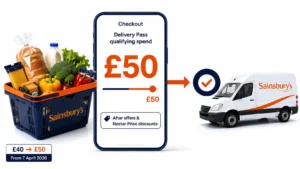
The current Sainsbury’s Delivery Pass minimum spend is £50 per transaction.
The £50 amount is calculated after multibuy offers, product promotions and Nectar Price discounts have been applied.
Sainsbury’s increased the previous £40 Delivery Pass threshold to £50 for delivery and collection slots dated on or after 7 April 2026.
This is different from the minimum basket needed to place a standard grocery home-delivery order.
Sainsbury’s current terms state that grocery home delivery has a £25 minimum order value, but orders below £50 can attract a higher delivery charge.
What Happens If a Sainsbury’s Delivery Pass Order Is Under £50?
A Delivery Pass holder whose qualifying basket falls below £50 does not receive the normal Delivery Pass delivery benefit for that order.
Sainsbury’s states that standard home-delivery orders below £50 are charged £7.50. Same-day delivery has separate charges, with orders below £50 currently charged up to £9.50.
That means a household spending £47 cannot assume that having already paid for a Sainsbury’s Delivery Pass removes the delivery fee.
Do Nectar Prices and Discounts Count Towards the £50 Minimum?
The £50 qualifying amount is assessed after multibuy offers, product promotions and Nectar Price discounts.
For example, if products initially total £53 but Nectar Prices and product promotions reduce the qualifying basket to £48, it does not meet the £50 Delivery Pass threshold.
Sainsbury’s also distinguishes product discounts from payment methods such as Nectar points and gift cards.
Its April 2026 update states that Nectar points, gift cards and vouchers cannot be used to build the basket up to the £50 qualifying level because these are applied after the relevant qualifying-value calculation.
Seasonal discounts can make this calculation particularly relevant. Grocery promotions such as supermarket Valentine meal deals can reduce the amount ultimately charged for selected products, so Delivery Pass customers should look at the qualifying checkout total rather than simply adding up shelf prices.
Why Did the Sainsbury’s Delivery Pass Minimum Spend Change?
Sainsbury’s increased the Delivery Pass threshold from £40 to £50 on 7 April 2026.
The supermarket described the change as its first Delivery Pass threshold increase in more than a decade and said it was intended to support the continued delivery of its service as costs and operational demands increased.
The practical effect is more significant for households whose regular online shop previously sat between £40 and £49.99. They must now either increase the qualifying basket to £50 or pay the applicable delivery charge.
Why Older Sainsbury’s Delivery Pass Information Can Be Misleading?
Some older information still refers to a £40 minimum spend or earlier Delivery Pass prices.
That includes historical shopper discussions such as this MoneySavingExpert forum discussion about Sainsbury’s Delivery Pass terms, which is useful for understanding customer concerns but should not replace current official terms.
There is even an inconsistency within Sainsbury’s own help content. One help-page section retrieved in August 2026 still displayed an older £40 Midweek threshold and £40 annual Midweek price, while Sainsbury’s newer grocery delivery charges page lists the current Midweek terms as a £50 qualifying spend and £50 annual price.
For current pricing, the newer delivery-charges page and checkout information provide the stronger evidence.
How Much Does Sainsbury’s Delivery Cost Without a Delivery Pass?
Customers do not need a Delivery Pass to order Sainsbury’s groceries online.
For next-day home delivery, current Sainsbury’s information states:
- Orders Under £50 Are Charged £7.50
- Orders Over £50 Generally Cost Between £1 And £6 Depending On The Slot
- Same-Day Orders Under £50 Can Cost £9.50
- Same-Day Orders Over £50 Currently Cost Between £6 And £8
The minimum basket for home delivery is £25.
Are Sainsbury’s Saver Slots Cheaper Than a Delivery Pass?
Saver slots can be cheaper than standard one-hour delivery slots because they use a longer delivery window. Sainsbury’s describes Saver slots as cheaper delivery options with a window of four hours or more, followed by a more precise one-hour notification on the day.
Whether Saver slots are better value depends on shopping frequency.
A customer making only a handful of online grocery orders each year may spend less by paying for individual low-cost slots.
A customer ordering weekly is more likely to accumulate enough delivery charges for a subscription to become competitive.
Delivery availability can also become more important during busy seasonal periods. The way Tesco Easter delivery slots are released illustrates how advance planning can matter across the UK online grocery market.
How to Get Free Delivery With Sainsbury’s?
The clearest way to avoid a separate Sainsbury’s grocery delivery charge on qualifying orders is to hold an eligible Delivery Pass and meet its conditions.
However, calling this completely “free delivery” can be misleading because the pass itself has a subscription cost.
For the delivery charge to be removed, a customer generally needs to:
- Hold An Active Sainsbury’s Delivery Pass
- Spend At Least £50 After Relevant Product Offers And Nectar Price Discounts
- Select A Day Covered By The Pass
- Keep Within The One Delivery Pass Delivery Per Day Limit
- Place An Eligible Sainsbury’s Online Grocery Order
Sainsbury’s current Delivery Pass sign-up page lists the available plans and states the £50 qualifying spend for delivery without a separate charge.
Can a Sainsbury’s Delivery Pass Provide Free Delivery?

It can provide delivery with no additional delivery charge once the subscription has been purchased and the order meets the rules.
The distinction matters when assessing value. A household paying £80 for an annual Anytime Pass has prepaid for the delivery benefit rather than receiving an entirely cost-free delivery service.
When Can Delivery Charges Still Apply?
Charges can still arise when:
- The Qualifying Basket Is Below £50
- A Midweek Pass Holder Selects A Day Outside Tuesday To Thursday
- More Than One Delivery Is Received On The Same Day
- The Order Falls Outside The Delivery Pass Conditions
- A Customer Uses Click & Collect, Which Has Separate Charges
Holiday availability can also differ from normal trading patterns. Shoppers planning around public holidays can check UK supermarket bank holiday opening times alongside the slot availability shown in their grocery account.
Is Sainsbury’s Delivery Pass Worth It?
A Sainsbury’s Delivery Pass can be worth paying for when a household orders regularly, consistently spends at least £50 and would otherwise choose delivery slots with meaningful individual charges.
The calculation becomes less favourable when orders are infrequent or regularly fall below £50.
When a Sainsbury’s Delivery Pass May Be Worth It?
A pass may suit shoppers who:
- Order Groceries Online Every Week
- Routinely Spend £50 Or More
- Prefer Home Delivery To Click & Collect
- Normally Pay Several Pounds For Delivery
- Need Predictable Delivery Costs
- Can Use Midweek Slots Regularly If Choosing The Cheaper Plan
Sainsbury’s says customers can receive only one pass-funded delivery per day, but they may order as often as they wish subject to that limitation.
When a Sainsbury’s Delivery Pass May Not Be Worth It?
The pass may be less attractive for shoppers who:
- Order Online Only Occasionally
- Usually Spend Less Than £50
- Have Access To Low-Cost Saver Slots
- Prefer Shopping In Store
- Regularly Use Click & Collect
- Cannot Use Tuesday To Thursday Slots With A Midweek Pass
Some customers have discussed their experiences with the service over several years in this Mumsnet Sainsbury’s Delivery Pass discussion. The thread dates from 2021, so its comments are useful as historical consumer experiences rather than evidence of current prices or rules.
How to Calculate Whether a Sainsbury’s Delivery Pass Will Save Money?
A simple calculation is:
Expected number of annual deliveries × average delivery fee = estimated annual delivery cost without a pass
That figure can then be compared with £80 for the annual Anytime Pass or £50 for the annual Midweek Pass.
For example, if a household would normally pay an average of £3 per delivery:
| Option | Pass Cost | Approximate Deliveries Needed To Match Cost |
|---|---|---|
| Anytime Annual | £80 | 27 Deliveries |
| Midweek Annual | £50 | 17 Deliveries |
| Anytime Monthly | £7.50 | 3 Deliveries Per Month |
| Midweek Monthly | £4 | 2 Deliveries Per Month |
These are break-even illustrations based on an assumed £3 delivery fee, not guaranteed savings. A customer normally selecting £1 slots needs far more deliveries to justify a pass, while a customer regularly paying £5 or £6 reaches the break-even point sooner.
Are Supermarket Delivery Passes Worth It?
Supermarket delivery passes are generally most useful for customers who place predictable, frequent grocery orders and would otherwise pay repeated delivery charges.
They are less compelling when a shopper alternates between supermarkets, shops mostly in store or takes advantage of very cheap delivery slots.
The better question is not simply whether a supermarket delivery pass sounds inexpensive. It is whether the annual cost of the pass is lower than the delivery fees the household would realistically pay without it.
Grocery budgeting can also include savings beyond delivery charges. Reduced-price shopping strategies, including Tesco yellow sticker reductions, can sometimes have a larger effect on the total grocery bill than changing delivery plans alone.
Does Sainsbury’s Have a Delivery Pass Guarantee?
Yes. Sainsbury’s currently provides a money-saving guarantee for the Delivery Pass.
The supermarket states that if a customer does not save enough in delivery charges to cover the cost of the Delivery Pass, it will issue a voucher for the difference.
The guarantee improves the financial proposition for regular users, although customers should still review the current conditions attached to their pass rather than assuming every delivery-related charge will count towards the calculation.
Does Your Shopping Pattern Actually Suit a Delivery Pass?
Change four details from a normal grocery month. The comparison below uses the article’s current annual Midweek and Anytime prices.
Midweek currently has the stronger cost case
At this shopping frequency and assumed delivery fee, estimated annual pay-as-you-go delivery charges are above the £50 annual Midweek Pass price. Because Tuesday to Thursday works for this pattern, Midweek is the lower-cost pass to compare first.
This is an illustration based on the delivery frequency and fee selected above. Actual savings depend on the delivery slots the customer would otherwise have booked.
How Often Can a Customer Use a Sainsbury’s Delivery Pass?
Sainsbury’s states that Delivery Pass customers can order as often as they like but can receive only one Delivery Pass delivery per day.
Any additional order scheduled for delivery on the same day is charged at the advertised delivery rate.
For Midweek pass holders, that qualifying delivery must also fall on Tuesday, Wednesday or Thursday. Anytime customers have access across all seven days.
This is why describing the service simply as “unlimited free delivery” would omit an important condition.
Can Sainsbury’s Delivery Pass Be Used for Click & Collect?

A Sainsbury’s Delivery Pass does not make Click & Collect free.
Sainsbury’s currently states that standard Click & Collect orders of £25 or more are charged from 50p, while standard orders below £25 carry a £4 collection charge.
There is no minimum order value for standard Click & Collect itself under Sainsbury’s general grocery terms.
For customers living close to a collection point, these relatively low charges can make Click & Collect a practical alternative to paying for a Delivery Pass.
Do Gift Cards, Vouchers and Coupons Affect Sainsbury’s Delivery Pass Orders?
Gift cards and Nectar points are different from product promotions when Sainsbury’s determines whether the £50 Delivery Pass requirement has been reached.
Sainsbury’s April 2026 guidance says the order must reach £50 after multibuy offers, product promotions and Nectar Price reductions.
Nectar points, gift cards and vouchers are then applied separately and cannot be used to artificially bring a sub-£50 basket up to the qualifying level.
For example, a qualifying £55 grocery basket does not cease to qualify simply because part of the eventual payment is made using an eligible gift card. What matters is how Sainsbury’s calculates the qualifying basket before those payment mechanisms are applied.
Consumers comparing different forms of retail credit can also find examples among the most popular gift cards in the UK.
Because Sainsbury’s published wording has varied across help pages, shoppers using a particular coupon or voucher should check the qualifying total shown at checkout before confirming an order.
How to Buy a Sainsbury’s Delivery Pass?
Customers can purchase a Delivery Pass through Sainsbury’s online grocery service.
Sign In to a Sainsbury’s Online Account
An existing online grocery customer should sign in using the account that will be used for future deliveries.
New online customers must create a Sainsbury’s Online Grocery account. Sainsbury’s says a newly registered customer may need to wait 24 hours before purchasing a Delivery Pass.
Open the Delivery Pass Section
The Delivery Pass section displays the available plans and current subscription prices.
Choose Midweek or Anytime
Customers should decide whether deliveries restricted to Tuesday, Wednesday and Thursday are sufficient or whether seven-day Anytime access is needed.
Select the Subscription Period
Current choices include monthly and annual options, plus a six-month option for the Anytime pass.
Check the Current Price and Terms
Prices, qualifying thresholds and delivery conditions should be checked immediately before payment because Sainsbury’s reserves the right to change delivery and collection charges.
Complete the Purchase
Sainsbury’s says the pass should be registered to the Online Groceries account within 24 hours. It also provides a voucher code after purchase so an eligible customer can use the benefit sooner on a qualifying order.
Does Sainsbury’s Delivery Pass Automatically Renew?
Yes. Sainsbury’s says Delivery Pass subscriptions renew automatically according to the duration of the pass purchased.
That can mean monthly, six-monthly or annual renewal depending on the selected product. Customers are provided with an option to opt out of renewal, and Sainsbury’s says it sends a reminder email 28 days before a renewal payment is due.
Customers who no longer want the subscription should therefore distinguish between ending the current membership immediately and switching off future auto-renewal.
How Can a Customer Cancel a Sainsbury’s Delivery Pass?
Sainsbury’s current general help guidance gives customers a 14-day cooling-off period after purchasing a Delivery Pass.
If the pass has not been used during that period, Sainsbury’s says a full refund can be issued. If the pass has been used, the value of delivery slots already used can be deducted from any refund due.
Its general help page states that membership cannot normally be cancelled more than 14 days after purchase, although customers can opt out of future automatic renewal.
There was a separate temporary cancellation arrangement when the £50 threshold was introduced in April 2026, but the stated deadline for that change-specific partial refund was 21 April 2026, so it is no longer a current cancellation route in August 2026.
Sainsbury’s Delivery Pass vs Paying Per Delivery
| Shopper Pattern | Delivery Pass | Paying Per Delivery |
|---|---|---|
| Weekly £50+ Orders | Often More Competitive | Charges Accumulate Quickly |
| Two Orders Per Month | Depends On Slot Cost | May Be Competitive |
| Occasional Orders | Often Less Compelling | Usually More Flexible |
| Orders Usually Below £50 | Poor Fit | Delivery Charge Still Applies |
| Tuesday To Thursday Shopping | Midweek Can Be Attractive | Depends On Individual Slot Price |
| Frequent Weekend Orders | Anytime Is More Suitable | Individual Fees May Add Up |
| Mainly Click & Collect | Usually Less Useful | Collection Charges May Be Lower |
The best comparison is based on actual shopping behaviour rather than the maximum theoretical saving advertised by a retailer.
Customers should estimate how many £50-plus home-delivery orders they place in a typical month, check the delivery prices they normally select and compare that total with the relevant subscription.
Conclusion: Is the Sainsbury’s Delivery Pass Good Value for UK Shoppers?
The Sainsbury’s Delivery Pass can offer good value for UK shoppers who order groceries online regularly, consistently spend £50 or more and would otherwise pay repeated home-delivery charges.
The Anytime pass currently costs £7.50 monthly, £43 for six months or £80 annually. The Midweek option costs £4 monthly or £50 annually and restricts the delivery benefit to Tuesday, Wednesday and Thursday.
The most important change for 2026 is the £50 minimum qualifying spend, which replaced the previous £40 threshold from 7 April. Smaller households that frequently spend between £40 and £50 may therefore find the pass less useful than it was previously.
Regular £50-plus shoppers should compare the pass price with their likely annual delivery fees. Less frequent shoppers may be better served by individual Saver slots or Click & Collect.
Frequently Asked Questions About Sainsbury’s Delivery Pass
How Much Is a Sainsbury’s Delivery Pass?
The Anytime Delivery Pass currently costs £7.50 per month, £43 for six months or £80 for 12 months. The Midweek Delivery Pass costs £4 per month or £50 for 12 months.
What Is the Minimum Spend for Sainsbury’s Delivery Pass in 2026?
The minimum qualifying spend is £50 per order after multibuy offers, product promotions and Nectar Price discounts. The new threshold took effect on 7 April 2026.
What Happens If a Sainsbury’s Delivery Pass Order Is Below £50?
A standard home-delivery order below the £50 Delivery Pass threshold is charged £7.50, even when the customer has a Delivery Pass.
Is the Sainsbury’s Midweek Delivery Pass Worth It?
It can be worthwhile for regular customers who order at least £50 at a time and can consistently schedule deliveries on Tuesday, Wednesday or Thursday. Customers needing weekend flexibility are more likely to benefit from the Anytime option.
Can Nectar Prices Take an Order Below the Delivery Pass Minimum?
Yes. Sainsbury’s calculates the £50 qualifying value after Nectar Price discounts, product promotions and multibuy offers. A basket can therefore start above £50 but fall below the qualifying threshold after discounts are applied.
Can a Sainsbury’s Delivery Pass Be Used for Click & Collect?
The Delivery Pass does not make Click & Collect free. Standard collection charges currently start from 50p for orders of £25 or more, with a £4 charge on standard orders under £25.
Can a Sainsbury’s Delivery Pass Be Cancelled?
Customers generally have a 14-day cancellation period after purchase under Sainsbury’s current Delivery Pass guidance. They can also opt out of future automatic renewal. Refunds within the cooling-off period may be reduced if the pass has already been used.