


When someone reports suspected tax fraud or avoidance to HMRC, the information is assessed before any decision is made about further action.
HMRC may compare the report with tax records and other information already available to it, gather further intelligence, open a compliance check or begin a specialist investigation.
A report does not automatically mean the person or business will be investigated, and being reported does not prove wrongdoing.
Reports can be made anonymously. However, HMRC generally does not provide the reporter with details about what action it eventually takes.
For serious tax avoidance or evasion, an eligible person who provides identifying and contact details may potentially qualify for HMRC’s Strengthened Reward Scheme.
What Are the Latest HMRC Tax Fraud Changes and Updates in 2026?

HMRC’s approach to tax compliance has become more enforcement-focused in 2026.
Its updated Transformation Roadmap says the department added more than 1,600 compliance caseworkers during 2025/26 and plans at least 30,000 high-street-linked interventions in 2026/27.
It is also expanding specialist work against fraud, abusive phoenixism and illegal activity involving businesses.
This increased enforcement makes areas such as HMRC action against phoenixing particularly relevant where directors repeatedly close companies while attempting to escape tax liabilities.
Another major development is the Strengthened Reward Scheme, launched in November 2025 and promoted further during 2026. It targets high-value information involving serious avoidance or evasion.
A further change was announced on 13 July 2026. Draft Finance Bill 2026-27 legislation proposes that rewards under the scheme will have Income Tax deducted at source at the additional rate of 45% once the legislation takes effect.
The current proposal is therefore a future withholding mechanism rather than something that should be described as already operating. The latest Finance Bill tax proposals provide further detail on the planned change.
What Can You Report Someone to HMRC For?
HMRC accepts information concerning people or businesses suspected of deliberately failing to meet tax obligations or committing other fraud within HMRC’s remit.
Tax Evasion and Undeclared Income
Reports may concern deliberately undeclared earnings, rental income, business takings, offshore income or assets that someone knowingly fails to disclose.
Cash transactions are not automatically evidence of tax evasion.
However, unexplained business income and patterns involving unusually large amounts of undeclared cash can attract scrutiny, which is why questions about cash deposits raising suspicion in the UK should be considered separately from evidence of actual tax fraud.
Business, VAT and Payroll Fraud
HMRC may receive reports relating to businesses deliberately concealing sales, manipulating payroll records, evading VAT or accounting incorrectly for employees.
Payroll compliance is particularly important where reported wages, deductions and business records do not match, and HMRC can carry out payroll compliance checks on employers when it identifies potential irregularities.
Tax Avoidance Schemes
Tax avoidance and tax evasion are not identical. Evasion involves deliberate dishonest conduct designed to escape tax, whereas avoidance generally concerns arrangements intended to obtain a tax advantage within or around the wording of tax rules.
HMRC can nevertheless investigate and challenge avoidance arrangements it considers ineffective or abusive.
What Should Be Reported Somewhere Else?
Not every suspected offence belongs with HMRC.
General benefit fraud normally has a separate reporting process. HMRC’s tax-fraud service does, however, cover Child Benefit and tax credit fraud.
Other crimes, identity fraud, immigration offences and immediate threats should be reported through the appropriate government or law-enforcement route.
How Do You Report Someone to HMRC in 2026?
The main route is HMRC’s online service. The official report tax fraud to HMRC service allows information about a person or business to be submitted without requiring the reporter to disclose personal details.
If the online service cannot be used, HMRC’s fraud hotline is 0800 788 887 from within the UK or +44 203 080 0871 from outside the UK. Current published opening hours are Monday to Friday, 9am to 5pm, excluding bank holidays.
Can You Submit Documents With Your Initial Report?
HMRC says supporting documents should not be sent with the initial report. Instead, the reporter can explain what evidence exists. If contact details have been provided and HMRC needs the material, it can request further information later.
What Information Should You Give HMRC?

Useful information should be factual, specific and easy to understand.
For reports involving serious avoidance or evasion, HMRC asks for information including:
- what activity is suspected
- how the reporter knows about it
- their relationship with the person or business
- how long the activity has been occurring
- the estimated value involved
- details of any supporting information available.
HMRC specifically tells reporters not to investigate the activity themselves or tell others that they are making a report.
Do You Need Proof Before Reporting Someone?
You do not need to prove the entire case before submitting information. The purpose of a report is to tell HMRC what you genuinely know or reasonably suspect.
However, vague speculation will naturally provide less useful intelligence than specific information about transactions, dates, businesses, income or records.
Can You Report Someone to HMRC Anonymously?
Yes. HMRC allows people to report suspected tax fraud without giving personal details.
Providing a name and contact information can still be useful because HMRC may need clarification later. Information supplied about the reporter is treated as private and confidential.
There is an important 2026 distinction: someone making an anonymous report cannot receive a payment under the Strengthened Reward Scheme.
Can HMRC Tell Someone Who Reported Them?
HMRC states that information provided by reporters is private and confidential. Reporters therefore should not assume that their details will simply be passed to the person being reported.
The safest wording is not to promise absolute anonymity in every imaginable legal circumstance.
Someone particularly concerned about personal or professional exposure should avoid independently confronting the person involved or revealing that a report has been made.
What Happens After HMRC Receives a Tax Fraud Report?
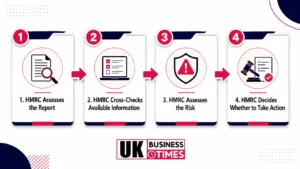
Step 1 — HMRC Assesses the Report
HMRC first considers the information it has received and whether it falls within its responsibilities.
Step 2 — HMRC Cross-Checks Available Information
Information in a tip-off can be considered alongside records and intelligence already available to HMRC. A discrepancy may justify further enquiries, while an allegation unsupported by other information may not.
Step 3 — HMRC Assesses the Risk
HMRC can consider factors such as the potential amount of tax involved, credibility of the information, seriousness of the conduct and whether the activity appears to be deliberate or repeated.
Step 4 — HMRC Decides Whether to Take Action
Possible responses range from no immediate action to additional intelligence gathering, compliance activity, a specialist civil investigation or, in sufficiently serious circumstances, criminal investigation.
Does HMRC Investigate Every Report?
No. A report does not automatically trigger a formal investigation.
HMRC receives information from numerous sources and decides how to use it based on its assessment of risk and available evidence.
This distinction is important. Being reported does not establish that tax has been underpaid, and HMRC’s own COP9 guidance states that investigators keep an open mind to the possibility of an innocent explanation even where fraud is suspected.
Will HMRC Tell You What Happened After You Report Someone?
Usually, no. For reports under the Strengthened Reward Scheme, HMRC confirms that the reporter will be notified that the report was received.
However, HMRC says reporters should not submit duplicate reports or contact it seeking an outcome because it cannot provide feedback about the case.
HMRC may contact a named reporter when further information is required or when they may qualify for a reward.
How Does HMRC Investigate Suspected Tax Fraud?

Not every investigation follows the same procedure.
What Is an HMRC Compliance Check?
A compliance check allows HMRC to examine whether the correct amount of tax has been declared and paid. The scope depends on the issue and may involve tax returns, accounts, expenses or business records.
What Is HMRC Code of Practice 8?
Code of Practice 8, or COP8, is principally used by specialist HMRC teams for complex cases where COP9’s Contractual Disclosure Facility is not considered appropriate.
HMRC’s internal guidance says COP8 is primarily associated with avoidance investigations, although it can apply in other circumstances.
What Is HMRC Code of Practice 9?
Code of Practice 9, or COP9, is HMRC’s civil investigation procedure for cases where fraud is suspected.
HMRC may offer the taxpayer the Contractual Disclosure Facility.
If the taxpayer accepts it and makes a complete disclosure of deliberate behaviour under the required terms, HMRC agrees not to pursue a criminal investigation into the fraud properly disclosed through that process.
COP9 should therefore not be described simply as a criminal investigation. HMRC separately retains discretion to pursue criminal cases where appropriate.
HMRC Investigation Routes Compared
| HMRC route | General purpose | Nature |
|---|---|---|
| Compliance check | Checking whether tax affairs are correct | Usually civil |
| COP8 | Complex or high-risk specialist tax matters | Civil |
| COP9/CDF | Cases where HMRC suspects fraud | Civil fraud procedure |
| Criminal investigation | Serious cases selected for criminal enforcement | Criminal |
The route used depends on the facts and HMRC’s assessment. Receiving a compliance letter should therefore not automatically be interpreted as an allegation of fraud.
How Long Does an HMRC Investigation Take?
There is no single standard HMRC investigation timeframe.
Straightforward compliance matters may be resolved faster than cases involving numerous tax years, companies, offshore arrangements or large quantities of financial evidence.
HMRC specifically warns that investigations connected with its high-value reward scheme can take a long time and that years may pass between the original report and any eventual reward payment.
What Can Affect the Length of an Investigation?
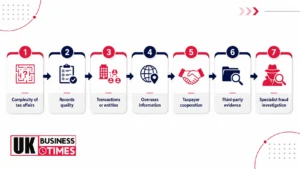
Factors can include:
- complexity of the tax affairs
- availability and quality of records
- number of transactions or entities involved
- overseas information
- cooperation from the taxpayer
- third-party evidence
- whether suspected fraud requires specialist investigation.
What Powers Does HMRC Have During an Investigation?
HMRC has statutory powers that can allow it, where the relevant legal conditions are met, to request information and documents, inspect records and premises, question discrepancies and obtain information from third parties.
The precise power available depends on the type of tax and investigation. HMRC does not have unlimited authority, and statutory safeguards and taxpayer rights continue to apply.
Can HMRC Visit a Business Without Warning?
Some inspections are arranged in advance, but HMRC also has powers for authorised unannounced inspections in particular circumstances. It is therefore inaccurate to state that HMRC must always provide advance notice.
What Can Happen to Someone Reported to HMRC?
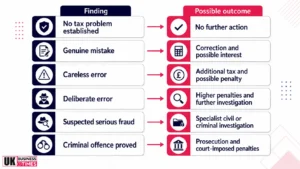
The outcome depends on what HMRC ultimately finds, not simply on the fact that a report was made.
| Finding | Possible outcome |
|---|---|
| No tax problem established | No further action |
| Genuine mistake | Correction and possible interest |
| Careless error | Additional tax and possible penalty |
| Deliberate error | Higher penalties and further investigation |
| Suspected serious fraud | Specialist civil or criminal investigation |
| Criminal offence proved | Prosecution and court-imposed penalties |
HMRC can also publish details of certain deliberate tax defaulters where statutory conditions are satisfied.
Can You Go to Prison After Being Reported to HMRC?
Merely being reported to HMRC cannot send someone to prison.
Imprisonment would require a much more serious sequence of events: HMRC would need grounds for criminal investigation, prosecutors would need to bring a case and a court would ultimately need to convict the person of an offence for which imprisonment is available.
Many tax disputes and compliance failures are instead resolved through additional tax, interest, penalties or civil investigation.
Can You Get a Reward for Reporting Someone to HMRC in 2026?
Yes, but the Strengthened Reward Scheme is aimed at serious, high-value tax avoidance and evasion, not ordinary small tip-offs.
HMRC’s scheme is targeted particularly at information involving large companies, wealthy individuals, offshore arrangements and avoidance schemes.
How Does the HMRC Strengthened Reward Scheme Work?
Information must lead HMRC to collect at least £1.5 million in tax for a potential reward under the strengthened scheme.
The HMRC Strengthened Reward Scheme can provide eligible informants with 15% to 30% of the additional tax collected, excluding penalties and interest. The precise amount depends on HMRC’s assessment and is not guaranteed.
Can Anonymous Reporters Receive an HMRC Reward?
No. HMRC explicitly states that anonymous reports are accepted, but anonymous reporters are not eligible for payment. Contact details must be supplied to be considered for a reward.
Are HMRC Informant Rewards Taxable in 2026?
Yes. HMRC says informant rewards are already taxable income.
Draft legislation published on 13 July 2026 would introduce automatic withholding at the 45% additional rate when a Strengthened Reward Scheme payment is made.
As of August 2026, this should be described as a proposed mechanism intended to apply after the relevant Finance Bill provision receives Royal Assent, not as an already operative deduction.
What Happens If Someone Makes a False Report to HMRC?
HMRC does not treat a tip-off as proof that someone has broken tax law. Information can be assessed against existing records and other intelligence before decisions are taken.
Anyone reporting suspected wrongdoing should therefore provide what they genuinely know rather than exaggerating circumstances, manufacturing evidence or making allegations they know to be false.
What Should You Do If HMRC Investigates You After a Report?

If HMRC contacts you, do not assume automatically that another person has reported you. Compliance activity can arise from tax returns, data matching, third-party information and HMRC’s own risk-assessment systems.
Read the correspondence carefully, establish what HMRC is requesting, preserve relevant records and respond accurately within applicable deadlines.
If contact arrives unexpectedly, checking whether an HMRC call is genuine before sharing sensitive information can also help reduce the risk of impersonation fraud.
Specialist professional advice may be appropriate where allegations of deliberate behaviour, COP8, COP9 or significant tax liabilities are involved.
How Can Businesses Reduce the Risk of HMRC Compliance Problems?
Businesses can reduce avoidable tax problems by maintaining accurate records, declaring taxable income, operating PAYE correctly, filing VAT information accurately and retaining evidence behind tax returns and expenses.
Employers should also investigate inconsistencies rather than assuming payroll information is correct, particularly when a payslip check identifies an HMRC issue or figures reported through payroll do not correspond with business records.
Good records do not prevent HMRC from carrying out checks, but they can make it considerably easier to explain transactions and establish the correct tax position.
Conclusion
Reporting someone to HMRC begins an assessment process, not an automatic investigation or finding of guilt.
HMRC can consider the information alongside its existing records and decide whether no action, a compliance check, civil investigation or more serious enforcement is appropriate.
Reports can be anonymous, although providing contact details allows HMRC to request further information and is required for eligibility under the Strengthened Reward Scheme. HMRC generally does not tell reporters what happens afterwards.
For 2026, the most significant development is the greater emphasis on high-value informant information, alongside expanded compliance and enforcement activity.
Anyone making a report should provide accurate information and avoid carrying out their own investigation, while anyone contacted by HMRC should deal carefully with requests and seek specialist tax advice where the matter is serious.
Frequently Asked Questions
Can I Report Someone to HMRC Anonymously?
Yes. HMRC allows anonymous tax-fraud reports. However, providing contact details allows HMRC to ask for further information, and anonymous reporters cannot qualify for the Strengthened Reward Scheme.
Does HMRC Investigate Every Tip-Off?
No. HMRC assesses information and decides what action, if any, is appropriate. A report itself is not proof of tax fraud.
Will Someone Know I Reported Them to HMRC?
HMRC says information supplied by reporters is private and confidential. Reporters should nevertheless avoid telling the person involved or trying to investigate them independently.
Does HMRC Tell You the Outcome of a Report?
Normally no. HMRC states that it cannot provide feedback about a submitted report, although it may contact a reporter if additional information is required.
How Quickly Does HMRC Act on Reports?
There is no universal timetable. The time needed depends on the seriousness and complexity of the information and the investigation that follows, if any.
Do I Need Evidence Before Reporting Tax Fraud?
You can report what you genuinely know or suspect without proving the entire case yourself. HMRC specifically advises people not to conduct their own investigation.
Can HMRC Check Someone’s Bank Account?
HMRC has statutory information powers that can be used to obtain relevant financial information where legal requirements are met. The precise powers and safeguards depend on the circumstances.
Can HMRC Visit a Business After Receiving a Report?
Potentially, yes. An inspection may form part of compliance activity, although a report does not automatically result in a visit.