

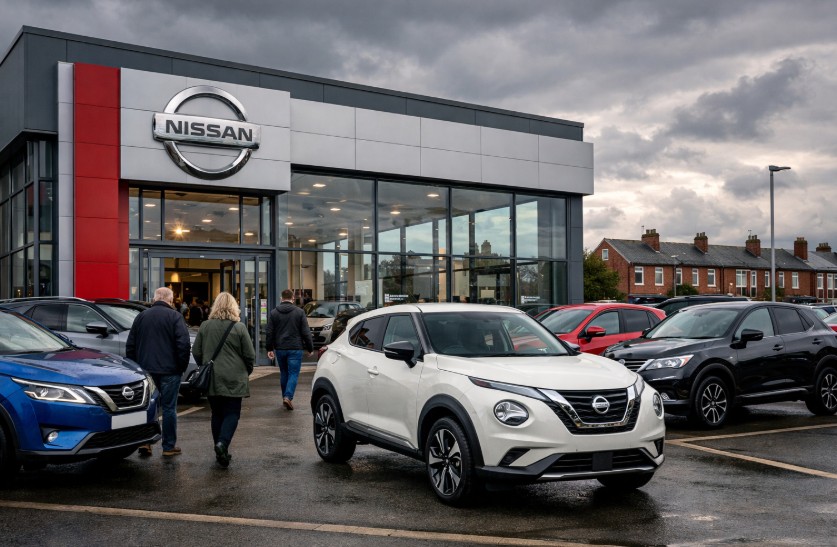
No, Nissan is not going out of business. However, the company is facing severe financial pressure in 2025 and is undergoing one of the most aggressive restructuring programmes in its history to stabilise operations and return to profitability by 2026.
Reports of a 4.5 billion dollar annual net loss, 20,000 job cuts, and seven planned factory closures have understandably sparked concern across the UK.
Here are the key facts:
- Nissan reported a 4.5 billion dollar annual net loss in May 2025
- The company is cutting 20,000 jobs globally
- Seven factories worldwide are set for closure or sale
- Production capacity is being reduced by 20 percent
- The Sunderland plant in the UK remains operational
While the situation is serious, restructuring does not equal collapse. The brand is fighting to survive, not preparing to disappear.
Is Nissan Going Out of Business in 2026?
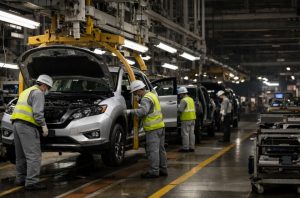
The short answer is no, Nissan is not going out of business in 2026. What the company is experiencing is a critical turnaround phase following major financial losses and declining profitability.
Executives previously warned that Nissan had roughly 12 to 14 months to correct its trajectory, which triggered widespread speculation about its future. In reality, Nissan has entered what leadership described as an emergency mode period.
This involves rapid restructuring, leadership changes, cost reductions, and production cuts designed to protect long term viability. The company has not filed for bankruptcy, nor has it announced plans to cease operations in the UK or globally.
Instead, Nissan is attempting to streamline its business model, reduce excess production, and focus on profitable vehicle segments. The goal is to restore stability by the 2026 financial year. The company remains operational, selling vehicles and maintaining dealership networks across Britain.
Why Are People Asking if Nissan Is Going Out of Business?
Public concern has grown due to a combination of financial disclosures, merger failures, and executive warnings. Headlines about billions in losses have created the impression that Nissan may be approaching collapse.
Several factors have fuelled speculation:
- A reported 4.5 billion dollar annual net loss in May 2025
- Announcement of 20,000 global job cuts
- Plans to close or sell seven factories worldwide
- A failed merger attempt with Honda in early 2025
- Public statements referencing a limited time window to recover
Online discussions have amplified the issue. Comments on forums and social media platforms have misinterpreted executive urgency as confirmation of imminent shutdown. However, financial distress does not automatically mean insolvency.
Nissan’s leadership has openly admitted that sales projections were overstretched and that inventory levels increased significantly during 2024 and 2025.
The company responded with a restructuring strategy rather than liquidation planning. While uncertainty remains, the narrative of total collapse lacks full financial context.
How Serious Is Nissan’s Financial Crisis in 2025?

Nissan’s financial situation in 2025 is undeniably severe. The company posted a 4.5 billion dollar annual net loss and previously reported a significant loss during the 2024 Japanese financial year.
Operating profit projections were revised downward, highlighting ongoing instability and pressure on margins across key global markets.
Inventory imbalances and slowing global sales further complicated recovery efforts, exposing a gap between production targets and real demand.
Addressing this miscalculation, former CEO Makoto Uchida publicly acknowledged the issue, stating,
“We cannot deny the fact that our sales plan was overstretched.”
That admission reflected a broader internal recognition that expansion targets had exceeded realistic market conditions.
Leadership changes followed, including the appointment of Ivan Espinosa as CEO. Asset sales and production adjustments were introduced to stabilise cash flow and rebuild financial discipline.
Nissan Financial Snapshot 2024–2026
| Financial Indicator | 2024 | 2025 | Outlook 2026 |
|---|---|---|---|
| Annual Net Result | Major loss reported | 4.5B dollar net loss | Targeting profitability |
| Production Capacity | High output | 20 percent reduction | Streamlined efficiency |
| Job Cuts | Initial reductions | 20,000 global cuts | Cost stabilisation |
| Factory Sites | Global network intact | 7 closures announced | Consolidated operations |
| Merger Status | Talks ongoing | Honda talks failed | Exploring alternatives |
The scale of restructuring shows that Nissan is not minimising the crisis. However, management insists these actions are necessary to rebuild operating performance and restore financial discipline by 2026.
Nissan’s restructuring plan is one of the most extensive in its recent history. The strategy focuses on reducing fixed costs, consolidating production, and prioritising profitable vehicle segments.
Leadership describes this as a survival driven transformation rather than routine corporate restructuring.
The urgency behind these measures became clear when former CEO Makoto Uchida admitted,
“We cannot deny the fact that our sales plan was overstretched,”
signalling internal recognition that previous growth targets were unsustainable. Under new CEO Ivan Espinosa, the company has moved quickly to implement what it calls the Re, Nissan turnaround strategy.
Job Cuts and Workforce Reduction
The company announced 20,000 global job cuts as part of its turnaround programme. These reductions are aimed at lowering operating expenses and improving efficiency across manufacturing and administrative divisions.
Key elements include:
- Workforce reductions across multiple global regions
- Organisational restructuring under new leadership
- Executive pay adjustments during the crisis period
While painful, management believes workforce resizing is necessary to align staffing levels with current production volumes.
Emphasising internal commitment to recovery, Espinosa stated,
“Through the collective efforts of employees company-wide, we are delivering steady progress under Re, Nissan.”
The message is intended to reassure investors that restructuring is coordinated rather than reactive.
Factory Closures and Production Cuts
Seven global vehicle plants are scheduled for closure or sale. This includes two plants in Japan, as well as facilities in Mexico and Argentina. Nissan also sold its stake in a joint venture plant in India, marking a significant reduction in its global manufacturing footprint.
The restructuring includes:
- Closure of the Oppama plant, Nissan’s oldest production site
- Planned exit from selected international facilities
- Reduction of global production capacity by 20 percent
- Long term consolidation to cut excess output by up to three million vehicles
These closures are expected to be completed by March 2028. The objective is to eliminate inefficiencies and better match supply with demand.
Addressing concerns about the scale of consolidation, Espinosa explained, “We have announced all seven sites for consolidation within ten months, reflecting disciplined execution and significant advancement on fixed-cost improvements.
Although sales remain under pressure and tariff impact continues, we are maintaining operational focus and recognizing the ongoing momentum of our product lineup.”
Cost Cutting and Asset Sales
To generate liquidity, Nissan has taken additional steps beyond workforce and factory reductions. The company sold its global headquarters building in Yokohama in a deal reportedly worth approximately 894 million dollars, demonstrating a willingness to monetise assets to strengthen its balance sheet.
Other cost measures include:
- Pausing selected new vehicle development projects
- Reducing investment in less profitable segments
- Cancelling certain electric sedan projects
- Prioritising hybrid and SUV models with stronger margins
Leadership maintains that these sacrifices are temporary but necessary.
Espinosa acknowledged the financial impact of these decisions, stating,
“While FY25 will reflect a substantial net loss driven primarily by non-cash accounting charges, these actions are necessary to strengthen our long-term operating performance.
We will continue reinforcing our financial foundation and increasing revenue through the introduction of competitive new models, supporting our trajectory toward the goals of Re:Nissan.”
The broader aim is to reinforce Nissan’s financial foundation and improve long term competitiveness rather than signal retreat from the global automotive market.
What Does This Mean for the Nissan Sunderland Plant?
For UK readers, the biggest concern is the future of the Sunderland plant. At present, there has been no confirmed announcement of closure for Sunderland. The plant remains a central part of Nissan’s European operations.
Sunderland continues to produce key models such as the Qashqai and Juke, which remain popular in the British market. While global production cuts are underway, the UK facility has not been included among the seven announced closures.
The restructuring could create uncertainty around employment and investment levels. However, Nissan has historically emphasised the strategic importance of its UK manufacturing base. For now, Sunderland remains operational, and there is no official statement indicating withdrawal from British production.
Did the Failed Honda Merger Put Nissan at Risk?
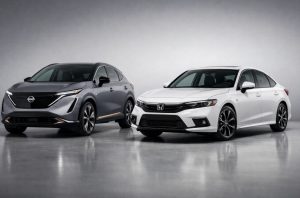
The collapse of merger discussions with Honda in early 2025 intensified speculation about Nissan’s stability. Many analysts viewed the potential partnership as a lifeline during financial turbulence.
Why Talks Collapsed?
Negotiations reportedly broke down due to strategic disagreements and concerns over long term integration. Both companies ultimately decided not to proceed, despite earlier optimism about collaboration.
This raised questions about whether Nissan had lost a critical opportunity for shared resources and cost savings.
What It Would Have Meant?
A merger could have provided:
- Shared research and development costs
- Joint electric vehicle platforms
- Improved economies of scale
- Greater bargaining power in global markets
Such cooperation may have accelerated Nissan’s recovery. Its absence increases pressure on independent restructuring success.
Potential Future Partnerships
Despite the setback, Nissan has not ruled out future alliances. Industry analysts suggest that strategic partnerships remain possible, especially in areas such as battery development and hybrid technology.
The company continues to explore collaboration opportunities that do not require full corporate integration.
Foxconn Speculation
Reports have linked Nissan with potential discussions involving technology manufacturers such as Foxconn. While no confirmed deal exists, interest from technology firms reflects the growing convergence between automotive manufacturing and advanced electronics. Such partnerships could provide financial backing or technical expertise if pursued.
Acquisition Possibility
Analysts from financial research firms suggest Nissan is likely to survive in one form or another. This may include restructuring as an independent company or becoming part of a larger automotive group.
While acquisition remains speculative, Nissan’s global footprint and established dealer network make it a valuable asset. The failed Honda merger did not push Nissan into bankruptcy, but it removed one potential safety net.
Is Nissan Still Selling Cars Successfully in the UK?

Despite restructuring headlines, Nissan continues to sell vehicles successfully in the UK market. Core models such as the Qashqai and Juke remain central to the brand’s British presence, and dealerships across the country are operating as normal.
While global production is being reduced to improve efficiency, Nissan has not signalled any withdrawal from the UK market.
Globally, several models recorded year to date sales growth in 2025, demonstrating that consumer demand has not disappeared despite financial turbulence.
Reinforcing confidence in the company’s commercial stability, Nissan U.S. sales chief Vinay Shahani stated, “There’s cash in the bank and we’re investing in new products. It’s full-speed ahead.”
At the corporate level, CEO Ivan Espinosa has also emphasised operational continuity during the restructuring, noting, “We are maintaining operational focus and recognizing the ongoing momentum of our product lineup.”
These statements underline that Nissan’s turnaround strategy is focused on financial repair rather than retreat from customers.
Selected Model Performance 2025
| Model | 2025 YTD Sales | Growth vs 2024 |
|---|---|---|
| Nissan Kicks | 76,638 | 47 percent increase |
| Pathfinder | 72,285 | 22.7 percent increase |
| Murano | 32,400 | 124.4 percent increase |
In Britain, aftersales services, warranties, and finance agreements remain fully supported. The company’s restructuring programme is designed to restore profitability, not abandon UK drivers or close its dealership network.
Could Nissan Actually Go Bankrupt?
Bankruptcy remains unlikely at this stage. While financial losses are substantial, Nissan retains global operations, dealership infrastructure, and ongoing vehicle sales.
The company is actively implementing corrective measures rather than entering insolvency proceedings. Restructuring typically occurs before bankruptcy becomes unavoidable.
Analysts believe survival is probable through internal reform or possible partnership. Although risks exist, current evidence suggests that Nissan is fighting to recover rather than preparing to close its doors. Financial distress does not automatically translate into corporate collapse.
Should UK Drivers Be Worried About Buying a Nissan?

UK drivers do not need to panic. Nissan dealerships and service centres remain operational, and warranties continue to be honoured.
Restructuring efforts are focused on corporate finances rather than consumer support. Parts availability, servicing, and manufacturer backing remain intact.
For buyers, competitive pricing and incentives may even create attractive opportunities. While resale values could fluctuate depending on market perception, there is no immediate indication that ownership support will disappear in Britain.
What Happens Next for Nissan in 2026 and Beyond?
Nissan’s immediate objective is to restore profitability by the 2026 financial year. Leadership insists the current sacrifices are intended to secure long term stability.
Key developments to watch include:
- Progress on cost reduction targets
- Completion of factory consolidations
- Potential new strategic partnerships
- Recovery in operating profit margins
- Expansion of hybrid focused models
The company aims to reduce excess capacity and align production with real demand. If successful, 2026 could mark the beginning of a more stable era.
Failure to meet recovery targets would increase pressure from investors and creditors. However, current restructuring efforts indicate a determined attempt to rebuild rather than retreat.
Conclusion
Nissan is not going out of business, but it is undergoing one of the most challenging periods in its modern history. A 4.5 billion dollar net loss, 20,000 job cuts, and seven factory closures demonstrate the severity of the crisis.
Yet restructuring, asset sales, and production consolidation are designed to restore profitability by 2026. For UK readers, the Sunderland plant remains operational and dealerships continue to serve customers nationwide.
While uncertainty surrounds global operations, there is no confirmed plan to exit the British market. Nissan’s future depends on the success of its turnaround strategy, not on immediate shutdown. The brand is fighting to survive, and current evidence suggests recovery is possible.
Frequently Asked Questions
Could Nissan leave the UK market entirely?
There is no official announcement suggesting Nissan will exit the UK market. The Sunderland plant remains operational and dealerships continue trading normally.
Is the Sunderland factory safe long term?
Sunderland has not been listed among the planned factory closures. While restructuring creates uncertainty, no confirmed closure plans have been released.
Are Nissan shares at risk of collapse?
Financial losses have created volatility, but restructuring aims to stabilise the company. Share performance will depend on the success of recovery efforts.
Will Nissan stop making petrol cars?
Nissan is shifting focus towards hybrids and efficient models. However, it has not announced a complete end to petrol vehicles.
How does Nissan compare financially to competitors?
Nissan is under greater pressure than some rivals due to recent losses. However, it retains global operations and remains active in major markets.
Could another company buy Nissan?
Acquisition is possible if financial pressure continues. Analysts suggest survival may occur independently or through partnership.
Is it risky to finance a Nissan vehicle in 2026?
Finance agreements remain supported through operational dealerships. There is no indication that consumer contracts are at risk.