
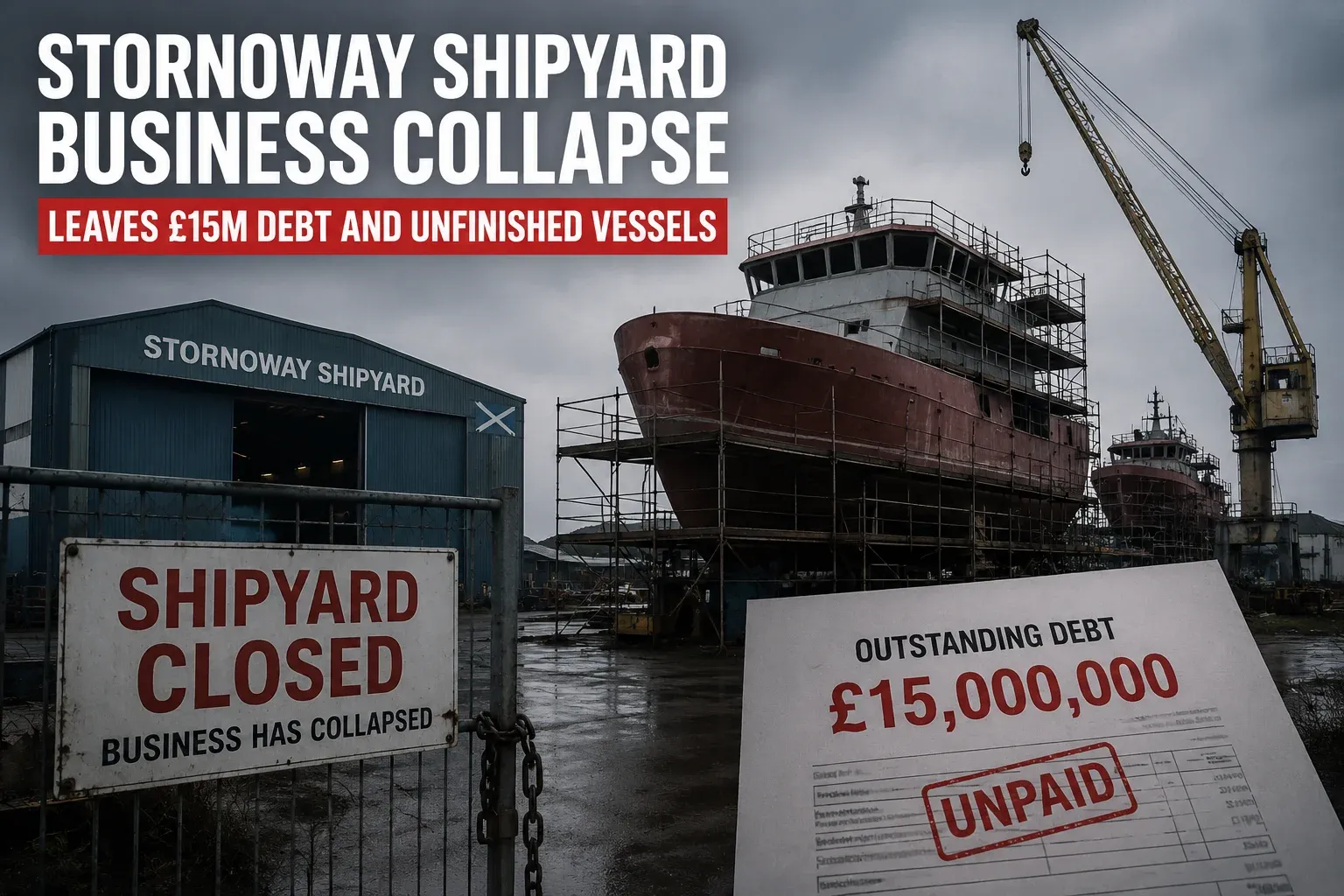
The Stornoway Shipyard business collapse happened after Coastal Workboats Scotland Limited entered administration owing around £15 million to 78 creditors.
The company, based at Goat Island in Stornoway, had aimed to revive shipbuilding on the Isle of Lewis but folded after design issues, supply chain delays, loan repayment problems and creditor pressure affected cash flow.
Five vessels were left unfinished, including an all-electric commercial workboat, and all jobs were lost.
Key takeaways:
- Coastal Workboats Scotland Limited collapsed with about £15 million in debt.
- The business owed money to 78 creditors, including suppliers and public bodies.
- Five vessels were unfinished when the firm entered administration.
- Public funding included £6.2 million through Innovate UK.
- The collapse affected local jobs, suppliers and confidence in island shipbuilding.
What Happened in The Stornoway Shipyard Business Collapse?
The Stornoway Shipyard business collapse centred on Coastal Workboats Scotland Limited, a shipbuilding and fabrication company incorporated in 2018 by Brian Pogson and Julie Pogson.
The firm operated from a leased shipyard on Goat Island in Stornoway after signing a long-term lease agreement with Stornoway Port Authority. It had moved its fabrication business from south of the Border to the Isle of Lewis, aiming to develop a new base for commercial workboat construction in Scotland’s Western Isles.
The project carried major local significance. Shipbuilding had not been active on the island in this way for around a century, and the company’s arrival created hopes of skilled employment, supplier opportunities and long-term maritime activity.
At the time of collapse, the company had five staff and had aimed to employ around 20 more people. Those ambitions ended when the company folded, leading to the loss of all jobs and leaving vessels unfinished at the site.
Coastal Workboats Scotland Limited and the Goat Island Shipyard
Coastal Workboats Scotland Limited was linked to the wider Coastal Workboats group, although the administration process applied specifically to Coastal Workboats Scotland Limited.
The directors also own Coastal Workboats Limited and Coastal Pure Limited, which were not subject to insolvency proceedings and continued under their control.
The Goat Island shipyard was intended to become a serious working base for fabricating and building commercial vessels.
Its location in Stornoway gave the project strategic value because of the island’s maritime heritage, harbour infrastructure and access to coastal and offshore marine markets.
How Shipbuilding Returned to the Isle of Lewis?
The return of shipbuilding to the Isle of Lewis was not only a business story. It was also seen as a regional development opportunity.
The company planned to build a range of workboats for customers including Damen, the Dutch shipbuilder. These contracts helped create optimism that Stornoway could become a specialist shipbuilding and marine engineering hub.
However, the gap between ambition and delivery became increasingly difficult to manage. As vessel build timescales slipped, the business faced mounting pressure from creditors, lenders and suppliers.
Why Did Coastal Workboats Scotland Limited Collapse Into Administration?
The collapse was caused by a combination of technical, operational and financial pressures. According to documents lodged at Companies House, the company had started a number of large shipbuilding contracts from 2022 onwards and had secured grants and loans to support the work.
However, by 2025, the business was facing severe financial challenges. Design issues and supply chain delays affected progress on vessel build timescales. This placed significant pressure on cash flow, making it harder for the company to meet liabilities as they fell due.
In shipbuilding, delays can be especially damaging because costs continue to build even when projects are not completed. Labour, materials, equipment, yard costs and financing charges can all keep rising while customer payments may be delayed until milestones are reached.
A maritime restructuring adviser described the risk clearly:
“I often see businesses underestimate how quickly a technical delay turns into a cash flow crisis. In shipbuilding, one unresolved design issue can affect materials, labour scheduling, lender confidence and customer payments at the same time.”
Design Issues and Vessel Build Delays
Design issues appear to have played a major role in slowing progress. In a specialist vessel-building environment, design problems can affect almost every stage of production.
They may delay:
- Procurement of specialist components
- Engineering approvals
- Fabrication schedules
- Electrical and mechanical installation
- Testing and commissioning
- Customer handover dates
For a company already dependent on external funding and contract milestones, delays of this kind can reduce available cash and increase debt exposure.
Supply Chain Pressures and Cash Flow Problems
Supply chain delays also contributed to the company’s problems. Shipbuilding relies on a wide network of suppliers, including steel fabricators, marine engineers, electrical contractors, propulsion specialists, safety equipment providers and logistics firms.
When materials or components arrive late, work can slow down or stop. That can lead to higher costs, supplier disputes and delayed revenue.
The company was also unable to settle supplier liabilities as they fell due. This created creditor pressure and added to the wider insolvency risk.
How Much Debt Was Left After the Stornoway Shipyard Business Collapse?
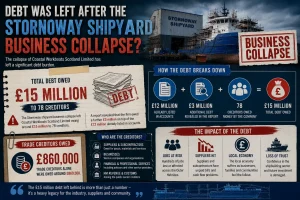
The Stornoway Shipyard collapse left Coastal Workboats Scotland Limited owing around £15 million to 78 creditors.
A report revealed that the firm owed a further £3 million on top of the £12 million already listed in accounts. Trade creditors alone were owed around £860,000.
The debt position shows the scale of financial exposure that had built up around the shipyard project.
| Debt or Liability Area | Reported Detail | Why It Matters |
|---|---|---|
| Total creditor debt | Around £15 million | Shows the full scale of the collapse |
| Number of creditors | 78 | Indicates wide financial impact |
| Previously listed accounts debt | Around £12 million | Existing recorded liability |
| Further debt revealed | Around £3 million | Additional exposure identified |
| Trade creditor debt | Around £860,000 | Direct impact on suppliers and service providers |
The figures underline why the collapse matters beyond one company. When a business of this type fails, the impact can spread across lenders, suppliers, public agencies, port authorities, contractors and local workers.
Who Are the Creditors Affected by the Shipyard Collapse?
The creditor list includes both private and public-sector organisations. Named creditors include Global Maritime Engineering Services Limited, HMRC, Highlands and Islands Enterprise, Hebridean Plant Limited, Stornoway Port Authority and SSE Energy Solutions.
This mix shows that the collapse affected more than financial lenders. It also reached local suppliers, government bodies, energy providers and regional development agencies.
Trade Creditors, Public Bodies and Local Suppliers
Trade creditors were owed around £860,000. These creditors are often among the hardest hit in a company failure because they may have already supplied goods, services, labour or equipment before receiving payment.
For smaller suppliers, unpaid invoices can create serious cash flow pressure. In island economies, the impact may be more concentrated because the business community is smaller and supply relationships are often closely connected.
A business recovery specialist explained the local effect in simple terms:
“When a remote-area employer fails, I do not only look at the company itself. I look at the unpaid suppliers, the families behind those jobs and the confidence of other firms considering investment in the area.”
Loan Repayments and the Damen Hardinxveld Guarantee
The administrator’s report stated that an additional loan was secured in February 2025. However, the company was unable to settle pre-existing loan repayments with Solo Asset 1 under the agreed terms and was in default.
The loan had been guaranteed by Damen Hardinxveld. Solo Asset 1 notified Damen Hardinxveld that it would take steps to enforce the guarantee.
This is an important detail because it shows how the company’s financial difficulties extended into wider contractual and financing relationships.
What Happened to the Five Unfinished Vessels?
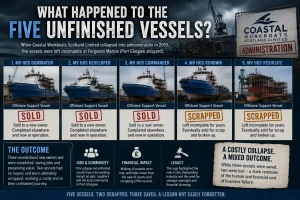
At the time of collapse, five vessels were still unfinished. This isone of the most striking parts of the Stornoway Shipyard collapse, because incomplete vessels represent tied-up capital, delayed customer delivery and uncertain recovery value.
Unfinished vessels can be difficult to deal with in administration. Their future may depend on ownership terms, contract conditions, stage of completion, customer agreements and whether another firm can complete the work.
| Unfinished Vessel Issue | Possible Business Impact |
|---|---|
| Part-built assets | May be difficult to value or sell |
| Customer contracts | Could be delayed, renegotiated or terminated |
| Storage and site costs | May continue during administration |
| Specialist components | Could be tied to specific vessel designs |
| Completion work | May require another shipbuilder or contractor |
For creditors, the unfinished vessels may represent possible value. For customers, they may represent delays and commercial disruption. For the local area, they symbolise the gap between the project’s promise and its final outcome.
Why Was the All-Electric Commercial Workboat Significant?
One of the unfinished vessels was described as the UK’s first all-electric commercial workboat of its kind. That made the project important not only for Stornoway but also for the wider shift towards cleaner maritime technology.
Electric commercial vessels are increasingly relevant as ports, marine operators and governments look for ways to reduce emissions. Workboats are used in harbour operations, aquaculture, construction, survey work and other marine services, so electrification could support cleaner day-to-day operations.
The unfinished all-electric vessel was significant because it reflected three wider trends:
- The move towards low-emission maritime transport
- The demand for specialist workboats in UK waters
- The opportunity for smaller shipyards to support green innovation
However, innovative vessels can also be more difficult to deliver. New designs, specialist parts and technical testing can increase complexity and cost.
How Did Public Funding Support the Stornoway Shipyard Project?
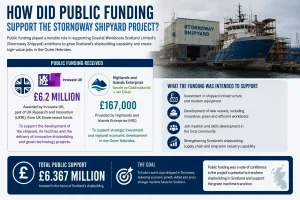
Public funding played a notable role in supporting the company’s ambitions. The firm received £6.2 million backing from the UK Government through Innovate UK and £167,000 from Highlands and Islands Enterprise.
This support reflected the potential economic and innovation value of the project. It also showed confidence in the idea that Stornoway could support a renewed shipbuilding operation.
| Funding Source | Reported Support | Purpose and Significance |
|---|---|---|
| Innovate UK / UK Government | £6.2 million | Supported innovation and vessel development |
| Highlands and Islands Enterprise | £167,000 | Supported regional economic development |
| Additional loans | Noted in administration report | Helped support contracts and operations |
Public backing does not remove business risk. It can help a company grow, innovate and take on ambitious projects, but the firm still needs strong delivery controls, reliable supply chains, contract management and enough working capital.
The Stornoway Shipyard business collapse is therefore likely to raise questions about how publicly backed projects are monitored, especially when they involve complex manufacturing and long build cycles.
What Does the Collapse Mean for Jobs and the Local Island Economy?
The most immediate impact was the loss of all jobs at Coastal Workboats Scotland Limited. The company had five staff and hoped to create around 20 further roles.
For a larger city, five direct job losses may seem modest. For an island economy, the effect can be more personal and more visible. Skilled jobs in shipbuilding, fabrication and marine engineering are valuable because they support technical careers and help retain talent locally.
Immediate Job Losses
The job losses ended the company’s short-term employment contribution and damaged hopes for further recruitment. The planned expansion could have created opportunities for welders, fabricators, engineers, project managers, apprentices and support staff.
The collapse also meant that workers connected to unfinished contracts faced uncertainty around ongoing employment and future work.
Wider Impact on Local Suppliers and Maritime Services
The wider effect may be felt by suppliers and service firms that supported the shipyard. These could include plant hire, transport, engineering, utilities, marine services and professional advisers.
In island locations, business failures can affect confidence. Future investors may look more carefully at transport costs, supply chain reliability, labour availability and project finance before committing to similar ventures.
What Does This Mean for Scotland’s Shipbuilding and Maritime Sector?
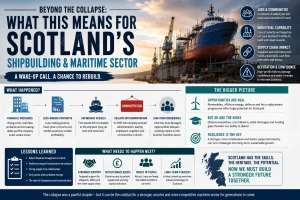
The stornoway shipyard business collapse does not mean Scotland’s maritime sector lacks opportunity. Scotland still has strong marine, offshore, ferry, port, aquaculture and renewable energy markets. However, the case shows that opportunity alone is not enough.
Shipbuilding requires careful management of:
- Design certainty
- Working capital
- Contract milestones
- Supplier reliability
- Technical risk
- Skilled labour
- Customer payment schedules
- Contingency planning
When several of these pressures arrive together, even a promising project can become financially fragile.
The collapse may encourage other maritime firms to review how they price contracts, manage design risk and structure funding. It may also prompt public agencies to consider how complex manufacturing projects are assessed before large grants or loans are committed.
What Business Lessons Can Be Learned From the Stornoway Shipyard Business Collapse?
The collapse offers several lessons for shipbuilding firms, public funders, lenders and regional development bodies.
First, ambitious contracts must be matched with realistic delivery capacity. A company may win valuable work, but if it lacks enough cash, labour, supplier certainty or technical readiness, those contracts can become a burden.
Second, cash flow planning is critical. Manufacturing businesses often fail not because there is no demand, but because they cannot survive the time between spending money and receiving it.
Third, remote-location projects need extra supply chain planning. Transport delays, specialist labour shortages and limited local supplier depth can all affect delivery.
Fourth, innovation carries risk. Building an all-electric commercial workboat may offer long-term value, but new technology can involve unexpected design, procurement and testing challenges.
Could the Goat Island Shipyard Still Have a Future?
The Goat Island site may still hold strategic value. The collapse of one company does not necessarily mean the location has no future as a maritime or fabrication base.
Its future may depend on the administration process, asset ownership, lease arrangements, local economic strategy and whether another operator is willing to take on the site or parts of the unfinished work.
There may still be demand for:
- Marine engineering services
- Workboat repair and maintenance
- Fabrication for ports and aquaculture
- Support services for offshore renewables
- Specialist vessel construction
However, any future operator would need to address the financial and operational weaknesses exposed by the previous collapse.
What Is the Wider Significance of the Stornoway Shipyard Business Collapse?
The wider significance lies in the contrast between promise and outcome. Coastal Workboats Scotland Limited represented innovation, regional development and the revival of shipbuilding on the Isle of Lewis. Its collapse instead left debt, job losses and unfinished vessels.
The Stornoway Shipyard business collapse also highlights the risks attached to public funding when projects involve complex engineering. Grants and loans can support growth, but they cannot guarantee delivery.
For the UK maritime sector, the case may become a reminder that green vessel innovation must be backed by strong commercial controls. Clean technology projects need both vision and disciplined execution.
For Stornoway, the collapse is likely to be remembered as a missed opportunity, but it may also provide lessons for future maritime investment in the Western Isles.
Conclusion
The Stornoway Shipyard business collapse shows how quickly an ambitious shipbuilding project can come under pressure when design issues, supply chain delays, loan defaults and creditor demands combine.
Coastal Workboats Scotland Limited had public backing, a long-term lease at Goat Island, contracts with major customers and plans to create more jobs. It also carried the symbolic importance of bringing shipbuilding back to the Isle of Lewis after around a century.
Yet the company entered administration owing around £15 million to 78 creditors, with five vessels unfinished and all jobs lost. The collapse underlines the importance of strong project controls, realistic funding, reliable supply chains and clear risk management in the maritime sector.
For Scotland’s shipbuilding industry, the lesson is not that ambition should be avoided. It is that ambition must be matched by financial resilience, technical readiness and practical delivery strength.
FAQs
What company operated the Stornoway shipyard on Goat Island?
Coastal Workboats Scotland Limited operated from the leased shipyard on Goat Island in Stornoway on the Isle of Lewis. The company was incorporated in 2018 by Brian Pogson and Julie Pogson.
Why did Coastal Workboats Scotland Limited enter administration?
The company entered administration after facing financial challenges linked to design issues, supply chain delays, pressure on vessel build timescales, loan repayment problems and creditor demands.
How many creditors were owed money after the collapse?
The company owed money to 78 creditors. These included trade creditors, public bodies, financial parties and organisations connected to the shipyard’s operations.
What was the total debt linked to the shipyard collapse?
The total creditor debt was reported to be around £15 million. This included £12 million listed in accounts and a further £3 million revealed in the administration report.
Were any vessels left unfinished at the Stornoway shipyard?
Yes, five vessels were left unfinished when the company collapsed. One of them was described as the UK’s first all-electric commercial workboat of its kind.
Did the company receive public funding?
Yes, the firm received £6.2 million from the UK Government through Innovate UK and £167,000 from Highlands and Islands Enterprise.
What happens to creditors after a company enters administration?
When a company enters administration, administrators review the company’s assets, debts and contracts. Creditors may receive some repayment if assets can be sold or money can be recovered, but full repayment is not guaranteed.
Is shipbuilding still possible on the Isle of Lewis?
Shipbuilding may still be possible on the Isle of Lewis if a future operator has the right funding, skills, contracts and supply chain support. The Goat Island site may still have maritime value, but any future project would need stronger financial and operational safeguards.