


The Universal Credit deadline extension has changed the timetable for some people moving from older benefits to Universal Credit.
However, the additional time announced in 2026 does not mean every claimant can delay applying until 2027.
The Department for Work and Pensions (DWP) introduced extra time for certain vulnerable and hard-to-reach claimants, particularly people receiving income-related Employment and Support Allowance (ESA) and working-age Housing Benefit.
The general closure date for remaining income-related ESA and applicable working-age Housing Benefit was 1 July 2026, although specific exceptions remain for some claimants needing an appointee and certain housing circumstances.
People who receive a Migration Notice must still follow their individual deadline or request more time before it passes. Missing that deadline could interrupt benefit payments and affect transitional protection.
What Is The Latest Universal Credit Deadline Extension?
The latest Universal Credit deadline extension concerns the final stages of the DWP’s managed migration programme.
Managed migration is the process of moving people from older benefits, known as legacy benefits, onto Universal Credit after they receive an official Migration Notice.
The DWP originally aimed to complete the remaining transfers by March 2026. However, the government recognised that some people needed additional time because of disabilities, serious illnesses, communication difficulties or problems arranging someone to manage their benefits.
Consequently, the final closure of income-related ESA and applicable working-age Housing Benefit was moved to July 2026, with exceptions for particular circumstances.
The wider programme has therefore reached its main closure milestone, but some individual cases can continue beyond that date.
Has The DWP Extended The Deadline Into 2027?
As of 16 November 2026, there is no confirmed general DWP announcement extending the Universal Credit managed migration deadline to 2027.
Nevertheless, certain claimants covered by statutory exceptions may still be awaiting completion of their move.
These cases should not be confused with a nationwide deadline extension.
People should distinguish between:
- The General Closure Date: The date when remaining legacy benefits were normally abolished
- The Individual Migration Deadline: The date printed on a claimant’s Migration Notice
- An Approved Extension: A revised deadline agreed by the DWP
- The Statutory Final Deadline: A later date relevant to certain qualifying late claims and transitional protection
Claimants should not assume they have extra time merely because information about Universal Credit changes refers to 2027.
What Is The Difference Between The Migration Deadline And Final Deadline?
The Migration Notice deadline is the date by which the DWP tells a claimant to submit their Universal Credit application.
Under the standard managed migration arrangements, most people were given approximately three months to apply, although shorter notice periods have also applied in specified circumstances.
The statutory final deadline is different. It is the last day of the first Universal Credit assessment period that would begin on the original deadline date.
This generally creates a period of approximately one month during which a qualifying late claim may still preserve transitional protection.
However, legacy benefits can stop after the original deadline, so claimants should not treat the additional period as permission to delay.
What Changed To Universal Credit Deadlines In 2026?
The year 2026 marked the final major stage of the transition from legacy benefits to Universal Credit.
The government ended most remaining awards of income-related ESA and working-age Housing Benefit, bringing those benefits into line with the earlier closure of tax credits, Income Support and income-based Jobseeker’s Allowance.
The wider DWP benefits closure programme affected different claimant groups at different times, rather than ending every benefit simultaneously.
Universal Credit Migration Timeline From 2025 To 2027
Date Universal Credit Migration Development
5 April 2025 Tax Credits Ended
1 April 2026 Remaining Income Support And Income-Based JSA Awards Were Generally Abolished
March–April 2026 DWP Confirmed Additional Time And Closure Arrangements For Certain Vulnerable Claimants
1 July 2026 Remaining Income-Related ESA And Applicable Working-Age Housing Benefit Were Generally Abolished, Subject To Exceptions
November 2026 Individual Migration Rules And Exceptions Remain Relevant
2027 No General New Managed Migration Deadline Confirmed As Of November 2026
The 1 July 2026 date is established in the amended abolition legislation.
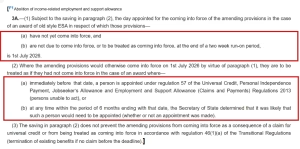
Official legislation establishes 1 July 2026 as the general abolition date for remaining income-related ESA, with specified appointee exceptions.
Which Legacy Benefits Have Already Closed?
Universal Credit has replaced six main legacy benefits.
These include:
- Working Tax Credit: Closed In April 2025
- Child Tax Credit: Closed In April 2025
- Income Support: Remaining Awards Generally Ended From April 2026
- Income-Based Jobseeker’s Allowance: Remaining Awards Generally Ended From April 2026
- Income-Related Employment And Support Allowance: Generally Abolished From July 2026, Subject To Exceptions
- Working-Age Housing Benefit: Generally Replaced By Universal Credit, With Exceptions For Certain Accommodation And Claimants
Not every benefit paid to people with disabilities or health conditions has ended.
Personal Independence Payment (PIP), for example, remains a separate benefit. New-style ESA also continues under its own eligibility rules.
Universal Credit payment amounts have changed independently of migration deadlines. The Universal Credit benefit rates for 2026 to 2027 include revised standard allowances and health-related elements.
Who Can Still Get More Time To Move To Universal Credit?
Although the general migration programme has reached its main closure date, some claimants remain covered by exceptions or individually agreed extensions.
The DWP considers relevant circumstances, existing entitlement and whether a claimant has received a valid Migration Notice.
Income-Related ESA Claimants
Income-related ESA was one of the final benefits affected because many recipients have long-term health conditions or disabilities.
Some claimants need additional assistance with online applications, identification documents or communication with the DWP.
A particularly important exception applies where an appointee was acting for a claimant immediately before 1 July 2026, or the DWP had determined within the preceding six months that an appointee was likely to be needed.
In qualifying cases, the general abolition date did not automatically terminate entitlement.
However, the exemption does not allow ESA to continue indefinitely. Making a Universal Credit claim or missing an applicable migration deadline can still bring entitlement to an end.
People moving directly from ESA may also retain their existing Work Capability Assessment status when they satisfy the relevant conditions.
For example, someone previously in the ESA Support Group may qualify for the Universal Credit Limited Capability for Work and Work-Related Activity element without a fresh assessment immediately upon migration.
The rules surrounding conditions that qualify claimants for LCWRA are particularly important for people whose health limits their ability to work.
Housing Benefit Claimants
Working-age Housing Benefit has generally been replaced by the housing costs element of Universal Credit.
However, important exceptions remain.
Housing Benefit can continue for qualifying people living in:
- Temporary Accommodation
- Specified Supported Accommodation
- Certain Hostels Or Specialist Housing
- Accommodation Covered By Specific Housing Benefit Exceptions
Housing Benefit also remains available to many people of State Pension age, subject to the relevant eligibility rules.
Some working-age claimants who also receive income-related ESA may fall within the appointee-related exceptions.
Therefore, living in supported accommodation does not automatically mean someone must stop receiving Housing Benefit.
People should contact their council if they are uncertain whether their housing arrangement falls under an exception.
Vulnerable Claimants And People Needing An Appointee
An appointee is someone authorised to manage benefit matters for a person who cannot manage their own claim.
A claimant may need an appointee because of significant cognitive difficulties, serious illness or another condition affecting their ability to manage their affairs.
People experiencing these problems may require additional support:
- People With Severe Health Conditions: Assistance With Applications And Communication
- People With Learning Disabilities: Help Understanding Official Notices
- People Without Reliable Internet Access: Telephone Or Assisted Claiming
- People Experiencing Homelessness: Support With Correspondence And Identity Verification
- People Requiring Appointees: Additional Time To Arrange Appropriate Representation
However, being vulnerable does not automatically create an exemption from the July 2026 closure date. The claimant must satisfy the applicable legal conditions or receive an individual extension.
How Can You Request A Universal Credit Deadline Extension?
Claimants unable to submit their Universal Credit application by the date in their Migration Notice can ask the DWP for more time.
The request must normally be made before the current deadline expires.
Extensions are considered individually and depend on whether the DWP accepts that there is a good reason for requiring additional time.
Acceptable Reasons For Requesting Extra Time
The DWP may consider several circumstances when deciding whether to extend a deadline.
Examples include:
- Serious Illness Or Hospital Treatment: A Condition Prevents The Claimant From Applying
- Mental Health Difficulties: Symptoms Significantly Affect The Ability To Complete The Claim
- Disability Or Learning Difficulties: Additional Assistance Is Needed To Understand The Process
- Appointee Arrangements: More Time Is Required To Arrange Someone To Manage The Claim
- Problems Obtaining Documents: Essential Information Cannot Be Obtained In Time
- Digital Exclusion: The Claimant Cannot Reliably Access Or Use Online Services
- Housing Or Family Emergencies: Exceptional Circumstances Disrupt The Application Process
These are examples rather than an automatic entitlement to an extension.
People struggling with digital access may also benefit from local digital inclusion services.
Some employment-related assistance may be available through Universal Credit laptop support, although there is no automatic nationwide laptop entitlement.
How To Contact The DWP And Apply For An Extension?
The Universal Credit Migration Notice Helpline provides assistance to people who have received a Migration Notice.
Universal Credit Migration Notice Helpline: 0800 169 0328
Opening Hours: Monday To Friday, 10am To 3pm
These are the opening hours published by the DWP on 9 November 2026.
Claimants should follow these steps:
- Check Your Migration Notice: Identify The Exact Deadline Printed On The Letter
- Contact The DWP Early: Request More Time Before The Deadline Passes
- Explain Your Circumstances: Describe Why You Cannot Reasonably Complete The Claim
- Discuss Available Support: Ask About Telephone Assistance, Accessibility Arrangements Or An Appointee
- Confirm The Revised Deadline: Request Clear Confirmation Of Any Agreed Extension
- Keep Relevant Records: Retain Letters, Call Details And Supporting Information
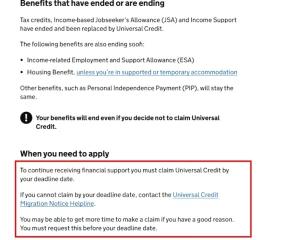
Official DWP guidance confirms that claimants can request additional time for a good reason before their Migration Notice deadline.
How Long Can The DWP Extend Your Deadline?
There is no universal extension period that applies to everyone.
The DWP considers the claimant’s circumstances and the reason additional time is necessary.
Its detailed decision-making guidance allows a deadline to be extended more than once, provided each request is made before the current deadline and there is a good reason.
For example, someone waiting for an appointee may need further assistance even after an initial extension.
However, approval is not guaranteed.
A claimant should obtain confirmation of the new deadline rather than assuming that a telephone conversation has automatically changed it.
What Happens If You Miss Your Universal Credit Deadline?
Missing a Universal Credit Migration Notice deadline can create serious financial difficulties because the claimant’s old benefits can end even if no new Universal Credit application has been submitted.
The DWP does not automatically move every claimant onto Universal Credit.
People normally need to complete a new application.
If the deadline passes without a claim or an agreed extension, the claimant may face a period without their regular financial support.
Can You Still Claim Within One Month Of Your Deadline?
Under the managed migration regulations, some claimants who miss their original deadline can still retain entitlement to transitional protection by making a qualifying Universal Credit claim before the statutory final deadline.
That date generally falls approximately one month after the original deadline, although it is calculated using Universal Credit assessment-period rules.
Consider this illustrative example:
Stage Example Date
Original Migration Deadline 10 November 2026
Approximate Statutory Final Deadline 9 December 2026
Claim Submitted 25 November 2026
Potential Outcome Transitional Protection May Still Be Available If All Conditions Are Met
In this example, the claim falls within the statutory final-deadline period.
However, a late claim may still create payment disruption, and transitional protection depends on the claimant satisfying the qualifying conditions.
A claim made after the final deadline will not normally qualify for managed migration transitional protection.
Anyone who has already missed their deadline should contact the DWP and an independent welfare adviser immediately.
What Happens If The DWP Refuses Your Extension Request?
An extension is not guaranteed simply because a claimant asks for one.
If the DWP refuses, the claimant should establish the deadline that remains in force and consider whether they can submit a Universal Credit claim in time.
They can also explain any important information that may have been overlooked and seek specialist welfare-rights advice about the decision and its consequences.
Claimants should not confuse a missed migration deadline with a missed Jobcentre appointment.
The rules covering acceptable reasons for missing Universal Credit appointments concern separate claimant responsibilities and possible sanctions.
Will You Lose ESA, Housing Benefit Or Transitional Protection?
Moving to Universal Credit can affect when benefits are paid, how much money a household receives and which financial protections apply.
The consequences depend on the claimant’s previous benefits, circumstances and whether the move qualifies under managed migration rules.
How Long Will Existing Benefits Continue?
Where the relevant conditions are satisfied, income-related ESA and Housing Benefit can continue for a two-week run-on following the transition to Universal Credit.
The run-on provides temporary financial support while the new claim is being processed.
For example, someone who makes their Universal Credit claim on 5 November may continue receiving an eligible legacy benefit for another two weeks.
However, the precise entitlement depends on the benefit and the claimant’s circumstances.
The DWP also explains that where someone does not claim by their migration deadline, their existing benefit entitlement will normally end two weeks after that deadline.
This does not mean they can safely delay their Universal Credit application.
How Does Transitional Protection Work After Migration?
Transitional protection helps prevent eligible households from experiencing an immediate reduction in their assessed benefit entitlement solely because of managed migration.
When the Universal Credit entitlement calculated under the relevant rules is lower than the previous legacy-benefit amount, an additional transitional element may be included.
Example Of Transitional Protection:
Payment Calculation Monthly Amount
Previous Legacy Benefit Entitlement £900
Indicative Universal Credit Entitlement £750
Illustrative Transitional Element £150
Total Illustrative Universal Credit Entitlement £900
This is a simplified example, not a guaranteed payment calculation.
The actual amount depends on the claimant’s circumstances and the DWP’s transitional protection rules.
Importantly, transitional protection is not necessarily permanent.
It can reduce when other Universal Credit elements increase and may end after certain changes, including changes in household relationships or the closure of a claim.
Savings, earnings and other financial circumstances can also affect Universal Credit entitlement.
For example, money received as a gift can affect means-tested benefits depending on how it is treated under the capital rules.
Certain transitional disregards exist, but these are specific and should not be assumed to apply to every claimant.
When Will You Receive Your First Universal Credit Payment?
The first Universal Credit payment normally arrives approximately five weeks after a claim is submitted.
This includes the initial monthly assessment period and the time needed to process payment.
Claimants facing financial difficulties may be able to request an advance.
However, an advance is repayable and will usually reduce future Universal Credit payments.
Universal Credit is calculated monthly, meaning changes in household income can affect the amount received.
For someone returning to work, the way earnings influence entitlement becomes important.
A claimant earning £1,000 a month, for example, may receive a different amount depending on their housing costs, children and work allowance, as shown by Universal Credit calculations for monthly earnings of £1,000.
People receiving occupational or statutory sick pay should also understand how that income affects their claim.
The interaction between long-term sick pay and Universal Credit eligibility can be especially important when income changes during illness.
What Should Claimants Do Before Their Migration Deadline?
The safest approach is to begin preparing as soon as an official Migration Notice arrives.
Claimants should check the letter carefully, confirm the deadline and gather the information needed to make their application.
Important Steps Include:
- Read The Migration Notice: Confirm The Deadline And Any Specific Instructions
- Prepare Identification: Gather National Insurance And Identity Information
- Check Financial Details: Have Bank Account, Income And Savings Information Available
- Prepare Housing Information: Confirm Rent, Landlord And Household Details
- Arrange Assistance Early: Contact A Carer, Appointee Or Adviser If Necessary
- Request An Extension Promptly: Contact The DWP Before The Deadline If More Time Is Needed
- Check Payment Arrangements: Understand The Two-Week Run-On And First Universal Credit Payment
- Keep Evidence And Correspondence: Retain Important Documents And Any Extension Confirmation
Claimants moving from ESA should also check that the DWP has accurately recorded their existing Work Capability Assessment decision.
People with serious health conditions may be entitled to reasonable adjustments, telephone assistance or help from an appointee.
After the Universal Credit claim has been established, household changes should be reported promptly to prevent incorrect payments.
Conclusion
The Universal Credit deadline extension gave certain vulnerable claimants additional time to move from legacy benefits, but it did not create an unlimited period for everyone to apply.
The most important change in 2026 was the general abolition of remaining income-related ESA and applicable working-age Housing Benefit from 1 July, with specific exceptions for some appointee and housing cases.
No general new Universal Credit migration deadline for 2027 has been confirmed as of November 2026.
Claimants who still have an outstanding Migration Notice should follow their individual deadline, request extra time before that date if necessary and understand how a late claim could affect payments and transitional protection.
Acting promptly, keeping DWP correspondence and obtaining advice where circumstances are complicated remain the best ways to protect benefit entitlement during the move to Universal Credit.
Frequently Asked Questions
Is The Universal Credit Deadline Extended To 2027?
No general nationwide extension into 2027 has been confirmed as of November 2026. Some individual cases may continue under existing exceptions or approved extensions.
Can I Request A Universal Credit Deadline Extension More Than Once?
Yes. DWP guidance allows repeated requests where there is a good reason, provided each request is made before the current deadline expires.
What Happens If I Miss My Universal Credit Migration Notice Deadline?
Your legacy benefits may end, but a qualifying claim before the statutory final deadline may still preserve transitional protection. Contact the DWP immediately.
Can ESA Claimants Still Receive Extra Time To Move To Universal Credit?
Certain income-related ESA claimants covered by appointee exceptions or individual extensions may receive additional time, depending on their circumstances.
Will Housing Benefit Stop When I Claim Universal Credit?
Usually, working-age Housing Benefit is replaced by Universal Credit housing support. Qualifying temporary and supported accommodation can remain covered by Housing Benefit.
Can I Keep Transitional Protection If I Claim Late?
Potentially, if you claim within the statutory final deadline and satisfy the qualifying conditions. Claims made after that deadline do not normally retain managed migration transitional protection.
Can The DWP Refuse To Extend My Universal Credit Deadline?
Yes. The DWP assesses extension requests individually and may refuse them where it does not accept that there is a good reason.