
There is no £140 Cold Weather Payment scheduled for winter 2026/27.
The Department for Work and Pensions (DWP) continues to provide £25 for each qualifying seven-day period of very cold weather between 1 November 2026 and 31 March 2027.
Eligible households should normally receive their payment within 14 working days after a qualifying cold spell.
The money is paid automatically into the same bank or building society account used for their qualifying benefit.
The £140 figure is commonly confused with the older Warm Home Discount, which is now worth £150.
Understanding the difference is important for people expecting financial assistance with their winter heating bills.
Why Is The £140 Cold Weather Payment Being Discussed?
The phrase “£140 Cold Weather Payment” continues to appear in online searches, but it does not describe an existing DWP benefit.
The confusion largely comes from the Warm Home Discount Scheme, which previously provided a £140 reduction on electricity bills. This amount increased to £150 from the 2022/23 scheme year.
Cold Weather Payments operate differently. They are designed to help eligible people meet additional heating costs when temperatures remain extremely low.
Unlike the Warm Home Discount, which is normally credited to an energy account, a Cold Weather Payment is paid directly into the claimant’s bank or building society account.
For winter 2026/27, the important figures are:
- Cold Weather Payment: £25 for each qualifying seven-day cold period
- Warm Home Discount: £150 towards an eligible energy bill
- Winter Fuel Payment: £100 to £300 for qualifying pension-age people in England, Wales and Northern Ireland
- Winter Heating Payment In Scotland: £62 for qualifying households
These are separate schemes with different eligibility conditions and payment arrangements.
When Will Cold Weather Payments Be Paid In 2026/27?
The Cold Weather Payment scheme began on 1 November 2026 and runs until 31 March 2027.
There is no fixed nationwide payment date because payments depend on qualifying temperatures in individual areas.
A payment is triggered when the average temperature in an area is recorded as, or forecast to be, 0°C or below for seven consecutive days.
Once the qualifying period has been identified, eligible claimants should normally receive £25 within 14 working days.
Working days generally exclude Saturdays, Sundays and bank holidays. Therefore, a payment could take longer than 14 calendar days to arrive.
The following examples demonstrate how payment dates may be calculated.
| Example Cold Weather Period | Illustrative Latest Payment Date |
|---|---|
| 1–7 November 2026 | 26 November 2026 |
| 8–14 November 2026 | 3 December 2026 |
| 15–21 November 2026 | 10 December 2026 |
These are hypothetical examples based on 14 working days after the stated seven-day period, excluding weekends and assuming no intervening bank holidays.
They are not confirmed payment triggers or official payment schedules.
Payments can arrive earlier than these estimated deadlines.
The official payment guidance also confirms that money is transferred into the same account used for regular benefit payments. Eligible people do not normally need to submit a separate application.
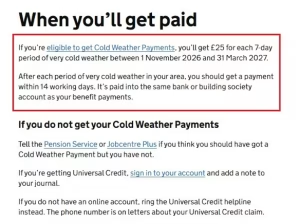
GOV.UK confirms the £25 payment amount, the 2026/27 scheme dates and the 14-working-day payment timeline.
How Much Cold Weather Payment Can You Receive?
The amount someone receives depends on how many separate qualifying cold-weather periods occur in their area.
There is no standard £140 lump sum and no fixed maximum total for the winter.
For example:
| Qualifying Seven-Day Periods | Total Payment |
|---|---|
| 1 | £25 |
| 2 | £50 |
| 3 | £75 |
| 4 | £100 |
| 5 | £125 |
| 6 | £150 |
These amounts are examples rather than guaranteed payments.
A household may receive nothing during a relatively mild winter if its postcode does not experience a qualifying temperature trigger.
Another household may receive several payments if its area experiences repeated qualifying cold spells.
Payments are calculated using non-overlapping qualifying periods, meaning the same cold days cannot simply be counted repeatedly to generate additional payments.
Cold Weather Payments do not reduce a claimant’s other benefits.
Who Is Eligible For Cold Weather Payments?
Receiving a qualifying benefit is essential, but not every benefits claimant automatically qualifies.
According to the current DWP eligibility guidance, the main qualifying routes are Pension Credit, income-related Employment and Support Allowance, Universal Credit and Support for Mortgage Interest.
Pension Credit
People receiving Pension Credit will usually qualify for a Cold Weather Payment when their area experiences a qualifying cold-weather period.
Pension Credit is designed to provide additional financial support to pension-age people with limited income.
Someone receiving the State Pension alone does not automatically qualify for Cold Weather Payments.
As the DWP State Pension age changes affect when people become eligible for certain retirement benefits, older households should check their Pension Credit entitlement separately.
Universal Credit
Universal Credit claimants can qualify for Cold Weather Payments, but additional conditions apply.
Normally, both the claimant and their partner, where applicable, must not be employed or gainfully self-employed.
At least one of the following must also apply:
- Limited Capability For Work: The claimant or their partner has a qualifying health condition or disability and limited capability for work
- Child Under Five: A child younger than five lives in the household
- Disabled Child Amount: The Universal Credit claim includes an eligible disabled child amount
The disabled child amount creates an important exception because a claimant may still qualify even when they or their partner are working.
Universal Credit payment amounts vary according to household circumstances, and the current Universal Credit benefit rates for 2026 to 2027 can help claimants understand their wider entitlement.
However, receiving Universal Credit by itself does not guarantee a Cold Weather Payment.
Income-Related Employment And Support Allowance
People receiving income-related Employment and Support Allowance may qualify if they belong to the support group or work-related activity group.
Other claimants may qualify if they receive certain disability or pensioner premiums, have a disabled child or have a child under five living with them.
It is important to distinguish income-related ESA from New Style ESA, which is not listed as a standalone qualifying benefit in the current GOV.UK Cold Weather Payment eligibility guidance.
The wider DWP benefits closure changes also explain why older benefit information may differ from current eligibility guidance.
Anyone whose claim has recently moved to Universal Credit should check the rules that apply to their new benefit arrangements.
Support For Mortgage Interest
People receiving Support for Mortgage Interest (SMI) may also qualify when they are treated as receiving a qualifying benefit and meet additional conditions.
These can include receiving certain disability or pensioner premiums, having a disabled child or having a child under five.
Not everyone receiving SMI will qualify, so the additional requirements should be checked carefully.
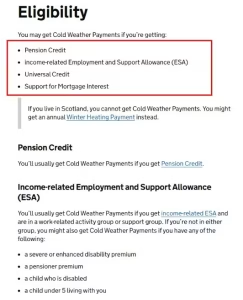
GOV.UK lists the qualifying benefits and explains the additional Cold Weather Payment eligibility conditions.
How To Check Cold Weather Payments By Postcode?
The DWP provides an official postcode checker for people living in England and Wales.
The service allows users to check whether their postcode is associated with a weather station that has triggered a Cold Weather Payment.
It displays payment triggers recorded since 1 November and identifies the weather station used to assess the area’s temperature.
To check your postcode:
- Visit The Official Checker: Open https://coldweatherpayments.dwp.gov.uk/
- Start The Service: Select the option to begin checking Cold Weather Payments.
- Enter Your Postcode: Provide the postcode for your current address.
- Review The Results: Check whether qualifying cold-weather periods have been recorded.
- Confirm Your Eligibility: Make sure you also meet the relevant benefit conditions.
A postcode showing a payment trigger does not mean everyone living there will receive £25.
Individual benefit entitlement remains important.
People wanting broader information about affected locations can also check the DWP Cold Weather Payment areas and postcodes during the winter season.
Northern Ireland residents must use the separate official checker provided by nidirect.
Why Has Your Postcode Not Triggered A Cold Weather Payment?
A postcode may not qualify even when local residents experience extremely cold conditions.
This happens because DWP uses official weather station information rather than individual household temperature readings.
Each postcode district is linked to a weather station selected to represent its local climatic conditions.
Several factors may explain why a payment has not been triggered:
- Insufficient Cold Weather: The average temperature has not met the required threshold
- Short Cold Spell: Freezing conditions lasted fewer than seven consecutive days
- Different Weather Station: A neighbouring area may be linked to another station
- Forecast Differences: Official forecasts may differ from temperatures experienced at an individual property
- No New Qualifying Period: The weather does not meet the requirements for an additional non-overlapping payment
For example, residents of two nearby towns might experience similar temperatures but receive different postcode checker results because their areas are linked to different weather stations.
A person should therefore use the official checker rather than assume that a nearby household’s payment means their own area has qualified.
What Temperature Triggers A Cold Weather Payment?
The key temperature requirement is an average of 0°C or below over seven consecutive days.
The temperature may be recorded or forecast by the weather station associated with the relevant postcode.
This does not mean temperatures must remain below freezing every hour of every day.
Instead, DWP uses average temperature information across the qualifying seven-day period.
Consider two examples:
Example One: An area experiences freezing conditions overnight, but daytime temperatures remain much warmer. If the seven-day average does not fall to 0°C or below, no payment is triggered.
Example Two: An area records consistently low average temperatures over seven days, meeting the official threshold. A payment may then be triggered for eligible households.
The Met Office supplies weather information used by DWP to determine qualifying cold-weather periods.
Claimants do not need to submit thermometer readings or weather reports themselves.
Can Changes In Your Circumstances Affect Your Payment?
Changes in household circumstances can affect Cold Weather Payment entitlement, particularly for people receiving Universal Credit or income-related ESA.
Although payments are normally automatic, claimants must keep their benefit information accurate.
Having A Baby Or A Child Under Five Move In
GOV.UK states that Universal Credit and income-related ESA claimants must report a change if they have a baby or a child under five moves into their household.
This can be important because having a young child may help establish eligibility.
For example, a Universal Credit claimant who recently had a baby may meet the relevant Cold Weather Payment conditions but still need to update their benefit record.
Universal Credit claimants should report the change through their online account.
Income-related ESA claimants should contact Jobcentre Plus.
Failing to report the change may prevent an otherwise eligible Cold Weather Payment from being issued automatically.
Hospital Stays And Other Changes
A hospital stay may affect entitlement, so claimants should notify the appropriate benefit office.
GOV.UK advises contacting the Pension Service or Jobcentre Plus when entering hospital, while Universal Credit claimants should record the change through their online account or journal.
Other changes in benefit entitlement or household circumstances should also be reported through the normal benefit reporting process.
Reporting a change does not automatically mean someone will lose their payment. It allows the relevant department to assess their entitlement correctly.
Why Has Your Cold Weather Payment Not Arrived?
A missing payment does not necessarily mean the claimant is ineligible.
The first step is to establish whether the postcode has experienced a qualifying cold-weather period.
If a payment has been triggered, check whether 14 working days have passed since the qualifying period.
Common reasons for a missing payment include:
| Possible Reason | What You Should Do |
|---|---|
| No Qualifying Temperature Trigger | Check the official postcode checker |
| Payment Window Has Not Ended | Allow the normal 14 working days |
| Benefit Eligibility Is Unclear | Review the current DWP eligibility conditions |
| Household Details Have Changed | Report any relevant changes |
| Incorrect Benefit Information | Contact the office handling your benefit |
| Payment Still Missing After 14 Working Days | Ask DWP to investigate |
What Should Universal Credit Claimants Do?
Sign in to your Universal Credit account and add a message to your journal explaining that an expected Cold Weather Payment has not arrived.
Include the relevant postcode and the qualifying cold-weather period shown by the checker.
If you cannot access your account, contact the Universal Credit helpline using the details shown in your benefit correspondence.
What Should Pension Credit And ESA Claimants Do?
Pension Credit claimants should contact the Pension Service if they believe a payment is missing.
People receiving income-related ESA should contact Jobcentre Plus where appropriate.
Explain when the postcode checker showed a payment trigger and why you believe you meet the eligibility requirements.
There is no ordinary application process for claiming Cold Weather Payments in advance. However, an expected payment that has not arrived can be investigated and corrected where entitlement is established.
How Do Cold Weather Payments Differ Across The UK?
Cold-weather support differs across the four UK nations.
Although England, Wales and Northern Ireland operate Cold Weather Payment schemes, Scotland provides a different form of winter heating assistance.
England And Wales
Eligible residents can receive £25 for every qualifying seven-day period between 1 November 2026 and 31 March 2027.
Payments are issued automatically when the weather and benefit requirements are satisfied.
The official DWP postcode checker is available for residents in both nations.
Northern Ireland
Northern Ireland operates a similar Cold Weather Payment scheme, also providing £25 for each qualifying seven-day cold period.
The scheme runs from 1 November 2026 to 31 March 2027.
Eligible payments should normally arrive within 14 working days.
Residents can check their area using the Northern Ireland Cold Weather Payment checker.
Scotland
Scotland does not operate the DWP Cold Weather Payment system.
Instead, qualifying households may receive a £62 Winter Heating Payment for winter 2026/27.
The Scottish payment differs because it does not depend on seven days of freezing temperatures.
The qualifying week for 2026/27 was 2 November to 8 November 2026.
Eligible people are normally paid automatically from December and through winter, according to Social Security Scotland.
Pension-age residents may qualify for a separate Pension Age Winter Heating Payment, subject to its own rules.
Cold Weather Payment Vs Warm Home Discount Vs Winter Fuel Payment
Several winter-support schemes provide financial help, but their amounts and eligibility conditions are different.
| Feature | Cold Weather Payment | Warm Home Discount | Winter Fuel Payment |
|---|---|---|---|
| Amount | £25 Per Qualifying Period | £150 | £100–£300 |
| Purpose | Extra Heating Costs During Severe Cold | Reduce Energy Bills | Winter Heating Support |
| Weather Dependent | Yes | No | No |
| Payment Method | Bank Account | Energy Bill Discount | Usually Bank Account |
| Frequency | Multiple Payments Possible | Normally Once Per Scheme Year | Normally Once Per Winter |
| Main Eligibility | Qualifying Benefits And Conditions | Qualifying Benefits And Supplier Conditions | Age And Other Eligibility Rules |
The £150 Warm Home Discount operates in Great Britain, with different rules in Scotland. It does not operate in Northern Ireland.
For England and Wales, the 2026/27 Warm Home Discount qualifying date was 23 August 2026. Eligible households are being contacted between late October 2026 and early January 2027.
The Winter Fuel Payment is separate and is generally available to eligible people born on or before 27 June 1960 in England, Wales and Northern Ireland.
People with individual income above £35,000 may have their Winter Fuel Payment recovered through the tax system under the Winter Fuel Payment clawback rules for 2026.
Importantly, receiving a Warm Home Discount does not automatically prevent someone from receiving Cold Weather Payments if they meet the conditions for both schemes.
Households looking for additional assistance should also distinguish these schemes from wider cost of living payment support in 2026, because different forms of assistance have separate eligibility requirements.
How To Avoid Cold Weather Payment Scams?
Scammers may exploit confusion surrounding winter benefits by circulating misleading information about supposed £140 payments or special government grants.
The most important point is that eligible Cold Weather Payments are normally issued automatically.
There is no requirement to pay a registration fee or use an unofficial website to release the money.
Watch for the following warning signs:
- Unexpected Payment Messages: Texts or emails claiming that you must urgently register for £140
- Requests For Bank Details: Messages asking for account information to release a Cold Weather Payment
- Suspicious Website Links: Unofficial pages pretending to be government benefit services
- Advance Payment Fees: Requests for money before a benefit can be released
- Pressure To Act Immediately: Threats that your payment will be cancelled unless you respond
Northern Ireland’s official Cold Weather Payment guidance specifically confirms that claimants will not receive a text or email asking for bank details to obtain the payment.
If you receive a suspicious message, avoid opening unfamiliar links and verify the information through GOV.UK or the appropriate government department.
Anyone experiencing financial hardship can also check legitimate government financial support and assistance schemes rather than relying on unsupported social media claims.
Conclusion
There is no £140 Cold Weather Payment for winter 2026/27. The genuine DWP scheme provides £25 for each qualifying seven-day period when an area’s average temperature is recorded as, or forecast to be, 0°C or below.
The scheme runs from 1 November 2026 to 31 March 2027, and eligible claimants should normally receive payments within 14 working days of a qualifying cold spell.
People expecting a payment should check their postcode, confirm their benefit eligibility and report relevant changes in circumstances.
If an expected payment does not arrive after the normal payment period, the appropriate benefit office can investigate.
Alongside government assistance, households may be able to reduce their ongoing heating expenses by comparing gas and electricity suppliers in the UK and checking available tariffs.
Frequently Asked Questions
1. Is There A £140 Cold Weather Payment In 2026/27?
No. Cold Weather Payments remain £25 per qualifying seven-day cold period. The £140 figure refers to an older Warm Home Discount amount.
2. When Will The First Cold Weather Payment Be Paid?
There is no fixed first payment date. Eligible households should receive £25 within 14 working days after their postcode experiences a qualifying seven-day cold period.
3. How Long Does A Cold Weather Payment Take To Arrive?
Payments normally arrive within 14 working days after a qualifying cold-weather period. Weekends and bank holidays are not normally counted as working days.
4. Can I Receive More Than One Cold Weather Payment?
Yes. Eligible claimants can receive £25 for every separate qualifying seven-day period during the winter scheme.
5. Does Everyone On Universal Credit Qualify For Cold Weather Payments?
No. Additional conditions normally apply relating to employment status, limited capability for work, young children or a disabled child amount.
6. Why Has My Neighbour Received A Cold Weather Payment But I Have Not?
Your neighbour may meet the benefit eligibility requirements while you do not. Different postcode areas can also be linked to different weather stations.
7. What Should I Do If My Cold Weather Payment Is Missing?
Check your postcode and allow 14 working days after the qualifying period. If the payment is still missing, contact the Pension Service, Jobcentre Plus or Universal Credit as appropriate.